Carpenter Assistant Job Duties: What to Expect on Day One

ChiselJobs Team
Published on 4/9/2026
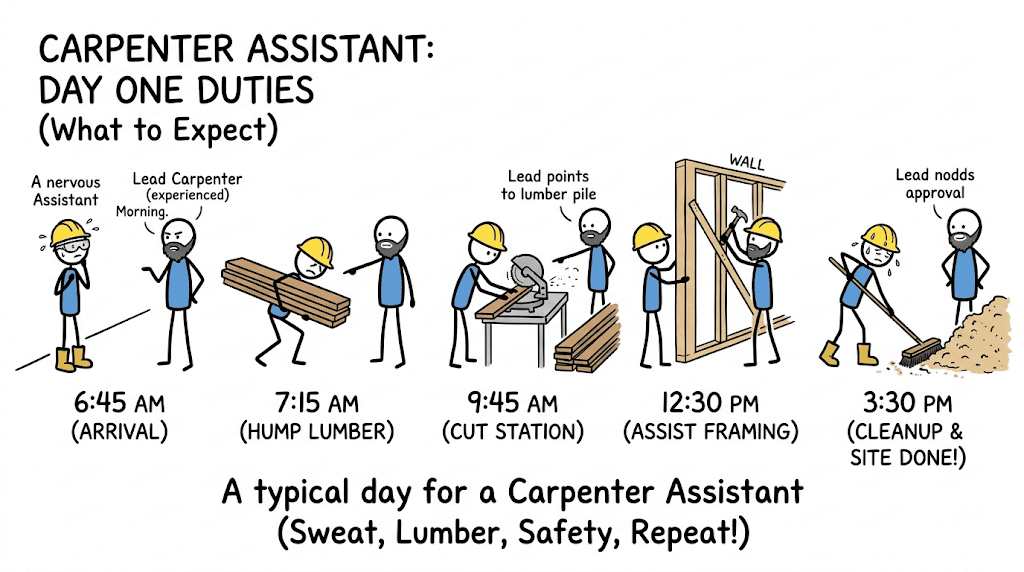
If you just scored your first gig as a carpenter helper or apprentice, congratulations. Breaking into the trades is a massive step. Whether you are walking onto a massive framing tract in Texas or a custom finish carpentry remodel in Chicago, that first morning is always a heavy mix of nerves and excitement.
A lot of greenhorns walk onto the site expecting to frame a wall or cut complex joinery right out of the gate. The reality is quite different. Your primary job is to make the lead carpenter faster and more efficient. We are going to dive deep into exactly what your daily tasks will look like so you can show up prepared, earn respect, and keep your job.
The Daily Grind: An Hour by Hour Breakdown
To give you a real sense of the physical rhythm of the trade, here is what a typical day looks like for a green assistant. Timings will shift depending on the contractor, but this timeline reflects a standard residential framing shift.
6:45 AM: Arrival and Unlocking. You are onsite before the lead carpenter. You unlock the tool trailer, start up the generator if the site lacks temporary power, and roll out the compressor. Your boots are laced, your pouches are on, and you are ready to sweat.
7:00 AM: Toolbox Talk and Strategy. The crew gathers. The foreman outlines the goal for the day, such as standing the exterior first floor walls. This is where safety hazards are discussed. Listen closely and ask questions if a task is unclear.
7:15 AM to 9:30 AM: Heavy Logistics and Staging. The lumber drop from the supply house needs to be sorted. You will spend this window carrying 2x4s and 2x6s to the specific zones where the framers are working. You crown the lumber, which means finding the natural bow in the wood and stacking it so the framers can grab it quickly without checking it themselves.
9:30 AM to 9:45 AM: First Break. Fifteen minutes to hydrate, grab a quick snack, and stretch your back.
9:45 AM to 12:00 PM: Cut Station Duty and Nailing. The lead carpenter sets you up at the miter saw. They will yell out measurements for cripple studs and window sills. You cut accurately and run the pieces over to the wall layout. You might also be handed a framing nailer to help tack subfloor panels together.
12:00 PM to 12:30 PM: Lunch. Do not go offsite. Bring a cooler. Eat fast, drink plenty of water, and use the spare minutes to look at the architectural blueprints spread out on the tailgate.
12:30 PM to 3:00 PM: Assembly and Bracing. Fatigue sets in, but the pace does not drop. You assist in lifting heavy assembled walls, temporarily bracing them with scrap lumber, and holding the dumb end of the tape measure while the lead checks for square.
3:00 PM to 3:30 PM: Site Clean Up. Framing creates a massive amount of debris. You will sweep sawdust, pile offcuts into the dumpster, and meticulously pack the tool trailer. If a tool is missing, nobody goes home until it is found.
Setting the Tone: Punctuality and Personal Protective Equipment
In the construction world, if you are on time, you are late. Your crew lead is evaluating your work ethic before you even touch a piece of lumber.
Before anything else happens, you must have your Personal Protective Equipment sorted. You are stepping into an environment with flying debris, loud tools, and overhead hazards. You will need a hard hat, steel toe boots, high visibility clothing, and safety glasses. Familiarize yourself with the Occupational Safety and Health Administration (OSHA) guidelines for construction worker safety to understand baseline requirements.
The Backbone of the Job: Material Handling
Your most frequent task on day one will be moving materials. Carpenters cannot build if they do not have lumber at the workstation. You will be humping 2x4s, carrying heavy sheets of plywood, and organizing structural headers like LVLs.
This sounds like pure grunt work, but it is actually a massive learning opportunity. By organizing the lumber pile, you learn how to identify different wood species, grades, and dimensions. You will also learn how to stack materials properly so they do not warp in the sun. Proper lifting techniques are critical here. The National Institute for Occupational Safety and Health (NIOSH) provides excellent resources on ergonomic lifting to prevent back injuries. Protect your spine because you will need it for the next forty years.
Mastering Site Preparation and Safety
A clean site is a safe and productive site. Your lead will likely task you with setting up the main cut station. This involves rolling out the heavy miter saw stand, running heavy duty extension cords, and ensuring the area is free of tripping hazards.
Do not let cords cross walkways where people carry heavy loads. According to the Center for Construction Research and Training, trips and falls are among the leading causes of job site injuries. You will also be responsible for sweeping up sawdust, collecting offcuts, and organizing the tool trailer at the end of the day. A lead carpenter will instantly notice an assistant who anticipates when the floor needs sweeping without being told.
Essential Tool Identification
You might not be calculating roof pitches or doing complex stair layouts on day one, but you will assist the lead with basic measurements. You will learn to hold the tape measure securely. When the lead calls out a measurement, repeat it back to confirm.
You must also learn the names of every tool on the site rapidly. When the boss asks for a speed square, a chalk line, or a specific size of wood chisel, you need to hand it over instantly. You will need to know the difference between a framing nail gun used for rough construction and a brad nailer used for delicate finish carpentry trim. If you want to brush up on tool terminology before you start, the National Center for Construction Education and Research (NCCER) offers great foundational knowledge modules.
Framing Component Assembly and Building Codes
Once the site is prepped and materials are staged, you will help assemble components. During a wall framing phase, you might be tasked with applying subfloor adhesive, handing studs to the framers, or helping lift a heavy wall section into place.
You will also learn about local building codes by observing the nailing patterns your lead uses for shear walls and headers. Understanding these structural requirements early on will set you apart. The International Code Council (ICC) is the governing body that sets these standards across most states. Additionally, keeping an eye on broader housing standards through the National Association of Home Builders (NAHB) will give you a better understanding of the residential industry at large.
Understanding Job Site Perils
Safety cannot be overstated. As the newest person on the crew, you are statistically at the highest risk for an accident. Always maintain situational awareness. Look up to check for overhead loads and look down for exposed nails in scrap wood.
If your crew is working on a second story or a roof, you must understand fall protection standards. Familiarize yourself with the OSHA Fall Protection standards to ensure you know how to properly inspect and wear a safety harness. It is also highly recommended that all tradespeople hold a valid first aid certificate. You can find local training courses through the American Red Cross.
Securing Your Future as a Journeyman
Your time as a carpenter assistant is the first step on a very lucrative and rewarding career path. The Bureau of Labor Statistics projects steady demand for skilled carpenters across the country, especially in booming residential markets in places like Florida and Arizona.
To move up the ranks, you need to show initiative. Ask questions during lunch breaks, read building plans when you have a spare minute, and invest in your own hand tools as soon as you can afford them. Many assistants transition into formal apprenticeship programs to accelerate their learning. You can explore registered apprenticeship opportunities through the United States Department of Labor Apprenticeship portal.
Joining a union is another excellent pathway to higher wages, comprehensive benefits, and rigorous training. Organizations like the United Brotherhood of Carpenters (UBC)represent hundreds of thousands of tradespeople and provide world-class training facilities.