Carpenter Labor Union Benefits: Is It Worth Joining?

ChiselJobs Team
Published on 5/17/2026
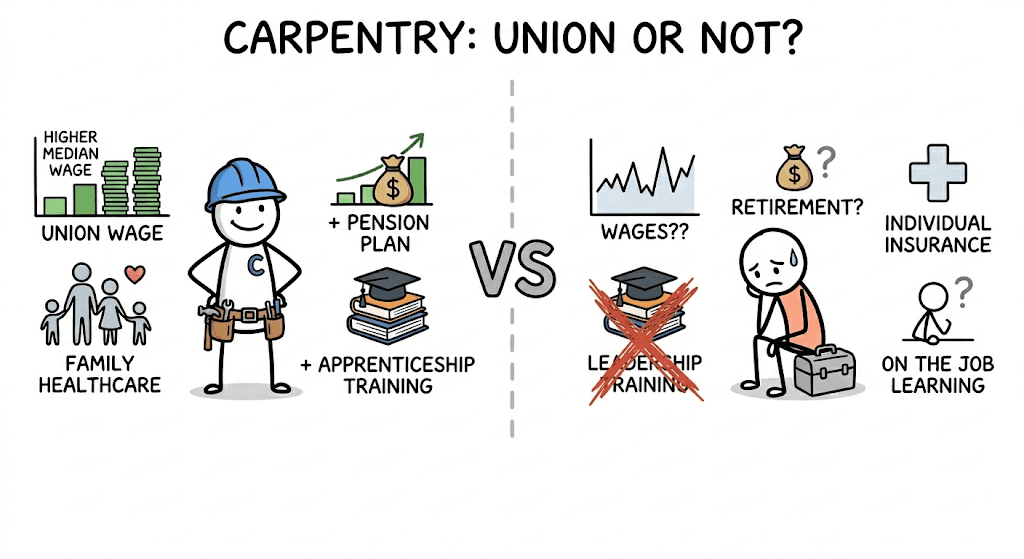
When you are starting out in the carpentry trade, or even if you have been swinging a hammer for years, you will eventually face a major choice. Should you go union or stay non-union? It is a debate heard on every job site, from residential framing crews to massive commercial concrete pours.
The choice you make impacts your daily routine, your safety, and your long term financial future. To figure out if joining a labor union is worth it, you need to look past the talk and check out the hard facts about pay, benefits, and how the work actually gets done.
Understanding the Role of the Union
For carpenters in North America, the primary organization is the United Brotherhood of Carpenters, often just called the UBC. The union acts as a collective bargaining agent. Instead of every individual carpenter negotiating their own pay, hours, and safety rules with a contractor, the union negotiates one master contract for all its members in a specific region.
This contract sets the baseline for everything. If a contractor wants union labor, they must agree to these terms. For a residential finish carpenter or a commercial layout specialist, this means knowing exactly what the minimum paycheck will look like before ever stepping foot on the property.
The Financial Breakdown: Union vs. Non-Union Pay
The most immediate difference people notice is the hourly rate. According to data from the US Bureau of Labor Statistics, union construction workers generally earn higher median wages than their non-union counterparts.
In the union system, your pay is tied directly to your classification.
Apprentices start at a set percentage of the journey-level wage, often around 50 percent.
Pay Increments happen automatically as you complete required hours and school modules.
Journeymen earn the full negotiated rate, which is standard across the board for that local chapter.
In non-union shops, pay is highly individualized. If you are an exceptional framer and a great negotiator, you might secure an excellent rate. However, if the local economy slows down, a non-union builder has the freedom to cut rates or offer lower starting pay to the next guy in line. The Government of Canada Job Bank shows similar wage stability for organized trade labor across Canadian provinces, showing that collective agreements protect baseline earnings during market dips.
Healthcare and Retirement Security
Wages are only part of the total compensation package. The real value of a union card often sits in the benefits package, which is paid by the employer on top of your hourly wage.
Health Insurance
Union health packages usually cover full medical, dental, and vision for the carpenter and their immediate family. Because the union pools thousands of members together, they have massive buying power to secure excellent coverage with low out of pocket costs.
Pension Plans
Most union locals offer a defined benefit pension plan alongside an annuity fund. A defined benefit pension guarantees a specific monthly payout when you retire, based on the hours you logged during your career. This is a rare perk in the modern construction landscape. Most non-union contractors do not offer retirement matches, leaving workers to fund their own retirement entirely through personal savings.
Training, Skill Development, and Apprenticeship
If you want to transition from rough residential work to complex commercial installations, you need advanced training. The union system runs comprehensive training centers funded by a small portion of every working hour logged by members.
For young workers, the training path is managed by local Joint Apprenticeship and Training Committees. These programs combine paid on the job work with classroom instruction. You can track trade educational standards through organizations like the National Center for Construction Education and Research, which emphasizes the importance of structured curriculum.
For journey-level carpenters, these training centers offer free continuing education. If a new building material hits the market, or if a major contractor requires specialized certification for cleanroom installations or scaffold building, the union provides that training at no extra cost to the member.
Job Site Safety and Legal Protections
Carpentry is tough on the body, and the risks are real. Statistics tracked by the Center for Construction Research and Training highlight that fall protection and proper scaffolding remain major issues in residential and commercial construction.
Union jobs generally enforce strict adherence to OSHA Construction Standards. Because the union provides a shop steward on site, workers have a direct representative to address safety hazards. If a trench is unshore or a guardrail is missing, a union carpenter can report it without fearing immediate termination.
Furthermore, your rights on the job are protected by federal guidelines managed by the National Labor Relations Board. If a dispute arises over overtime pay or unfair disciplinary action, the union handles the grievance process for you.
The Trade-Offs: What Are the Drawbacks?
No system is perfect, and joining the union comes with distinct trade-offs that might not appeal to every craftsman.
Union Dues: Maintaining the training centers, hiring halls, and legal teams costs money. Members pay monthly dues alongside a small percentage taken directly from their hourly wage.
The Hiring Hall System: When a project finishes, you go on the out of work list at the hall. Jobs are often distributed based on seniority or your place in line. During a recession, you might wait weeks for your name to be called.
Rigid Rules: Union rules strictly define who can do what work. A carpenter cannot touch electrical lines or pick up a pipe, even if it takes just two minutes to move it out of the way. For guys who like variety and total flexibility, this can feel restrictive.
Making the Decision
Whether the union is worth it depends on your career goals and your location. In heavily unionized metropolitan areas, major commercial, industrial, and infrastructure projects are exclusively union. If you want to work on skyscrapers, bridges, or massive hospital complexes, joining the hall is your best path.
If you prefer residential remodeling, custom cabinetry, or small scale home building, the non-union sector dominates. Military veterans looking to enter the trade can find expedited pathways into these organized systems through programs like Helmets to Hardhats, which bridges the gap between service and civilian trade careers.
Take the time to research your local area, look at the active job sites around you, and weigh the guaranteed benefits against the structural rules. For more insights into the trade or to browse active job listings across North America, check out the resources available on ChiselJobs.