How Modular and Industrialized Construction is Changing Carpentry

ChiselJobs Team
Published on 5/3/2026
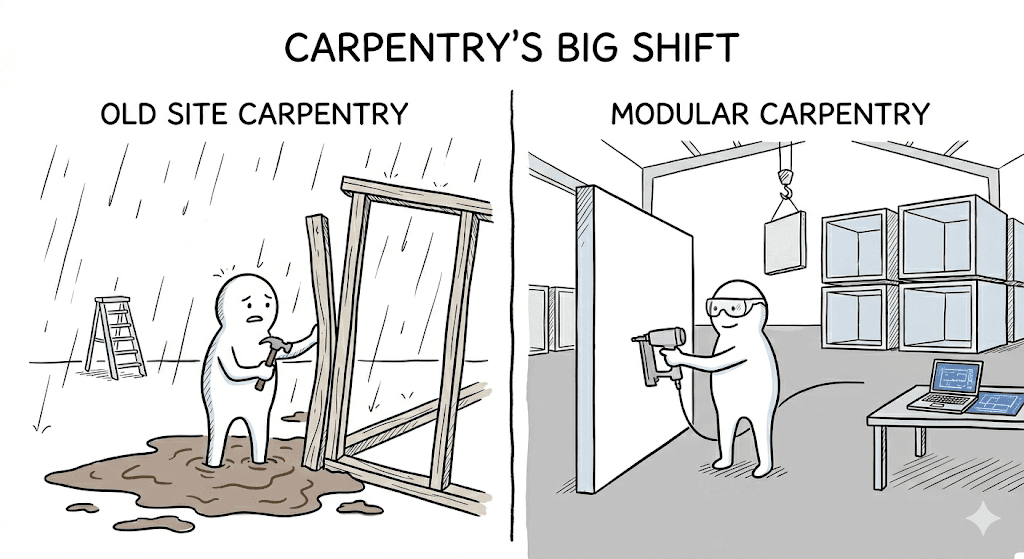
The image of a carpenter is shifting. We usually picture someone braving the rain, wind, or snow on a muddy job site. That reality is still true for many people in the trades. However, a growing number of carpenters are leaving their heavy weather gear at home. They are heading to work inside massive, climate-controlled warehouses.
Modular and industrialized construction is taking a huge bite out of the North American housing market. Builders are looking for ways to build houses faster and cut down on material waste. Because of this, the factory floor is becoming the new job site. If you swing a hammer for a living, you need to know how this shift impacts your daily tasks, your required skills, and your career growth.
The Shift from Mud to Manufacturing
Industrialized construction is a broad term. It basically means moving a large portion of the building process off-site. There are two main ways this happens in the carpentry world.
Panelized Construction: Carpenters frame walls, floors, and roof trusses flat on a factory table. These flat panels are loaded onto a flatbed truck, shipped to the foundation, and lifted into place with a crane.
Volumetric Modular Construction: Carpenters build entire 3D sections of a house in a factory. A single modular "box" might include the framing, drywall, electrical wiring, plumbing, and even the kitchen cabinets. These finished boxes are then shipped and stacked on the building site.
The Modular Building Institutetracks the growth of this sector closely. They note that offsite construction is solving major labor shortages and speeding up project timelines across the country.
A Different Kind of Job Site Environment
Working offsite completely changes the day-to-day environment. Traditional framing means dealing with whatever nature throws at you. A sudden rainstorm can shut down a site for days. In a factory, the weather is always perfect.
This controlled setting allows for high precision. Lumber stays dry, which prevents the wood from warping or bowing before it gets installed. You can learn more about how moisture affects framing lumber through the American Wood Council. Dry lumber means straighter walls and fewer headaches when it is time to install drywall or trim.
How Day-to-Day Carpentry Tasks Are Evolving
You still need to know how to read a tape measure, swing a hammer, and understand load-bearing paths. The core rules of carpentry remain the same. The way you apply those rules is what changes.
Framing and Layout on a Table
On a traditional job site, laying out a wall means snapping chalk lines on a plywood subfloor, cutting studs with a circular saw, and nailing everything together while kneeling or bending over.
In a panelized factory, you build walls on waist-high steel tables. You set your top and bottom plates into a massive jig. The jig holds the wood perfectly square. Instead of measuring every 16 inches for your studs, laser guides or pre-marked steel stops show you exactly where to place your framing members.
Many factories use automated bridge cranes that move over the table to drive nails or shoot staples into the wood sheathing. This guarantees that every fastener hits the stud perfectly. The National Association of Home Builders frequently highlights how these controlled framing techniques improve the structural integrity of the final building.
Finish Carpentry Moves Up the Schedule
Finish carpenters usually show up at the very end of a project. They install doors, baseboards, and window casings long after the roof is sealed.
In a volumetric modular plant, finish carpenters work right alongside the electricians and plumbers. As soon as the drywall is taped and painted on one end of the factory line, the box rolls forward to the finish carpentry station. You might install interior doors on a house that does not even have exterior siding yet.
The Impact on Carpenter Jobs and Pay
One of the biggest questions apprentices ask is how factory work affects their paycheck. The Bureau of Labor Statisticsprovides broad data on carpentry wages, but factory work introduces a few specific financial factors.
Consistent Hours: Traditional construction has busy seasons and slow seasons. Factory work usually offers a guaranteed 40-hour week, year-round. You do not lose pay because of a snowstorm.
Overtime Potential: Job site carpenters often work heavy overtime during the summer to make up for winter delays. Factory schedules are often more rigid, which might mean less opportunity for sudden overtime spikes.
Union vs. Non-Union: Compensation heavily depends on your region. In some areas, factory jobs are strictly non-union manufacturing roles. In heavily organized cities, offsite construction is actively managed by local trade unions, which protect high wage standards and benefits.
Physical Toll and Ergonomics
Traditional carpentry is brutal on the body. Carrying heavy lumber up ladders and kneeling on wet concrete destroys knees and backs. Offsite construction is generally safer. The Occupational Safety and Health Administration reports fewer fall hazards in factories because carpenters are rarely working high off the ground.
However, factory work introduces new physical challenges. You are standing on hard concrete floors all day. Doing the exact same layout task for eight hours can lead to repetitive strain injuries. Organizations like the National Institute for Occupational Safety and Healthprovide specific guidelines on preventing joint pain in manufacturing settings. Good boots with thick insoles are absolutely mandatory.
Essential Skills for the Modern Offsite Carpenter
If you want to succeed in an industrialized setting, you need a mix of old-school trade knowledge and new-school manufacturing awareness.
Blueprint Reading: This is non-negotiable. You must be able to read shop drawings quickly and accurately.
Code Compliance: Factory-built homes must meet strict standards. You need to understand local building codes. You also need to know federal standards, such as those set by the Department of Housing and Urban Development, for manufactured housing. You can also research the International Code Council for standard residential codes.
Cross-Training: In a factory, you are part of an assembly line. Understanding what the electrician or plumber needs to do next makes the whole line run smoother.
Waste Reduction: Factories focus heavily on efficiency. Learning how to optimize your cuts saves the company money and reduces environmental impact. The Environmental Protection Agency actively promotes modular construction specifically because it reduces landfill waste.
If you are just starting out, look into formal training programs. The National Center for Construction Education and Research offers great standardized training that applies to both job sites and factory floors.
The Future of the Trade
Traditional job sites will never completely disappear. Custom homes, complex renovations, and tricky terrain will always require boots on the ground. But industrialized construction is not a passing trend. It is a permanent shift in how North America builds homes.
Carpentry has always been a trade of adaptation. We moved from hand saws to power tools, and from solid timber to engineered lumber. Moving from the muddy field to the factory floor is just the next step in the evolution of the craft. Whether you are swinging a hammer in the rain or running a pneumatic nailer in a warehouse, the pride of building a solid, safe home remains exactly the same.