Trim Carpenter Job Description Template

ChiselJobs Team
Published on 4/29/2026
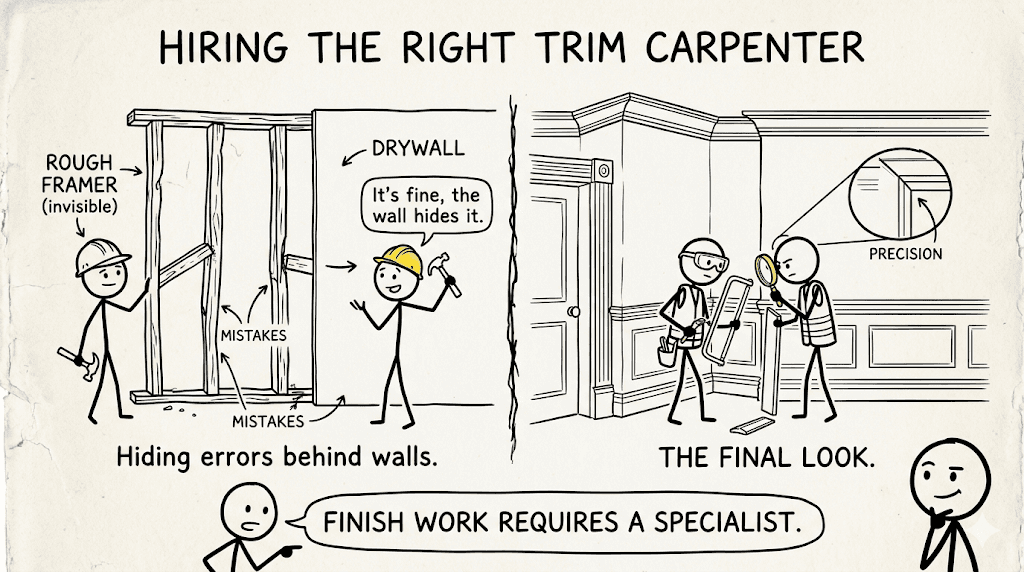
A framing carpenter hides their mistakes behind drywall. A trim carpenter has nowhere to hide. When a client walks into a newly built or renovated room, they do not see the joists or the wall studs. They see the crown molding, the baseboards, the custom cabinetry, and the window casings. That is the work of a skilled trim carpenter.
Finding the right person for this role is critical for any residential or commercial contractor in North America. The finish work dictates the final perceived quality of the entire build. If you are looking to hire a true craftsman, you need a job description that speaks their language and clearly outlines your expectations. Here at ChiselJobs, we have put together a guide and a plug-and-play template to help you attract top-tier finish carpentry talent.
The Reality of the Finish Carpentry Trade
Trim carpentry is a game of millimeters. It requires a specific mindset that blends mechanical precision with an artistic eye. While rough carpenters focus on structural integrity and load paths, trim carpenters focus on aesthetics, tight joints, and seamless transitions.
They are the last major trade on the jobsite before the painters arrive. This means they often inherit the imperfections of the trades that came before them. A great trim carpenter knows how to scribe a piece of baseboard to a wavy wall or shim a door jamb so it hangs perfectly plumb in an opening that is decidedly out of square.
Core Competencies You Should Look For
When you are reviewing applicants, you want to look beyond a basic tool belt. True professionals in this field understand the behavior of wood. They know how moisture content affects different species of timber, and they know how to read complex architectural plans provided by the American Institute of Architects.
You also need someone who respects safety protocols. Operating high-speed miter saws, table saws, and pneumatic tools inside a finished home requires serious caution. Familiarity with OSHA nail gun safety guidelines is non-negotiable to prevent jobsite injuries. Furthermore, they should be well-versed in proper hearing protection standards, as outlined by NIOSH, given the constant exposure to power tools.
The Trim Carpenter Job Description Template
Below is a field-tested job description template. You can copy this, adjust the bracketed information to fit your specific company needs, and post it directly to your careers page or on ChiselJobs.
Job Title: Trim / Finish Carpenter
Company: [Your Company Name] Location: [City, State/Province] Job Type: [Full-Time / Part-Time / Contract] Compensation: [$XX.XX to $XX.XX per hour, commensurate with experience]
About Us
At [Your Company Name], we pride ourselves on delivering exceptional craftsmanship. We are a growing residential and commercial construction firm specializing in [insert specialty, e.g., high-end custom homes, historic restorations, commercial build-outs]. We are looking for a detail-oriented Trim Carpenter who takes immense pride in their work and wants to grow alongside a dedicated team of builders.
The Role
As our lead Trim Carpenter, you will be responsible for the final interior woodwork on our projects. You will interpret blueprints, measure precisely, cut accurately, and install various millwork elements. You will work closely with our project managers and other sub-trades to ensure the final product meets our rigorous quality standards and complies with all local International Code Council building regulations.
Key Responsibilities on the Jobsite
Measure, cut, and install interior trim, including baseboards, crown molding, casing, and chair rails.
Hang solid core and hollow core interior doors, ensuring they are perfectly plumb, level, and square.
Install door hardware, locks, and complex hinge systems.
Assemble and install custom cabinetry, vanities, and built-in shelving units.
Construct and install complex staircases, including treads, risers, newel posts, and balusters.
Scribe materials to fit uneven surfaces seamlessly.
Perform punch-list tasks to bring a project to total completion before client handover.
Maintain a clean, organized, and safe work environment.
Required Skills and Qualifications
Minimum of [Insert Number, e.g., 3-5] years of verifiable experience strictly in finish or trim carpentry.
Mastery of trade-specific tools, including compound miter saws, table saws, coping saws, routers, and pneumatic brad/finish nailers.
Strong understanding of woodworking joints (miters, copes, bevels) and which applications suit them best.
Ability to read and interpret detailed blueprints and shop drawings.
Comprehensive knowledge of American Wood Council material standards and wood species characteristics.
Valid driver's license and reliable transportation to various jobsites.
A complete set of personal hand tools and basic power tools.
What We Offer
Competitive hourly wages paid weekly.
[Insert benefits: e.g., Health, dental, and vision insurance options].
[Insert perks: e.g., Tool allowance, paid time off, retirement matching].
Consistent, year-round work with a backlog of premium projects.
How to Apply
Please submit your resume, a brief description of your experience, and photos of your past finish work to [Insert Email Address or Application Link].
Understanding the Current Labor Market
If you are struggling to fill this role, you are not alone. The construction industry is facing a massive shortage of skilled tradespeople. According to the National Association of Home Builders, finish carpentry is consistently ranked among the hardest positions for contractors to staff.
To remain competitive, you need to understand the going rate for talent. The Bureau of Labor Statistics provides baseline salary data for carpenters, but remember that specialized trim carpenters often command a premium over general rough framers. In many metropolitan areas, a master finish carpenter can easily earn top-tier wages, especially if they carry certifications from organizations like NCCER or have completed apprenticeships through the United Brotherhood of Carpenters.
Employers who want the best must offer more than just a paycheck. Cultivating a culture of craftsmanship is vital. You might also consider partnering with local trade schools or programs like SkillsUSA to recruit hungry apprentices who can shadow your master carpenters.
A well-crafted job description is your first point of contact with a potential hire. By clearly defining the duties, respecting the skill level required, and offering competitive compensation, you will attract the kind of trim carpenter who measures twice, cuts once, and leaves your clients speechless.