Carpenter Foreman Job Description Template

ChiselJobs Team
Published on 3/20/2026
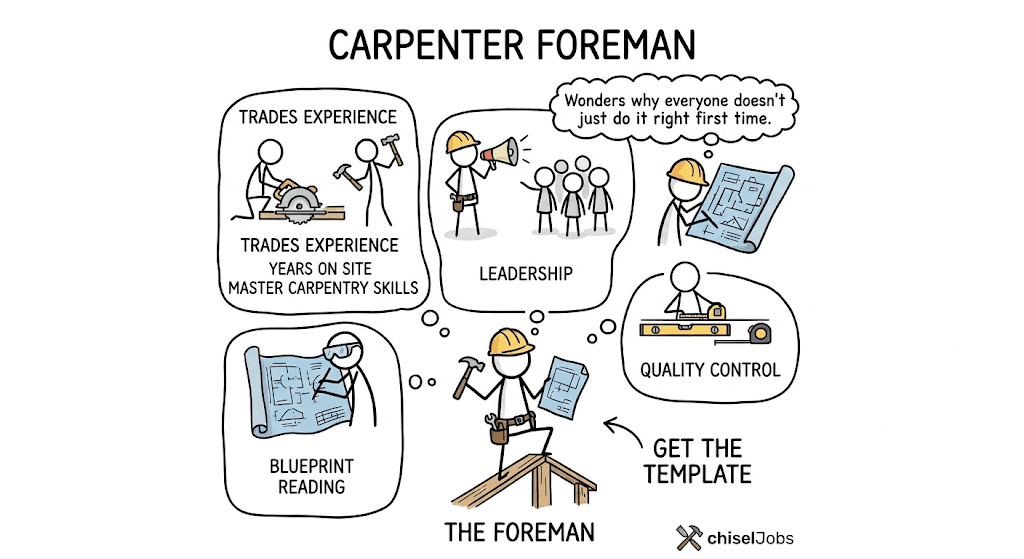
Finding the right person to run your carpentry crew is one of the most critical decisions a contractor can make. A skilled carpenter foreman bridges the gap between the project manager's vision and the daily grind on the job site. They are responsible for keeping the crew safe, ensuring the framing is plumb, and making sure the finish work meets high quality standards.
At ChiselJobs, we know that generic job postings do not attract top tier talent. You need a job description that speaks the language of the trades. Whether you are building commercial high rises in Chicago or custom residential homes in Texas, the template and insights below will help you attract an experienced leader who knows how to read blueprints, manage a crew, and push a project across the finish line.
The Role of a Lead Carpenter on Today's Job Site
A carpenter foreman does much more than swing a hammer. They are the tactical commanders of the construction site. This role requires a deep understanding of structural integrity, local building codes, and material management. From the initial layout and framing to the final punch list, the foreman ensures every cut and joint meets exact specifications.
Furthermore, a modern foreman must blend traditional craftsmanship with construction technology. It is no longer just about using a chalk line and a speed square. Today's crew leaders rely on digital tools for material takeoffs, daily reporting, and schedule tracking. Employers want leaders who are just as comfortable reading digital schematics on an iPad as they are operating a circular saw.
Crafting the Perfect Hiring Pitch
To attract a veteran carpenter, your job description needs to be clear, authoritative, and fluff free. Top candidates want to know what they will be building, who they will be leading, and what tools they will be expected to use.
Below is a highly optimized template you can adapt for your next hiring campaign.
Job Summary
Company Name: [Insert Company Name]
Location: [Insert City, State]
Job Type: Full Time
Salary Range: [Insert Salary Range, e.g., $35 to $55 per hour based on experience]
About Us: [Insert a brief paragraph about your company. Mention the types of projects you take on, such as heavy commercial, multi family residential, or high end custom remodeling. Highlight your company culture and commitment to safety.]
Position Overview: We are seeking an experienced Carpenter Foreman to lead our field operations. The ideal candidate possesses exceptional trade skills, a strong command of OSHA safety standards, and the ability to motivate a crew to hit tight deadlines without sacrificing quality. You will work closely with project managers and superintendents to coordinate materials, manage trade sequencing, and ensure every phase of construction aligns with the approved blueprints.
Core Daily Responsibilities
Crew Leadership: Direct, train, and manage a crew of journeyman carpenters and apprentices. Assign daily tasks and monitor productivity.
Blueprint Translation: Read and interpret architectural drawings, structural plans, and digital models to determine dimensional layouts and material requirements.
Quality Control: Inspect all work in progress. Ensure everything from rough framing to finish carpentry is level, plumb, square, and true.
Safety Enforcement: Conduct weekly toolbox talks and maintain strict adherence to site safety policies. Correct hazards immediately to prevent accidents.
Material Management: Perform accurate material takeoffs. Coordinate with suppliers to ensure lumber, hardware, and tools arrive on time to avoid costly delays.
Documentation: Complete daily field reports, track crew hours, and document job site conditions using construction management software.
Required Skills and Qualifications
Minimum of 5 to 7 years of hands on carpentry experience, with at least 2 years in a supervisory role.
Comprehensive knowledge of the International Building Code (IBC) and regional construction regulations.
Proficiency with a wide array of power tools, including circular saws, compound miter saws, pneumatic nail guns, and heavy duty hammer drills.
Ability to perform complex construction math for roof pitching, stair stringer calculations, and structural load bearing distributions.
Strong communication skills to interface effectively with subcontractors, clients, and project managers.
Preferred Certifications and Tech Competency
OSHA 30 Hour Construction Certification is highly preferred.
Familiarity with industry standard software such as Procore, PlanGrid by Autodesk, or Fieldwire.
Completion of a recognized apprenticeship program or NCCER carpentry certification.
Why the Right Tools Matter for Recruitment
When you list the tools and systems your company uses, you signal to candidates that you run a professional and well equipped operation. A seasoned foreman has likely developed preferences for reliable gear over their career. Mentioning that your site supplies high quality DeWalt 20V Max power tools, reliable Makita circular saws, or precision Stabila levels can genuinely attract candidates who care about their craft.
Similarly, structural framing requires exact precision. Noting your company's standardized use of Simpson Strong-Tie hardware for load-bearing connections or Bluebeam Revu for plan markups shows that you prioritize structural integrity and efficient workflows. These details elevate your job posting from a basic want ad to an attractive career opportunity.
Regional Demand and Compensation Strategies
Construction markets vary wildly across the United States. If you are hiring in rapidly expanding markets like Texas or Florida, demand for qualified site leaders is incredibly high. You must offer competitive compensation to secure top talent.
According to the Bureau of Labor Statistics, the top earners in the carpentry trade, which primarily consist of foremen and superintendents, can command premium hourly rates. Employers in major metropolitan areas such as New York or California often need to provide sign-on bonuses, comprehensive health benefits, and company vehicles to remain competitive against larger commercial outfits.
If your company operates a union shop, you will also need to align your job description with the specific local guidelines provided by the United Brotherhood of Carpenters (UBC). Union roles typically require specific dispatch procedures, whereas non-union contractors have more flexibility but must work harder to match union pension and healthcare packages.
Elevating the Industry Standard
A great foreman is the backbone of a profitable job site. By setting clear expectations regarding safety, quality, and leadership, you protect your bottom line. Organizations like the Associated General Contractors of America (AGC) and the National Association of Home Builders (NAHB) consistently emphasize that investing in field leadership is the most effective way to reduce rework and improve overall project safety.
When you are ready to find your next project leader, do not waste time on generic job boards. Post your optimized job description on ChiselJobs. We connect serious contractors with dedicated tradespeople who know their way around a job site. Use the template above, customize it to fit your exact project needs, and start building a crew that delivers excellence on every single build.