What to Put on a Carpenter Job Application to Get Hired

ChiselJobs Team
Published on 3/6/2026
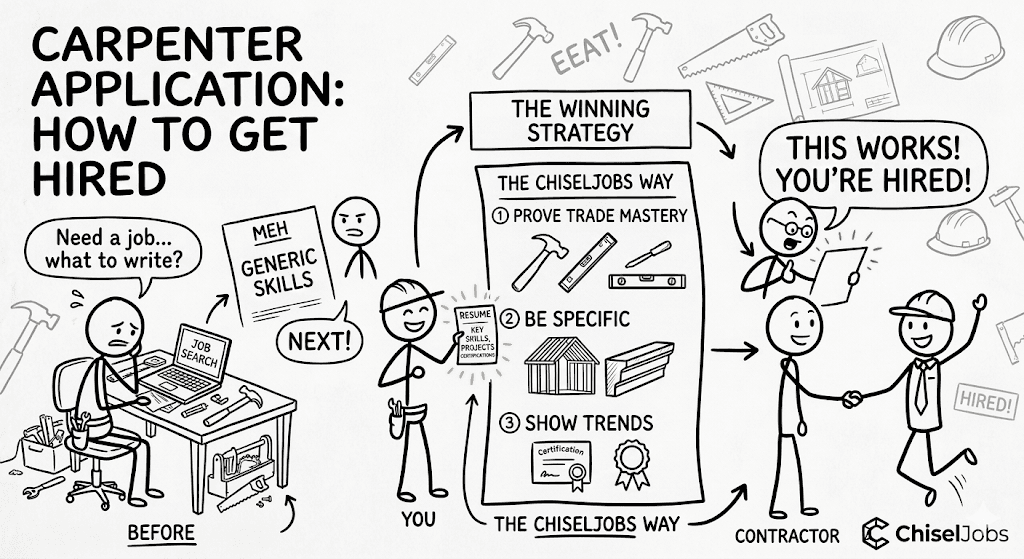
Getting hired as a carpenter requires much more than just knowing your way around a busy job site. A strong job application is your first opportunity to demonstrate your reliability, your technical skillset, and your deep understanding of modern job site safety.
At ChiselJobs, we see hundreds of resumes cross the desks of hiring managers every single week. The applications that consistently land interviews are the ones that clearly communicate practical expertise alongside a strong work ethic. If you want to stand out in a competitive market, you must treat your application like a blueprint for your career.
Highlighting Precise Tool Mastery
Contractors do not have the time to guess what you can actually do on the clock. Your application needs to clearly and confidently state your technical capabilities. You should avoid vague, filler statements like "experienced with power tools." Instead, you must get highly specific about the exact equipment you master daily.
Cutting Equipment: Detail your proficiency with essential saws, including standard circular saws, sliding compound miter saws, and table saws. Mentioning your ability to maintain hand tools and blades shows you respect the equipment and the financial investment behind it.
Layout and Measurement: Mention your consistent accuracy with layout instruments. List your experience using spirit levels, laser levels, plumb bobs, and traditional framing squares.
Pneumatic Systems: List your daily experience with pneumatic tools, specifically detailing your comfort with various nail guns, brad nailers, and heavy duty staplers.
Fine Woodworking Tools: Highlight your finishing skills, including the proper use and sharpening of hand chisels, block planes, and the execution of precision joinery techniques found in advanced basic carpentry skills guides.
Tool Maintenance: Add a brief note about your ability to perform routine maintenance on your tools. A carpenter who respects their equipment is a carpenter who respects the job.
When hiring managers scan your profile on the ChiselJobs platform, they are looking for exact keywords that match their immediate project needs. If a foreman in Chicago is desperately looking for a finish carpenter, they want to see terms like "crown molding," "custom cabinetry," and "cope joints" directly in your skills section.
Defining Your Carpentry Specialization
Carpentry is an incredibly broad trade. One of the most common mistakes applicants make is failing to specify their exact niche. A rough framer and a trim carpenter possess vastly different daily routines and skillsets. You must categorize your experience so employers know exactly where to place you on the crew.
Rough Carpentry and Structural Framing
If your primary background is in rough carpentry, emphasize your ability to read complex architectural blueprints and perform accurate structural layouts.
Detail your experience erecting wood and metal stud framing, installing heavy floor joists, and pitching complex roof systems as outlined in comprehensive framing project guides. You should also explicitly mention your working knowledge of local building codes. A framing crew lead in California, for example, needs to know you understand strict seismic requirements and International Code Council standards.
Trim Work and Finish Carpentry
Conversely, if you specialize in finish work, your application must highlight absolute precision. Discuss your ability to install baseboards, hang interior solid core doors, and execute intricate trim work without leaving gaps. Referencing advanced techniques like cutting hunting miters for curved moldings or taking professional courses in finish carpentry basicsproves y our dedication to the craft. Give real-world examples to build your authority. Stating that you independently trimmed out a 4,000 square foot custom home carries significantly more weight than simply writing that you perform trim carpentry.
Elevating Your Profile with Job Site Safety Credentials
Safety is a massive financial and legal liability for construction companies across North America. Employers actively seek out candidates who naturally prioritize a secure working environment. Including your documented safety credentials on your application instantly elevates your professional standing above the competition.
Prominently display any official safety certifications, particularly the OSHA 10 Certification or OSHA 30 hazard recognition cards.
Highlight your strict commitment to personal protective equipment protocols on all sites, reflecting official OSHA construction training standards.
Mention your formal training in fall protection standards, which is especially critical if you have extensive experience with scaffolding, ladders, or steep roof framing.
Note any specialized site training you possess, such as lead paint awareness, asbestos awareness, or confined space entry protocols.
Expert commentary from seasoned construction superintendents consistently reveals a hard truth. A candidate with documented, up to date safety training will almost always beat out a candidate of equal skill who lacks those specific credentials. It shows you respect the physical trade and will actively protect the contractor from costly job site violations.
Showcasing Applied Mathematics and Problem Solving
The true foundation of all good carpentry is solid, fast mathematics. Hiring managers need absolute reassurance that you can calculate complex angles, determine accurate rafter lengths, and read a tape measure down to the sixteenth of an inch without any hesitation. If you have mastered the math required for complex tasks like stair building layout, state that clearly.
Your application should also reflect your on site problem solving capabilities. Describing a past situation where you had to quickly correct a structural error or optimize material cuts demonstrates higher level trade craft. A master carpenter is an on site engineer who turns paper architectural drawings into physical reality. Make sure your application reflects that high level of cognitive skill.
Navigating the Union and Private Contracting Landscape
The construction industry operates differently depending on where you live and the type of work you pursue. Your application should reflect your deep understanding of the local labor market.
If you are applying for union gigs in major structured markets like Boston or Seattle, you need to clearly state your apprenticeship completion dates, your current journeyman status, and your specific local union affiliation with organizations like the United Brotherhood of Carpenters. Union contractors look for standardized training milestones and recognized hours.
If you are targeting non union residential contractors associated with the National Association of Home Builders in states like Florida or Georgia, you should focus heavily on your adaptability, your raw speed, and your diverse, multi trade skillset. Non union crews often require carpenters to wear multiple hats. Highlighting your cross functional abilities, perhaps even touching on drywall and ceiling systems recognized by the Association of the Wall and Ceiling Industry, will make you highly attractive to these private employers.
Structuring Your Project History and Milestones
Hiring contractors look for context. Saying you worked for a local builder for three years provides very little actual, actionable information. You need to break down the scale and the exact scope of the projects you helped complete.
Specify the dollar value of the construction projects if you know them. Detail the size of the crews you worked alongside and carefully note whether you held any leadership roles, such as lead carpenter or site foreman. Engaging with industry resources for construction pro tips and actively mentoring junior apprentices are remarkably strong indicators of your own mastery and your long term value to a growing company.
Securing Your Next Position Through ChiselJobs
Crafting the perfect carpenter job application requires the exact same attention to detail as cutting a perfect miter joint. You need to measure your words twice and present your field skills clearly. By highlighting your specific tool proficiency, defining your distinct niche, emphasizing safety protocols, and providing concrete examples of your past projects, you firmly position yourself as a top tier candidate. Polish your resume, upload your refined application directly to ChiselJobs, and start connecting with elite contractors actively hiring in your region today.