Commercial Interior Systems Carpenter Job Description

ChiselJobs Team
Published on 2/26/2026
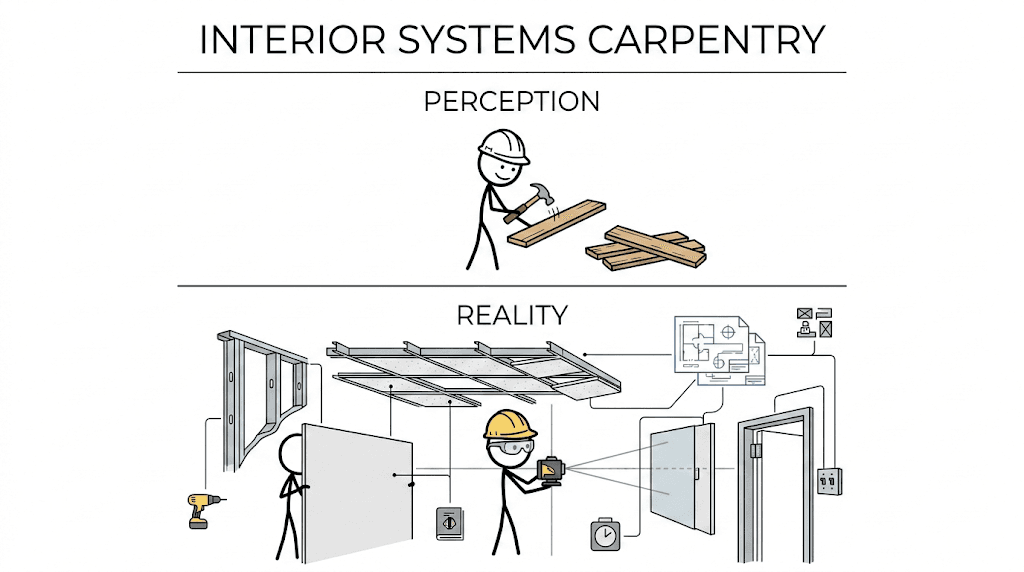
When you walk into a newly finished hospital wing, a high-tech corporate office, or a modern retail space, the structural bones and aesthetic finishes you see are the direct result of a commercial interior systems carpenter. These specialized tradespeople transform empty concrete shells into functional, safe, and visually appealing spaces within the broader construction industry. Whether you are an experienced journeyman looking for your next major role on ChiselJobs or a contractor drafting a job posting, understanding the exact duties, tool requirements, and realities of this role is critical for any commercial building.
Core Responsibilities on the Job Site
Unlike traditional rough wood framers, interior systems carpenters primarily work with light-gauge steel, acoustic materials, and specialized composite panels. Their daily tasks require a high degree of precision because their work directly impacts the final visible surfaces of a room.
Light-Gauge Steel Framing: Laying out and constructing metal stud partitions, bulkheads, and soffits. This requires precise measurements and adherence to strict structural engineering plans.
Acoustic Ceiling Systems: Installing suspended ceiling grids, dropping in acoustic tiles, and ensuring proper integration with commercial HVAC and lighting systems overhead.
Drywall Installation: Cutting, hanging, and securing gypsum board to metal framing. This often involves working with heavy, fire-rated, or moisture-resistant specialty drywall depending on the room's function.
Commercial Doors and Hardware: Setting hollow metal door frames, hanging commercial-grade wood or steel doors, and installing complex panic hardware and automatic closer mechanisms.
Specialty Installations: Fitting demountable glass partitions, assembling raised access flooring for server rooms, and mounting sound-baffling wall panels.
Fire-stopping and Building Code Compliance: Commercial structures have strict building codes. Carpenters must accurately install fire-rated assemblies and apply intumescent sealants around structural gaps to ensure the structure passes rigorous municipal safety inspections.
The Master Toolkit and Required Skill Set
A commercial interior systems carpenter carries a different arsenal than a residential wood framer. Speed and accuracy are paramount, meaning the right tools are non-negotiable for success on any construction project.
Essential Gear and Equipment
Laser Levels: Rotary lasers and point lasers are essential for establishing perfectly level ceiling grids and plumb steel tracks over massive commercial floor plans.
Aviation Snips and Metal Punches: Required for cutting, crimping, and modifying light-gauge steel tracks and studs.
Power Tools: High-speed collated screw guns and cordless impact drivers are heavily utilized for rapidly fastening gypsum board to steel framing without stripping the screws.
Powder-Actuated Fasteners: Used efficiently for securing base tracks directly into poured concrete slabs.
Basic Carpentry Hand Tools: Tape measures, chalk lines, utility knives, chisels, and torpedo levels remain daily staples in the tool belt.
Crucial Technical Skills
Beyond manual dexterity, these professionals must excel at reading complex commercial blueprints. They need to understand reflected ceiling plans, architectural elevations, and wall-type details. Mathematics is a daily requirement. Calculating square footage, understanding load distributions, and translating a scaled drawing to a massive concrete floor require sharp analytical skills and extreme attention to detail.
Expert Insight: Many veteran carpenters on ChiselJobs note that the transition from residential framing to commercial interior systems requires a major mental shift. The tolerances are often much tighter, and the real-time coordination with massive construction teams, including electricians and HVAC technicians, is constant.
The Professional Work Environment
Commercial construction is a high-energy, fast-paced work environment. Interior systems carpenters typically work indoors, which protects them from extreme weather conditions compared to exterior construction workers. However, the environments are often loud, dusty, and physically demanding.
Workers spend hours on elevated platforms like scissor lifts or baker scaffolds. The physical toll includes overhead reaching, heavy lifting of building materials, and constant movement. Project locations vary widely, ranging from active hospitals requiring strict infection-control barriers to vacant skyscraper floors undergoing tenant improvements.
Navigating Regulatory Protocols and Site Protection
Safety compliance is a massive component of the job description. Commercial contractors maintain strict safety plans, and interior systems carpenters must lead by example to guarantee safe work practices on every shift.
Governed by federal occupational safety and health laws, job sites must strictly adhere to regulations. Oversight comes directly from the safety and health administration. Specifically, the Occupational Safety and Health Administration OSHA provides the foundational rules that all contractors must follow to avoid severe penalties and protect human life.
Daily Site Compliance: Enforcing these baseline safety standards includes applying specific safety measures and following daily safety guidelines specific to the site.
Gear and Apparel: Proper use of personal protective equipment ppe is mandatory. This includes hard hats, safety glasses, high-visibility clothing, steel-toed boots, and hearing protection.
Silica Dust Mitigation: Cutting drywall and drilling into concrete exposes workers to hazardous silica dust. Proper use of HEPA vacuums and N95 respirators is heavily enforced.
Ongoing Education: Regular safety training ensures crews are up to date on fall protection, elevated platform operation, and proper ergonomics for lifting heavy materials to prevent career-ending back injuries.
Educational Pathways and Apprenticeship Programs
Earning the title of journeyman interior systems carpenter does not happen overnight. The journey typically begins with a high school diploma or equivalent, followed by entry into a formal apprenticeship program.
These programs typically last four years and combine thousands of hours of paid, on-the-job training with intensive classroom instruction. Apprentices learn building codes, blueprint reading, and advanced layout techniques. Many professionals in this sector are members of the United Brotherhood of Carpenters (UBC), which offers robust training facilities and structured wage progressions.
For non-union workers, technical colleges and on-the-job training provided by large commercial drywall contractors serve as the primary entry points. Regardless of the path, employers actively seek candidates who possess their basic safety certifications prior to stepping on the site.
Wage Expectations and Career Growth Potential
The financial trajectory for an interior systems carpenter is highly competitive within the skilled trades. While wages fluctuate based on regional demand and union affiliation, these professionals generally command strong hourly rates due to the specialized nature of commercial construction.
Apprentices start at a set percentage of the journeyman wage, receiving steady increases as they master new skills and log required hours. Fully licensed journeymen can earn excellent base salaries, often supplemented by comprehensive health and retirement benefits. Regional variations play a significant role in earning potential, with major urban hubs in the United States and Canada presenting highly lucrative opportunities for skilled professionals.
The career ladder is also incredibly diverse. Experienced carpenters frequently transition into lucrative leadership roles within construction management:
Foreman: Managing a crew of carpenters, coordinating material deliveries, and ensuring daily production goals are met efficiently.
Superintendents and Leaders: Overseeing the entire interior build-out and acting as the primary point of contact for the general contractor. Eventually, many step into roles as full project managers, overseeing budgets and timelines for massive developments.
Estimator: Moving into the office to analyze blueprints, calculate material costs, and submit highly accurate bids for future commercial projects.