Concrete Formwork Carpenter Job Description

ChiselJobs Team
Published on 3/11/2026
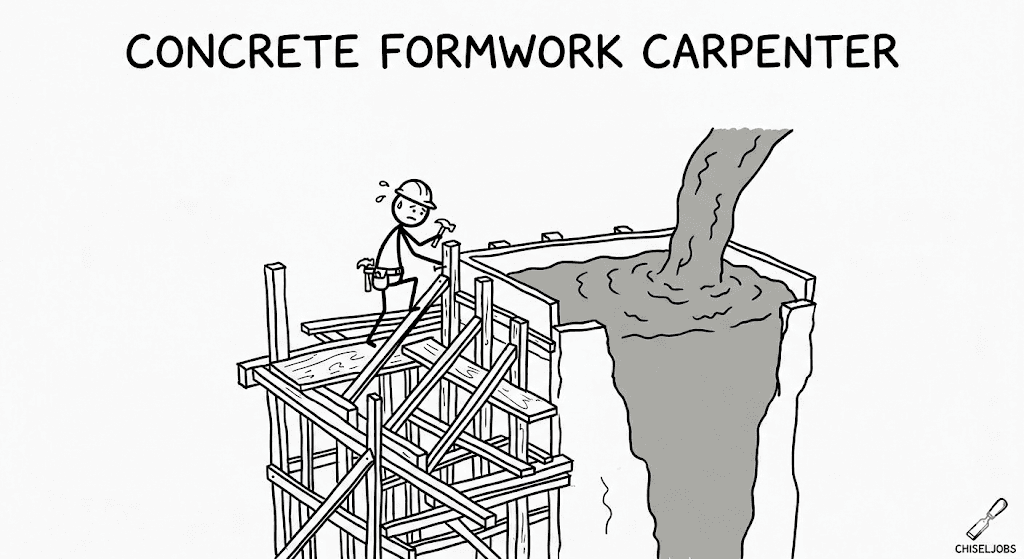
Concrete is the literal foundation of modern infrastructure. From towering commercial high-rises in New York to sprawling industrial complexes in Texas, wet concrete requires a precise mold to give it shape and structural integrity. This is where the concrete formwork carpenter steps in.
Formwork carpentry is a highly specialized branch of the trade. It demands an intricate understanding of geometry, load-bearing physics, and heavy construction techniques. Unlike finish carpenters who work with delicate trim, form carpenters build temporary structures designed to hold thousands of pounds of wet, shifting concrete. If you are exploring careers in the building trades or looking to hire skilled talent through ChiselJobs, understanding the exact duties, skills, and working conditions of a formwork carpenter is critical.
Core Daily Responsibilities on the Job Site
The role of a concrete form carpenter goes far beyond simply nailing boards together. The day-to-day routine involves complex problem-solving and constant collaboration with other trades, especially ironworkers and concrete finishers.
Blueprint Interpretation and Site Layout
Before any lumber is cut or hardware is placed, a form carpenter must understand the project blueprints. This includes reading structural drawings to determine the exact dimensions, elevations, and locations of footings, walls, columns, and suspended slabs. Accuracy at this stage is non-negotiable. A layout error of half an inch at the foundation level can translate into massive structural alignment issues on the upper floors.
Erecting and Bracing Form Systems
Once the layout is established, the physical building begins. Form carpenters work with a variety of materials. For custom pours, they may use traditional dimensional lumber and plywood. For large-scale commercial projects, they often assemble prefabricated, engineered formwork systems like Symons, Doka, or Peri panels.
The most critical aspect of this step is bracing. Wet concrete creates immense hydrostatic pressure. Formwork carpenters must install strongbacks, walers, and kickers to ensure the forms do not bulge or blow out during the pour.
The Pour Watch and Stripping Phase
During the actual concrete pour, form carpenters conduct a pour watch. They monitor the forms under the stress of the heavy material, looking for leaks or shifting, and making emergency adjustments if necessary. Once the concrete cures to a specified strength, the carpenters dismantle, clean, and organize the forms for the next phase. This process is known as stripping.
Essential Tools and Technical Abilities
To execute these heavy-duty tasks, formwork carpenters rely on a specialized loadout of tools and a deep reservoir of trade knowledge.
The Tool Belt: A standard setup includes a heavy framing hammer, a 30-foot tape measure, a chalk line, a speed square, torpedo levels, and a plumb bob.
Power Tools: Proficiency with circular saws, reciprocating saws, rotary hammers, and impact drivers is mandatory.
Mathematical Aptitude: Form carpentry requires constant calculations. Workers must quickly compute fractions, geometry for squaring up corners, and material estimations.
Material Knowledge: Carpenters must understand the properties of release agents, the load capacities of various coil ties and snap ties, and the cure times of different concrete mixes.
Compensation and Geographic Demand in the United States
For those entering the trade, understanding the financial landscape is just as important as knowing how to swing a hammer. Formwork carpentry is a highly sought-after skill, and compensation reflects the physical and technical demands of the role.
Earnings Overview and Experience Levels
Entry-level apprentices typically start at a percentage of the journeyman wage, often earning between $20 to $25 per hour depending on the local market. As you gain experience and master the complexities of blueprint reading and engineered form systems, wages increase significantly. Fully ticketed journeymen in major metropolitan areas can easily command $35 to $50 per hour. Overtime is also a major factor in this sector, as concrete pours are time-sensitive and frequently require long shifts to ensure a seamless finish.
Union vs. Non-Union and Regional Variations
There is a distinct difference in pay structures between union and non-union sectors. Union carpenters typically enjoy standardized wage scales, comprehensive pension plans, and robust health benefits negotiated through collective bargaining. Non-union carpenters may have more flexibility in negotiating their base pay, though benefits packages can vary widely from contractor to contractor.
Geographically, states with booming infrastructure and commercial development offer the highest demand. Cities in Texas, Florida, and California are currently experiencing massive commercial growth, driving up both the availability of jobs and the corresponding wage rates. Specialized form workers willing to travel for large-scale industrial projects can further maximize their earning potential.
Workplace Environment and Physical Demands
Prospective formwork carpenters must be prepared for a rigorous physical environment. This is not a climate-controlled job. Carpenters are exposed to all weather conditions, from blistering summer heat to freezing winter mornings.
The physical toll is significant. The work involves lifting heavy engineered panels, carrying lumber across uneven terrain, and swinging a heavy hammer for hours at a time. Furthermore, formwork often takes place at heights. Carpenters frequently work on leading edges, scaffolding, and elevated decks.
Because of these hazards, safety is the highest priority. Strict adherence to OSHA construction safety guidelines regarding fall protection, personal protective equipment, and hazard communication is expected on every job site.
Pathways to Entry and Required Training
Entering the formwork trade requires dedication and formal training. While some individuals start as general laborers and learn on the job, the most reliable path to a lucrative career is through a structured apprenticeship.
Apprenticeship Programs
Union apprenticeships, often facilitated by the United Brotherhood of Carpenters, provide the gold standard for training. These four-year programs combine paid on-the-job experience with classroom instruction. Apprentices learn everything from basic blueprint reading to advanced rigging and layout techniques. Non-union contractors also offer excellent training programs, often through organizations like the Associated Builders and Contractors.
Industry Certifications
Employers look for specific credentials that prove a commitment to safety and professional development. An OSHA 10-hour or OSHA 30-hour construction safety certification is practically mandatory in the current market. Additional certifications from the National Center for Construction Education and Research in rigging, signaling, and aerial lift operation make a candidate highly competitive.
Expert Insight for Aspiring Tradespeople
Mastering concrete formwork is one of the most respected achievements in the construction industry. The work you do literally holds up the rest of the project. If the foundation is out of square or a structural column is compromised, every subsequent trade suffers.
For contractors looking to staff their next major commercial build, finding professionals who possess this exact blend of brute strength and mathematical precision is essential. Platforms like ChiselJobs are dedicated to connecting specialized tradespeople with the employers who need them. Whether you are an apprentice looking for your first commercial site or a seasoned superintendent building a concrete crew, understanding the depth of this job description is the first step toward a successful build.