A Deep Dive into the Framing Carpenter Job Description

ChiselJobs Team
Published on 1/22/2026
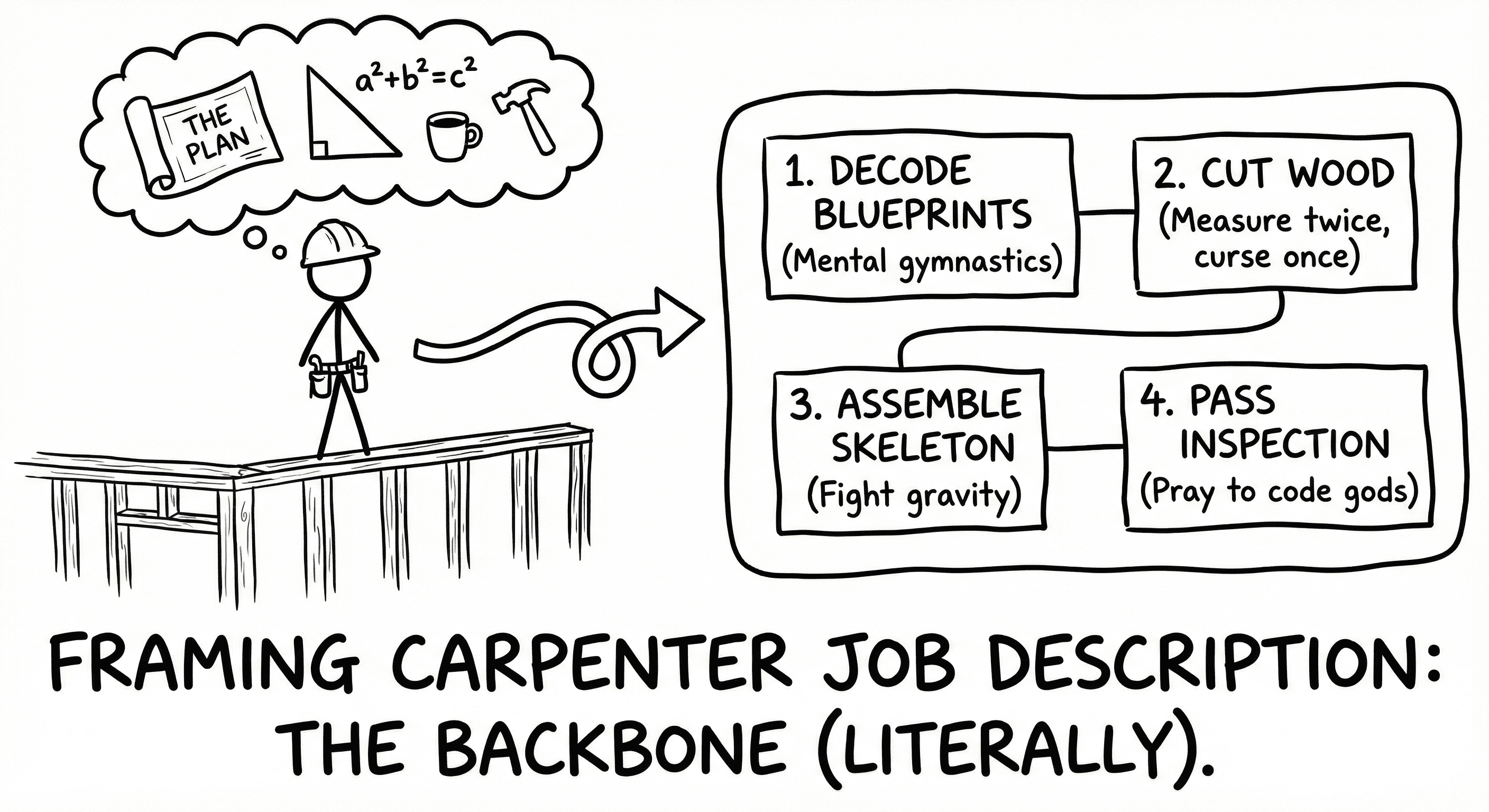
Framing is often considered the purest form of carpentry. It is rough, rapid, and mathematically precise work that dictates the integrity of the entire building. If you are an employer looking to hire or a tradesperson looking to understand the role better, this guide breaks down the reality of the job beyond the standard bullet points.
The Core of the Role: More Than Just Hammering Studs
A framing carpenter (or "framer") is responsible for constructing the structural shell of residential, commercial, and industrial buildings. They work from the ground up, typically starting once the foundation is poured and curing is complete.
The job is not simply about connecting wood to wood. It is about translating 2D blueprints into a 3D reality that can withstand gravity, wind, and time. A framer’s day involves constant calculation and physical execution.
Layout and Prep
Before a single nail is driven, the framer performs the layout. This involves snapping chalk lines on the subfloor or slab to mark exactly where walls will go. Accuracy here is non-negotiable; a wall merely a half-inch off-square at the bottom can translate to major structural issues by the time the build reaches the roof.
Structural Assembly
The daily grind involves cutting and assembling the three main structural components:
Floor Systems: Installing sill plates, rim joists, and floor trusses or I-joists. This creates the platform for the rest of the build.
Walls: Assembling wall sections on the deck (floor) and raising them into place. This includes placing studs (typically 16 or 24 inches on center), installing headers over window and door openings to disperse load, and securing top and bottom plates.
Roofs: The most complex part of framing. Whether using prefabricated trusses or "stick framing" with rafters and ridge beams, this requires advanced geometry to handle pitches, hips, and valleys.
Sheathing and Bracing
Once the skeleton is up, framers install sheathing, sheets of plywood or OSB to the exterior walls and roof. This ties the studs together, adding shear strength to prevent the building from racking (twisting) during high winds or seismic activity.
The Tool Belt: Essential Gear for the Job
A framer is only as fast as their tools allow. Unlike finish carpenters who might carry a light pouch, a framer’s rig is heavy and built for volume.
The Daily Drivers
Framing Hammer: Typically a 20oz to 22oz heavy-hitter with a milled face to grip nails.
Speed Square: The triangular "rafter square" used for quickly marking 90 and 45-degree angles and guiding circular saw cuts.
Tape Measure: Usually a 25-foot or 30-foot "fat max" style tape that has a long "standout" (can extend far without bending) for measuring alone.
Chalk Line: For snapping long, straight layout lines across subfloors.
Cat’s Paw: A specialized pry bar for digging out driven nails when mistakes happen.
Power Tools and Machinery
Speed is currency in framing. Pneumatic framing nailers are standard, rapidly driving 3-inch nails that would take multiple hammer strikes. The circular saw (often a worm drive model for more torque) is the primary cutting tool, used for cutting headers, studs, and blocking.
Technical Skills and Qualifications
While rough carpentry is less delicate than cabinetry, the margin for error is actually quite slim. A framer needs a college-level grasp of specific technical concepts.
Construction Math: Framers essentially do geometry all day. They must calculate rafter lengths using the Pythagorean theorem, determine stair rise and run, and estimate material quantities to minimize waste.
Blueprint Reading: Interpreting architectural drawings is essential. A lead framer must understand floor plans, elevation views, and section details to spot potential conflicts (like a plumbing pipe running through a critical structural beam) before they become expensive problems.
Code Knowledge: Building codes (IBC in the US, NBCC in Canada) dictate span tables, fastener schedules, and fire blocking requirements. A competent framer knows these codes by heart to ensure the building passes inspection the first time.
Physical Demands and Environment
This is not a climate-controlled profession. Framing carpenters work in the mud during spring, the baking heat of summer, and the biting cold of winter.
Heavy Lifting: Lifting pressure-treated lumber, sheets of 3/4-inch plywood, and LVL beams is standard.
Heights: Roof framing and second-story floor joist installation happen at significant heights. Fall protection gear and comfort when working on narrow surfaces are required.
Safety Awareness: OSHA (US) and CCOHS (Canada) regulations are strict. Framers must be vigilant about eye protection (sawdust/nails), hearing protection (saws/guns), and fall arrest systems.
1. Apprentice Framer
Best for: Companies willing to train; focus on attitude and reliability.
Job Title: Apprentice Framer (Will Train)
The Role: We are looking for a hard worker who wants to learn a trade, not just work a job. As an Apprentice Framer, you will be the engine that keeps our crew moving. You will work directly under a Lead Carpenter to learn the art of residential framing from the foundation up.
Daily Duties:
Material Handling: Staging lumber packages, moving plywood sheets, and keeping the cut station stocked.
Site Prep: Assisting with wall layout, keeping the job site clean (safety focus), and rolling out cords/hoses.
Skill Building: Learning to measure, cut, and nail accurately. You will start with blocking and sheathing and move to wall assembly.
Safety: Wearing all PPE and learning proper ladder/scaffold safety.
Requirements:
Valid driver’s license and reliable transportation.
Ability to read a tape measure down to the 1/16th.
Physical stamina (lifting 50+ lbs repeatedly).
Own basic hand tools (Hammer, tape, speed square, chalk line, pouch).
2. Custom Home Framer
Best for: High-end builders needing complex stick-framing skills.
Job Title: Skilled Residential Framer (Custom Homes)
The Role: We build complex, high-performance homes—no cookie-cutter tract houses here. We need a Framer who understands geometry and takes pride in tight joints. If you can stick-frame a bastard hip roof and troubleshoot architectural plans, we want to talk to you.
Daily Duties:
Complex Framing: Cutting and installing hand-stacked roofs, vaulted ceilings, and eyebrow dormers.
Precision Work: Installing LVL beams, steel moment frames, and subfloor systems with zero squeaks.
Blueprint Reading: Interpreting complex elevation sheets and section details.
Window/Door Prep: Building exact rough openings for high-end fenestration packages.
Requirements:
4+ years of residential framing experience.
Proficiency with worm-drive saws and beam saws.
Deep knowledge of load path transfer and structural codes.
Obsessive about plumb, level, and square.
3. Production Framer
Best for: Volume builders or sub-contractors focused on efficiency.
Job Title: Production Framer (Multi-Unit/Tract)
The Role: Speed and efficiency are the name of the game. We are framing 50+ units this season and need a Framer who can hustle without sacrificing code compliance. This is a high-volume environment perfect for those who like to put their heads down and bank hours.
Daily Duties:
High-Volume Assembly: Rapid wall plating, studding, and standing.
Truss Setting: Working with cranes to set roof trusses and fly sheeting efficiently.
Sheathing: Installing OSB and house wrap on tight deadlines.
Punch List: Quickly rectifying inspection fail items (adding hangers, clips, or blocking).
Requirements:
2+ years of experience in fast-paced environments.
High proficiency with pneumatic nail guns (framing and teco/positive placement).
Ability to work safely on top plates and trusses.
Team-oriented mindset (you keep pace with the line).
4. Commercial Carpenter (Wood & Metal)
Best for: Commercial GCs doing mixed-use, retail, or office fit-outs.
Job Title: Commercial Framer (Metal & Wood)
The Role: We are a commercial contractor seeking a versatile Carpenter proficient in both wood and light gauge steel framing. From mixed-use apartment complexes to office build-outs, you must be adaptable and safety-certified.
Daily Duties:
Metal Stud Framing: Layout and installation of tracks and studs for non-load bearing and structural walls.
Commercial Hardware: Installing heavy-duty hold-downs, tension ties, and seismic strapping.
Suspended Ceilings: Framing drops, bulkheads, and soffits for HVAC concealment.
Fire Blocking: rigorous installation of fire-rated lumber and drywall as per commercial code.
Requirements:
5+ years of commercial experience.
Tools: Laser level, snips, clamps, and powder-actuated tools license.
Certifications: OSHA 10 (Minimum), Aerial Lift/Scissor Lift certification preferred.
Ability to read commercial reflect ceiling plans (RCP).
Looking for verified carpentry jobs across the U.S. and Canada? Explore opportunities on ChiselJobs, the job board built for skilled trades.