How to Answer Carpenter Job Interview Questions (With Examples)

ChiselJobs Team
Published on 3/14/2026
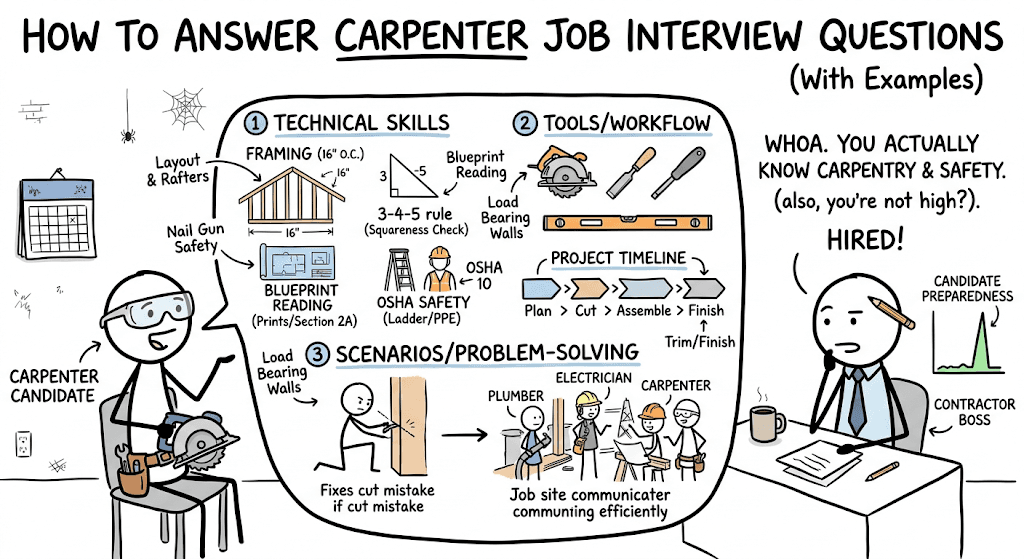
Landing a great carpentry job requires more than just owning a quality circular saw and a reliable framing hammer. Whether you are applying for a union apprenticeship through the United Brotherhood of Carpenters in Chicago or pursuing a lead framing position in Texas, employers want proof of your capabilities. They need to know you have the technical skills, the reliability, and the strict safety mindset required to succeed on a busy job site.
The Bureau of Labor Statistics projects steady demand for carpenters across the United States. To help you stand out in this competitive market and secure your next role, ChiselJobs has compiled a comprehensive guide to navigating the interview process with total confidence.
What Construction Hiring Managers Actually Evaluate
Contractors and hiring managers, often guided by standards from organizations like the Associated General Contractors of America, look at three main pillars during a carpentry interview. They want to verify your technical proficiency, assess your commitment to workplace safety, and determine if you are a good fit for their crew dynamics.
When preparing your answers, always anchor your responses in real-world experience. Instead of simply stating you know how to frame a wall, describe a specific commercial or residential build where your layout skills kept the project on schedule and under budget.
Showcasing Your Technical Carpentry Knowledge
Technical questions separate seasoned professionals from novices. Employers will test your knowledge of structural integrity, blueprint reading, and specific building techniques. They also want to ensure your work complies with the International Code Council guidelines.
Question: Describe your process for laying out a complex roof or wall frame.
How to Answer: Walk the interviewer through your exact methodology step by step. Start with reading the blueprints and verifying your measurements. Example Answer: "I begin by thoroughly reviewing the blueprints to understand the load-bearing requirements and local building codes. If I am framing a standard wall, I pull my tape measure and mark my plates for studs at 16 inches on center. I always check for square using the 3-4-5 rule or a laser level before securing the plates. I also consult resources like the Journal of Light Construction to stay updated on the best framing practices and ensure all headers are sized correctly for the spans."
Question: What is your experience with finish carpentry and complex joinery?
How to Answer: Detail the specific tools you use and the types of joints you are comfortable executing. Mention your precision with chisels, miter saws, and specialized techniques. Example Answer: "My finish carpentry experience ranges from installing baseboards and crown molding to building custom cabinetry. I am highly proficient with a compound miter saw for complex angles. For high-end custom work, I frequently use a router and sharp hand chisels to create tight mortise and tenon joints, a technique I refined by studying Fine Woodworking tutorials. I know that finish work requires absolute precision, so I always measure twice and cut slightly long to allow for fine tuning."
Proving Your Commitment to Job Site Safety
Safety is entirely non-negotiable on a construction site. An employer needs to trust that you will adhere strictly to OSHA Construction Industry regulations. Be prepared to discuss safety protocols in detail.
Question: How do you handle a situation where a coworker is ignoring safety protocols?
How to Answer: Demonstrate leadership and a commitment to site safety without sounding insubordinate. Example Answer: "If I see a crew member operating a tool without safety glasses or working on a roof without proper OSHA fall protection, I address it immediately but respectfully. I remind them of the regulations and the potential consequences of a mistake. If the unsafe behavior continues, I will escalate the issue to the site foreman. A single accident can shut down a major project in New York or California for weeks."
Highlighting Communication and Problem Solving
Mistakes happen in the construction industry. Boards get cut too short, weather delays framing, and materials arrive damaged. The interviewer wants to know how you troubleshoot these inevitable problems under pressure.
Question: Tell me about a time you made a significant mistake on a project and how you fixed it.
How to Answer: Own the mistake completely. Explain the corrective action you took and what you learned from the experience. Example Answer: "Early in my career, I misread a cut list and trimmed several expensive oak stair treads half an inch too short. I immediately informed the lead carpenter rather than trying to hide the error. We repurposed those shorter treads for the upper landing, and I ordered replacement material out of my own pocket to make it right. Since that day, I implemented a personal double-check system for all finish material cuts."
Question: How do you coordinate with other trades on a busy job site?
How to Answer: Highlight your communication skills and your respect for the workflow of electricians, plumbers, and HVAC technicians. Example Answer: "Communication is the most important tool on a multi-trade site. Before I close up a wall, I always check with the electrical contractor to ensure their wiring and outlet boxes are fully roughed in. Giving other trades the space and time they need prevents tearing down finished work later. Resources like the Procore Jobsite Blog really highlight how critical this cross-trade collaboration is for project success."
Discussing Proper Tool Maintenance Practices
Employers want carpenters who respect their equipment. Poorly maintained tools lead to sloppy work and highly dangerous working conditions.
Question: How do you maintain your tools to ensure precision and longevity?
How to Answer: Discuss your daily and weekly maintenance routines for both hand tools and power tools. Example Answer: "I clean my tools at the end of every single shift. I follow the safety and maintenance guidelines provided by the Power Tool Institute by blowing the dust out of my circular saw, checking power cords for any fraying, and oiling moving parts. I also adhere to NIOSH nail gun safety protocols by inspecting my triggers and air compressors daily. Sharp, well-maintained tools make the work safer and the final product much cleaner."
Advice for Apprentices Entering the Trade
If you are new to the trade, you might not have a massive portfolio of custom joinery or high-rise framing. Focus on your strong work ethic, your eagerness to learn, and your foundational tool knowledge. Highlight any pre-apprenticeship training you have completed. Employers in booming construction markets like Florida and Texas are desperate for reliable apprentices who show up on time and are willing to sweep the site while absorbing knowledge from the journeymen. You can find excellent resources for starting your journey at Apprenticeship.gov.
Insightful Questions to Ask the Hiring Manager
A job interview is a two-way conversation. Asking insightful questions shows you are serious about your career trajectory and not just looking for a quick paycheck. Consider asking the following questions when the interviewer opens the floor:
What does a typical day look like for a carpenter on your crew?
Do you offer opportunities for continued safety training, such as the OSHA Outreach Training Program for an OSHA 30 card?
Are most of your projects residential remodels, or do you handle large-scale commercial framing?
What are the most common challenges your crews face on current job sites?
Preparing Your Resume and Interview Attire
Show up to your interview looking like a professional tradesperson. You do not need a business suit. According to industry guides on construction interview attire, clean work pants, a tucked-in shirt, and sturdy work boots show respect for the environment. Make sure your application documents are up to date by following a solid construction resume guide, and bring a physical portfolio of your work if you specialize in custom finish carpentry.
At ChiselJobs, we know that the right preparation makes all the difference in your career journey. Practice your answers, review your local building codes, and step into the interview ready to prove your worth as a skilled carpenter.