The Complete Industrial Carpenter Job Description Template

ChiselJobs Team
Published on 4/7/2026
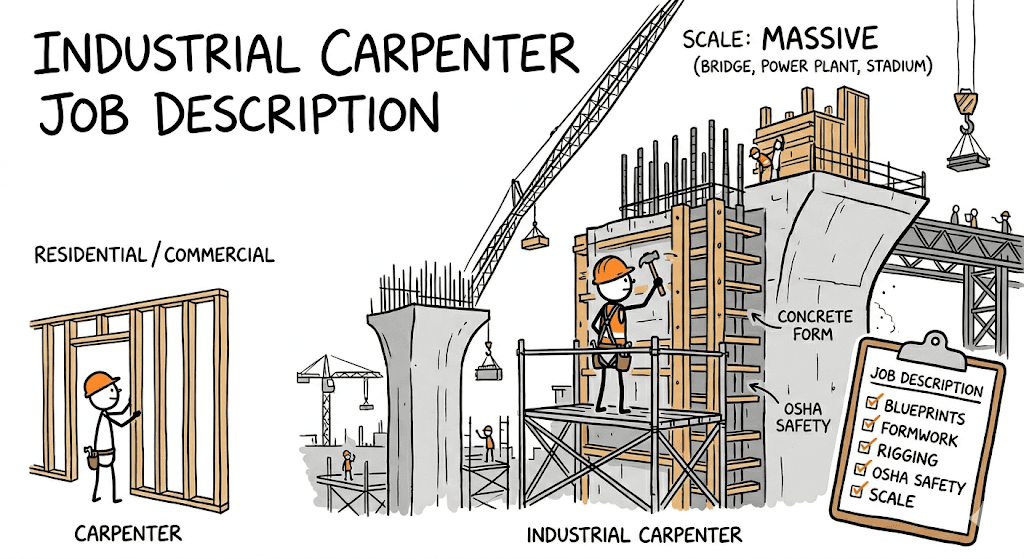
Hey ChiselJobs crew. Anyone who has spent time on a massive infrastructure project knows that industrial carpentry is a completely different beast compared to residential framing or finish work. We are not talking about coping crown molding or framing out a master bedroom. Industrial carpenters are the backbone of heavy construction. You are building the massive concrete forms for bridges, erecting heavy scaffolding for power plants, and setting the falsework that holds up tons of steel and concrete.
If you are a contractor trying to hire for these massive projects, or an apprentice figuring out what skills to master next, you need to understand exactly what this role demands. A generic job posting simply will not cut it when you need someone who understands heavy rigging, transit levels, and structural concrete pressures. Below, we are breaking down the realities of the job and providing a template you can use to attract top tier talent.
What Makes the Industrial Sector So Demanding
Working in industrial environments requires an intense focus on precision, scale, and safety. Industrial carpenters work on civil engineering projects like dams, tunnels, highways, and heavy manufacturing plants. The stakes are incredibly high. A blown formwork blowout during a massive concrete pour can cost hundreds of thousands of dollars and put lives at risk.
Employers are looking for professionals who understand the physics of the job. You need tradespeople who can read highly complex structural blueprints and coordinate with ironworkers, pipefitters, and crane operators. This is where organizations like the American Concrete Institute (ACI)set the standards for formwork and concrete construction that every senior carpenter on the site must follow.
Core Proficiencies and Tool Mastery Required
You will not just be bringing a basic tool belt to these sites. While you still need your framing hammer, speed square, and chalk line, industrial carpenters rely heavily on advanced layout and heavy duty power tools.
Precision Layout: Mastery of builder levels, transit levels, and laser measurement systems to ensure forms are perfectly plumb and level over long distances.
Heavy Duty Cutting and Drilling: Extensive use of rotary hammers, heavy duty circular saws, and bandsaws to cut thick timbers, engineered lumber, and steel bracing.
Formwork and Falsework: Constructing forms for pouring concrete foundations, retaining walls, and pillars. This requires a deep understanding of load distribution.
Scaffolding and Rigging: Erecting temporary structures safely. Workers often need to follow strict guidelines laid out by the Occupational Safety and Health Administration (OSHA) scaffolding rules.
Navigating Certifications and Safety Compliance
Safety is the undisputed top priority on any industrial site. Unlike a residential driveway pour, you are dealing with immense weights, extreme heights, and heavy machinery swinging overhead.
Most major industrial contractors require an OSHA 30 Hour Construction certification for their lead carpenters and foremen. Furthermore, knowing how to safely signal a crane operator and rig heavy loads is essential. Many projects prefer or mandate credentials from the National Center for Construction Education and Research (NCCER) to verify a worker has the exact skills needed for industrial scaffolding and concrete forming. Following safety guidelines from the National Institute for Occupational Safety and Health (NIOSH) is also a daily reality to prevent hearing loss, respiratory issues, and musculoskeletal injuries.
The Ultimate Industrial Carpenter Job Description Template
If you are a superintendent or hiring manager posting on ChiselJobs, you can copy and adjust this template to find the right tradespeople for your next big project.
About Our Company
[Insert Company Name] is a leading heavy civil and industrial contractor specializing in large scale infrastructure, water treatment facilities, and energy sector builds. We pride ourselves on our rigorous safety culture and our commitment to building structures that last for generations. We are looking for an experienced Industrial Carpenter to join our site crew.
Your Daily On Site Responsibilities
Read and interpret complex structural engineering blueprints and schematics to determine exact material requirements and dimensions.
Build, erect, and align wooden and steel forms for heavy concrete structures, including foundations, columns, and bridge decks.
Construct heavy-duty scaffolding, shoring, and falsework safely to support subsequent construction phases.
Operate transit levels, laser plumbs, and other precision measurement tools to establish accurate site elevations and grid lines.
Collaborate daily with site supervisors, ironworkers, and concrete finishers to ensure project phases are executed smoothly.
Dismantle formwork safely after concrete has cured and prepare materials for the next pour phase.
Required Trade Qualifications
Minimum of 4 years of documented experience in rough carpentry, concrete forming, or heavy industrial construction.
Completion of a recognized apprenticeship program through the United Brotherhood of Carpenters (UBC) or equivalent non-union training is highly preferred.
Valid OSHA 30 certification.
Current CPR and First Aid certification via the National Safety Council.
Physical ability to lift heavy materials up to 50 lbs, climb tall structures, and work outdoors in varied weather conditions.
Familiarity with federal standards for heavy construction, such as those outlined by the Federal Highway Administration (FHWA) for bridge and road projects.
Compensation and Growth Opportunities
Hourly Wage: $28.00 to $45.00 per hour based on verifiable experience and regional prevailing wage standards.
Comprehensive health, dental, and vision insurance packages.
Retirement planning options with a company match.
Ongoing funding for advanced trade certifications through Apprenticeship.gov approved programs.
Salary Expectations and Regional Demand in the US
Let us talk about the money and where the work actually is. The Bureau of Labor Statistics (BLS) notes that the median pay for carpenters is solid, but industrial specialists often push into the highest earning percentiles. Because you are dealing with critical infrastructure, the pay scales reflect that specialized knowledge.
Regional demand shifts constantly based on where federal and state money is flowing. Right now, massive infrastructure and energy projects are booming in states like Texas and New York. Texas has a massive demand in the energy sector for refineries and manufacturing plants. New York and Illinois are seeing huge surges in bridge replacements and heavy transit infrastructure upgrades.
Keep your saws sharp and your forms braced properly. Let us know in the ChiselJobs comments what the biggest industrial project you have ever worked on was, and what specific interview questions you always ask the new guys on the site.