The Rise of Solar Construction: Opportunities for Framing Carpenters

ChiselJobs Team
Published on 7/9/2026
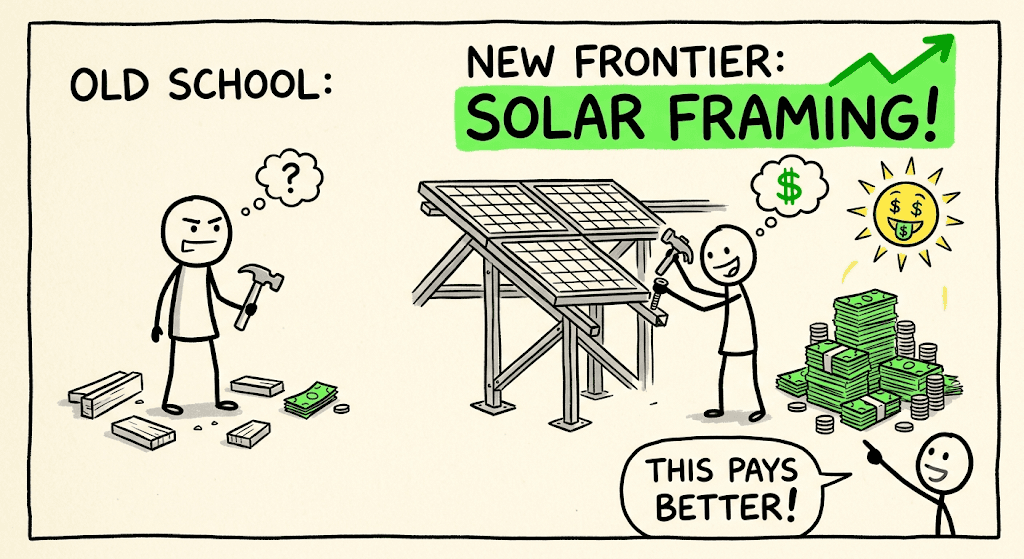
The construction landscape is shifting fast. While traditional residential framing remains the backbone of the housing market, a massive surge in utility-scale solar projects and commercial solar arrays is creating a brand-new avenue for rough carpenters.
For a long time, people assumed solar work belonged entirely to electricians. While sparkies handle the wiring, inverters, and grid connections, they do not build the massive structural foundations that hold the panels in place. That is where framing carpenters come in.
From utility-scale ground mounts in the desert to complex commercial rooftop racking systems, the solar boom needs workers who understand load paths, layouts, and heavy tool operation. If you can read a blueprint, swing a hammer, and run a crew, the solar sector is looking for you.
Why Solar Developers Need Traditional Framing Skills
A solar array is essentially a roof without a house, or a massive deck built directly into the dirt. The structural principles do not change just because the top layer is a photovoltaic panel instead of plywood and asphalt shingles.
Solar developers are realizing that hiring specialized framing carpenters speeds up production and slashes costly installation errors.
Layout Accuracy and Blueprint Reading
Ground-mounted solar fields require precise grid layouts. If your initial stakes are off by even half an inch, the pile drivers will set the steel posts incorrectly, and the racking system will not bolt together. Framing carpenters excel at using transit levels, laser lines, and string lines to establish square, true lines over hundreds of yards.
Structural Integrity and Wind Loads
Solar arrays act like giant sails. If they are not anchored and braced properly, a high-wind event can rip millions of dollars of equipment right out of the ground or off a roof. Carpenters understand how to transfer loads, install heavy-duty hardware, and ensure that every structural connection meets local building codes.
Speed with Power Tools
On a massive solar site, you are not dealing with wood studs, but you are dealing with heavy-gauge steel tracking, aluminum rails, and endless fasteners. The muscle memory a carpenter has from running circular saws, impact drivers, and framing nailers transfers perfectly to the high-speed assembly lines of solar racking.
The Daily Grind: What a Solar Carpentry Job Looks Like
If you transition from residential framing to solar construction, your day-to-day work environment will look a bit different, but the core mechanics remain the same.
Site Preparation and Staging: Unloading semi-trucks of racking materials and organizing them by section so the assembly crews do not lose momentum.
Post and Pile Alignment: Working alongside heavy equipment operators to ensure steel support posts are driven straight, level, and to the exact depth required by the engineering plans.
Racking and Truss Assembly: Bolting together the metal framework, torque tubes, and dampeners that allow the solar panels to track the sun throughout the day.
Rooftop Blocking and Flashing: On commercial roofs, carpenters are responsible for cutting into the roof asset, installing structural blocking to tie the racks to the building's main beams, and flashing the penetrations to prevent leaks.
Compensation and Career Growth: Union vs. Non-Union
Making the switch to solar can be highly lucrative, especially for experienced framing foremen and leads who know how to manage crews.
The Union Advantage
In many parts of North America, the United Brotherhood of Carpenters (UBC) has secured major contracts for utility-scale solar fields. Union carpenters on these sites enjoy full journeyman scale wages, excellent healthcare, and solid pension plans. Because these projects often fall under federal Davis-Bacon prevailing wage laws, even non-union carpenters can see a significant pay bump when working on government-backed clean energy sites.
Career Advancement
Solar is not a passing trend; it is a long-term infrastructure play. A framing carpenter who masters solar racking installation can quickly move up the ladder into roles like:
Solar Lead Hand: Managing a specific sub-crew on the racking line.
Framing Foreman: Overseeing the entire structural side of the project, coordinating with the electrical foreman.
Site Superintendent: Managing the entire job site, from grading to final commissioning.
Safety First: OSHA and the Solar Environment
Every carpenter knows that framing a three-story house carries risk. Solar construction has its own unique set of hazards that require strict adherence to OSHA standards.
Key Safety Focus: Working on utility-scale sites means zero shade. Heat stress and dehydration are major risks. Furthermore, working around heavy machinery like pile drivers and all-terrain forklifts requires constant situational awareness and proper high-visibility PPE.
On rooftop solar jobs, fall protection is non-negotiable. You will be spending your days in a harness, tied off to certified anchor points, working near leading edges. If you already have your OSHA 10 or OSHA 30 certification, you will have a massive leg up when applying to these positions on ChiselJobs.
How to Transition Your Carpentry Skills to Solar
You do not need to go back to school to get into solar construction. Your existing hand tools, your ability to read a tape measure, and your work ethic are your ticket in. Here is how to position yourself for these roles:
Highlight Your Layout Skills: When updating your resume, emphasize your experience with layout, framing math, and using leveling instruments.
Get Certified: If you do not have your OSHA 10 card, get it. Taking a basic course in rigging and signaling for cranes or forklifts also looks great to solar contractors.
Look for Commercial Subcontractors: Many traditional commercial framing and concrete formwork companies are taking on solar structural contracts. Look for these employers on specialized trade job boards.
The clean energy transition needs builders. By bringing the precision and grit of traditional framing to the solar fields, you can secure a stable, high-paying career path for decades to come. Ready to see who is hiring in your area? Check out the latest structural listings on ChiselJobs today.