Look the Part: The Dressing Guide to Construction Interview

ChiselJobs Team
Published on 2/2/2026
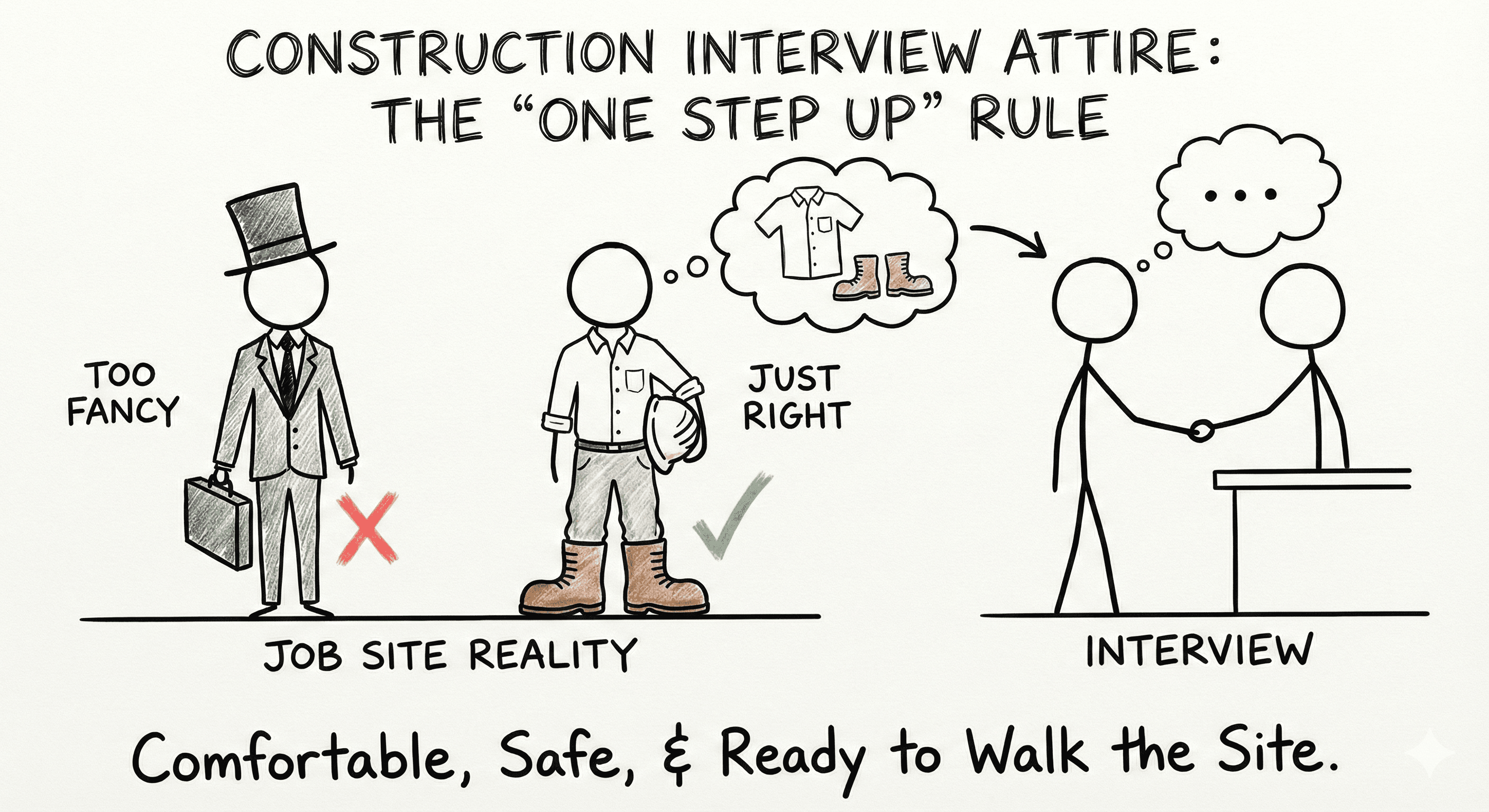
You wouldn’t frame a house with a sledgehammer, and you shouldn’t walk into a construction interview wearing a three-piece suit. In the skilled trades, the rules of "dressing for success" are different. If you look too corporate, you look inexperienced. If you look too messy, you look like a liability.
The goal is to hit the sweet spot: clean, capable, and safety-conscious.
Whether you are an apprentice carpenter, a seasoned foreman, or a project manager, your outfit is the first sample of your work. It tells the employer, "I respect the job, I know the environment, and I’m ready to work."
The "One Step Up" Rule
The golden rule for trades interviews is simple: dress one step up from what you would wear on a normal workday.
For a carpenter or general contractor, this usually means "Rugged Professional." You aren't trying to look like a banker; you are trying to look like a foreman. You want to project that you can handle a site tour without ruining expensive dress shoes, but you also respect the hiring manager enough to clean up.
Pro Tip: If you are applying for a hands-on role, ask yourself: "If they asked me to walk the job site right now, would I be safe?" If the answer is no, change your outfit.
What Works for Men: The "Clean Carhartt" Look
You don't need a tie. In fact, wearing a tie to a job site can actually be a safety hazard (snag risk). Instead, aim for clean, durable workwear.
The Shirt: A clean button-down work shirt (plaid or solid) or a high-quality polo. Ensure it is ironed. If you wear a flannel, make sure it’s new or very well-kept, not the one you’ve been sweating in for three years.
The Pants: Dark denim (indigo or black) or canvas work pants (like Dickies or Carhartt). They should be free of rips, paint stains, or drywall dust. Khakis are acceptable for management roles but can look out of place for labor positions.
The Boots: This is crucial. Wear leather work boots. They should be clean (wipe off the mud!) but they don’t need to be brand new. Worn boots show experience; dirty boots show laziness.
The Belt: Wear a solid leather belt. It pulls the look together and signals attention to detail.
What Works for Women: Practicality Meets Professionalism
Women in the trades often face a double standard—needing to prove competence immediately. Your attire should signal that you are practical and ready for the field.
The Top: A button-up work shirt, a blouse in a durable fabric, or a quality sweater. Avoid anything low-cut or overly loose, which can be a safety concern near machinery.
The Bottoms: Dark work trousers, boot-cut jeans, or canvas pants. Avoid leggings or yoga pants—they are not PPE-compliant and signal a lack of site awareness.
The Footwear: Closed-toe leather boots or sturdy work shoes. Avoid high heels, open-toed sandals, or canvas sneakers (like Converse). You need stability and protection.
Hair & Accessories: Tie long hair back. It’s a safety non-negotiable. Keep jewelry minimal—stud earrings are safer than hoops, and necklaces should be tucked away.
The "Site Tour" Factor: Be Ready to Walk
In many carpentry and construction interviews, the conversation moves from the office to the job site. The employer wants to see if you understand what you are looking at.
If you show up in dress loafers and a suit jacket, you can't walk through a muddy framing site safely.
The "Go-Bag" Strategy: If you are interviewing for a role that might involve a practical skills test (like cutting a rafter or reading a layout), bring a small bag with your essential gear:
Hard hat (if you have your own)
Safety glasses
Steel-toe boots (if you wore lighter boots to the interview)
Tape measure and pencil
Showing up with your own PPE (Personal Protective Equipment) is a massive green flag for employers. It shows you take OSHA regulations and personal safety seriously.
Deal-Breakers: What to Leave at Home
There are certain items that will almost guarantee you don't get the job. These items scream "I don't take this seriously."
Gym Clothes: Sweatpants, basketball shorts, and hoodies are for the weekend, not the interview.
Graphic Tees: Avoid shirts with offensive slogans, beer logos, or political statements.
Ripped Clothing: "Distressed" jeans might be fashionable, but on a job site, a rip is a snag hazard. Wear whole, intact clothing.
Excessive Cologne/Perfume: You might be working in close quarters or a small site trailer. heavy scents can be distracting.
Headphones/Earbuds: Take them out before you even exit your truck. You need to be alert.
Grooming: The Details That Count
You work with your hands, so they don't need to be manicured, but they must be scrubbed.
Hands: Clean your fingernails. If you have permanent grease stains or calluses, that's fine—it shows you work—but fresh dirt looks careless.
Hair/Beard: Trim your beard or shave. If you have a beard, make sure it’s neat. Construction requires precision; a messy face suggests a messy layout.
Smell: If you are coming straight from another job site, bring a change of clothes and deodorant. Do not walk into an interview smelling like sweat and sawdust if you can help it.
Summary: The Checklist
Before you walk out the door, check yourself against this list:
[ ] Am I wearing closed-toe, sturdy boots?
[ ] Are my clothes free of holes and offensive logos?
[ ] Is my shirt tucked in? (Usually looks more professional).
[ ] Do I have safety glasses in my car/bag just in case?
[ ] Do I look like someone a foreman can trust with expensive materials?
Confidence comes from knowing you look the part. When you dress like a professional tradesperson, you speak like one.
References
[1] Techforce. "What To Wear To a Construction Job Interview." https://www.google.com/search?q=Techforce.com.au. https://www.techforce.com.au/what-to-wear-to-a-construction-job-interview
[2] UKR Group. "What to Wear to a Construction Job Interview UK." UKRGroup.co.uk. https://www.ukrgroup.co.uk/what-to-wear-construction-job-interview/
[3] O'Neill & Brennan. "What to wear to a construction job interview." Oneillandbrennan.com. https://www.oneillandbrennan.com/ie/news/what-to-wear-to-a-construction-job-interview/bp480/
[4] Indeed Editorial Team. "What to wear to an interview (do's and don'ts)." Indeed.com. https://uk.indeed.com/career-advice/interviewing/what-to-wear-to-interview
[5] SSA LTD. "What to wear to a construction job interview." SSALTD.com. https://www.ssaltd.com/news-resources/what-to-wear-to-a-construction-job-interview/
[6] The Right Staff. "Proper Attire for Skilled Trades Job Interview." Therightstaff.com. https://www.therightstaff.com/2013/06/28/skilled-trades-job-interview-dress/
[7] Twin City Staffing. "How to Dress for a Skilled Trades Interview." Twincitystaffing.com. https://www.twincitystaffing.com/skilled-trades/how-to-dress-for-a-skilled-trades-interview/
[8] Workable. "Carpenter Interview Questions." Resources.workable.com. https://resources.workable.com/carpenter-interview-questions
[9] Westwood Hart. "Interview Attire Dos & Don'ts." Westwoodhart.com. https://westwoodhart.com/blogs/westwood-hart/interview-attire-dos-donts-professional-dress-guide
[10] Clover HR. "What Not to Wear to an Interview." Cloverhr.co.uk. https://www.cloverhr.co.uk/blog/what-not-to-wear-to-an-interview/
Looking for verified carpentry jobs across the U.S. and Canada? Explore opportunities on ChiselJobs, the job board built for skilled trades.