Top 10 Apprentice Carpenter Interview Questions & Answers to Nail the Job

ChiselJobs Team
Published on 12/14/2025
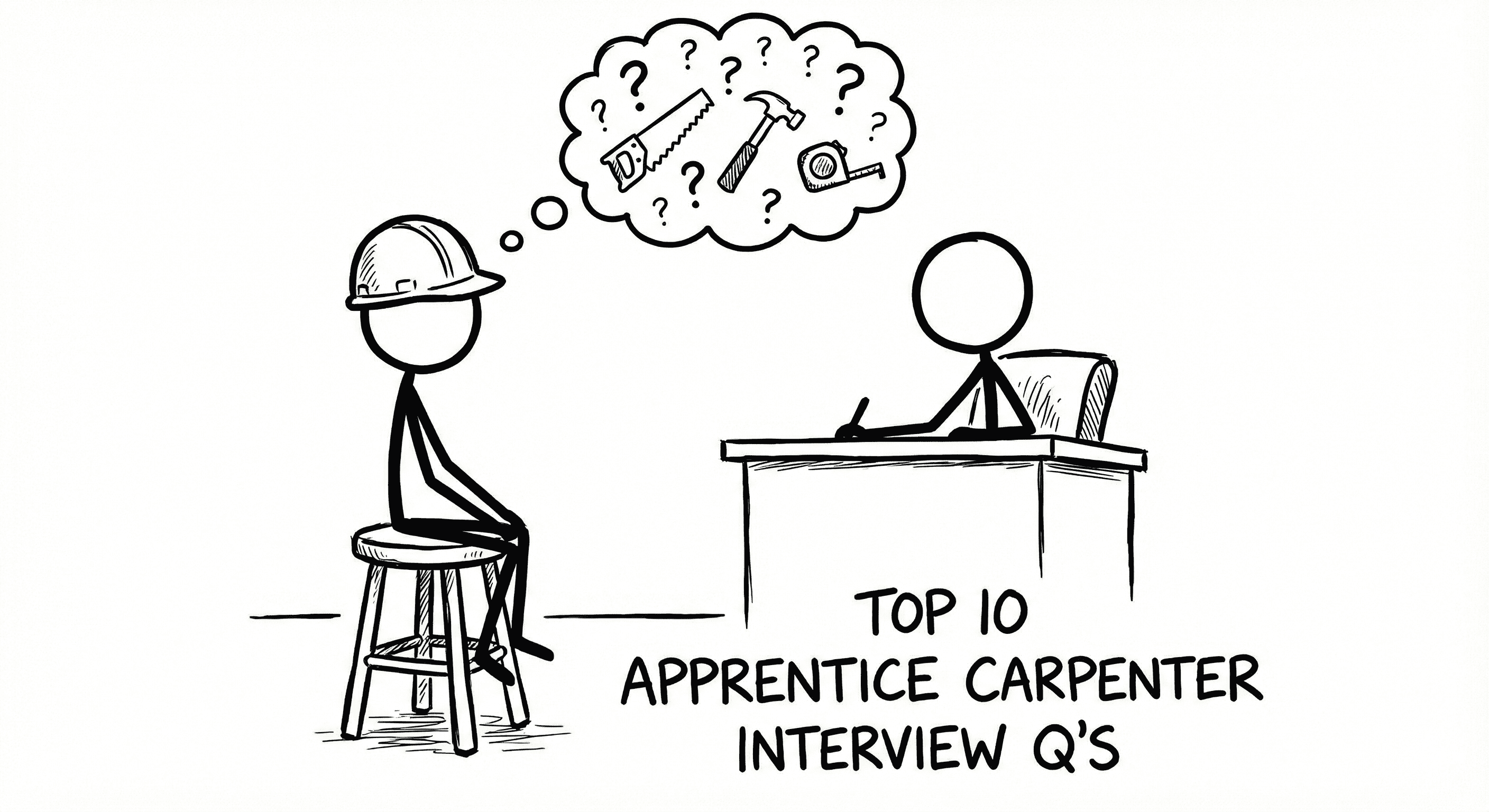
If you are working through our Carpenter Job Search Guide to break into the trades, you probably know that a resume only gets you so far. In carpentry, the foreman or lead contractor wants to know if you can show up, shut up, and learn. They aren't expecting you to cut complex rafter tails on day one. They are looking for "green" apprentices who are teachable, reliable, and safe.
The interview for an apprenticeship is less about your portfolio and more about your attitude. Can you read a tape measure? Will you be standing there with your belt on 15 minutes early? Do you understand that job site safety isn't optional?
This guide breaks down the top 10 interview questions you will face as an apprentice carpenter. We cover what they are actually asking and how to give an answer that proves you are worth the investment.
1. "Why do you want to be a carpenter?"
The Reality Behind the Question: Employers ask this to weed out people who just want a paycheck. Carpentry is physically punishing. If you don't have a genuine interest in building, you won't last through the first winter or the first week of hauling lumber.

How to Answer: Connect your answer to the satisfaction of tangible results. Avoid generic answers like "I like working with my hands." Be specific.
The Wrong Way: "I just need a job and I like wood."
The Right Way: "I’ve always preferred work where I can see the result at the end of the day. I helped my uncle re-deck his porch last summer, and I liked the process of measuring, cutting, and seeing the structure come together. I want a career where I can build real skills and eventually run my own projects."
2. "What is your experience with basic hand and power tools?"
The Reality Behind the Question: They need to know if you are starting from zero or if you have some baseline familiarity. They also want to know if you are going to cut your fingers off the first time you touch a circular saw.
How to Answer: Be honest. If you lie about your skills, you will be exposed in five minutes on the site. List the specific tools you are comfortable with.
Key Tools to Mention: Tape measure, speed square, hammer, chalk line, circular saw, drill/driver.
Sample Answer: "I have basic exposure. I am comfortable reading a tape measure down to the sixteenth. I’ve used circular saws and drills on home projects. I know how to change a bit and how to set the depth on a saw, but I am eager to learn the professional techniques for framing and finish work."
3. "Tell me about a time you made a mistake. How did you handle it?"
The Reality Behind the Question: This is an integrity test. Everyone makes mistakes in construction. A "measure twice, cut once" philosophy is great, but eventually, you will cut a board too short. The employer wants to know if you will hide it or own it.
How to Answer: Focus on immediate admission and fixing the problem.
The Strategy: Describe a specific error, how you told the supervisor immediately, and what you did to fix it.
Sample Answer: "I was helping on a garage build and cut a stud 1/4 inch too short because I read the wrong side of the mark. As soon as I realized it, I told the foreman. He wasn't happy, but he had me use that board for a shorter cripple stud later, so it wasn't wasted. I learned to slow down my layout process after that."
4. "How do you handle early mornings and physical labor?"
The Reality Behind the Question: Carpentry starts early. If you are not a morning person, or if you can't haul sheets of 3/4" plywood all day, you are a liability. They are asking: Are you going to call in sick because you are tired?

How to Answer: Validate their concern and provide proof of your reliability. If you don't have previous construction experience, prove your discipline through sports, school attendance, or side gigs.
The Right Way (With Job Experience): "I don't have an issue with early starts. At my last job, I was consistently there by 6:45 AM. I stay fit, and I know that hauling material is a huge part of an apprentice's job. I’m ready to do the heavy lifting to earn my place on the crew."
The Right Way (From School/No Experience): "I’m used to a strict schedule. During school, I was up early for practice (or class) every day and rarely missed a day. I take care of my physical health, so I’m ready for the labor, and I understand that being on time actually means being 15 minutes early."
5. "What do you know about job site safety and OSHA?"
The Reality Behind the Question: Safety violations cost companies money and shut down sites. An apprentice who ignores safety is unhirable. You don't need to quote OSHA code 1926, but you need to show respect for the rules.
How to Answer: Mention PPE (Personal Protective Equipment) and situational awareness.
Key Points: Hard hats, safety glasses, steel-toe boots, and hearing protection.
Sample Answer: "I take safety seriously. I already have my own steel-toed boots and OSHA-rated glasses. I understand that a clean site is a safe site, so I’m always looking for trip hazards or loose cords. If I’m ever unsure about how to use a tool safely, I will stop and ask before I pull the trigger.
6. "How would you find the center of a room?" (Or other math questions)
The Reality Behind the Question: Carpentry is applied math. They might ask you to read a tape measure on the spot or do simple fraction subtraction (e.g., what is 15 1/4" minus 3/8"?).

How to Answer: Walk them through your process verbally. It shows you can think on your feet.
The Math Check:
Finding Center: Measure the total width and divide by two. Or, measure from Wall A until you get a round number (like 60"), mark it, measure from Wall B to that mark, add the two, and split the difference.
Sample Answer: "I’d measure the full distance of the wall, say it’s 12 feet 4 inches. Half of 12 feet is 6 feet, half of 4 inches is 2 inches. So the center is 6 feet 2 inches. I’d mark it, then measure from the other side to verify."
7. "What would you do if you finished a task and the foreman wasn't around?"
The Reality Behind the Question: Productivity kills. Standing around leaning on a broom ("leaning on a shovel") is the fastest way to get fired. They want self-starters.
How to Answer: The answer is always "cleaning" or "prep."
The Right Way: "If I finish a task and can't find a supervisor, I would start organizing the lumber pile, sweeping the work area, or prepping the tools for the next task. There is always something to clean or organize on a site."
8. "Can you take rough criticism?"
The Reality Behind the Question: Construction culture is direct. It is often loud, high-pressure, and blunt. If you have thin skin, you will struggle. Journeymen will correct you sharply to prevent you from hurting yourself or ruining expensive material.

How to Answer: Show that you separate your ego from the work.
Sample Answer: "I can handle it. I know I’m there to learn, and sometimes that means being told I’m doing it wrong. As long as the feedback helps me get better, I don't take it personally. I’d rather be corrected loudly than build something unsafe."
9. "Where do you see yourself in 3 years?"
The Reality Behind the Question: Training an apprentice is an investment of time and money. If you plan to leave in six months to go back to college or switch industries, they don't want you. They want to know you are chasing the Journeyman ticket.

How to Answer: Focus on skill acquisition and loyalty.
Sample Answer: "In three years, I want to be a proficient framer who doesn't need constant supervision. I want to have my own full set of tools and be trusted to run small parts of the job. Ideally, I’d be well on my way to becoming a lead carpenter for this company."
10. "Do you have any questions for us?"
The Reality Behind the Question: If you say "no," you look disinterested. Asking smart questions shows you understand the trade.
How to Answer: Ask about the work culture, the tools, or the scope of work.
Good Questions to Ask:
"What does a typical day look like for an apprentice on your crew?"
"What tools do you expect me to have on day one versus year one?"
"What specific types of projects (commercial, residential framing, finish) do you have coming up?"
"Is there a formal apprenticeship program or reimbursement for trade school?"
Final Tips for the Apprentice Interview
Dress the Part: Do not wear a suit. Wear clean work pants (Carhartts or Dickies) and a clean shirt. Look like you are ready to work, not ready for a bank meeting.
Bring a Pen and Paper: Taking notes shows you are serious.
Be Early: "On time" in construction means 15-20 minutes early.
Construction is one of the few industries where your work ethic counts for more than your pedigree. If you can communicate that you are safe, reliable, and hungry to learn, you will find a crew willing to teach you.