Carpenter Resume Examples (No Experience vs. Experienced)

ChiselJobs Team
Published on 12/11/2025
In the trades, your work usually speaks for itself. A perfectly mitered joint or a plumb wall frame tells a foreman everything they need to know about your skill level. But before you ever set foot on a job site for a trial, you need to get past the gatekeeper. That is where your resume comes in.
The goal is not just to list where you have been; it is to prove you can handle the work that is coming next. We will break down exactly how to frame your experience for both entry-level and senior roles so you can land the interview and let your hands do the rest.
The Foundation: What Every Carpenter Resume Needs
Before we split into specific experience levels, let's establish the load-bearing walls of any construction resume. Regardless of your tenure, every document must contain these core elements to pass Applicant Tracking Systems (ATS) and catch a contractor’s eye.
Contact Info: Name, phone number, email, and location (City, State/Province).
Professional Summary: A 2-3 sentence hook. This replaces the outdated "Objective."
Skills Section: A mix of hard tools and soft skills.
Work Experience: Reverse chronological order.
Education & Certifications: OSHA cards, apprenticeships, or trade school degrees.
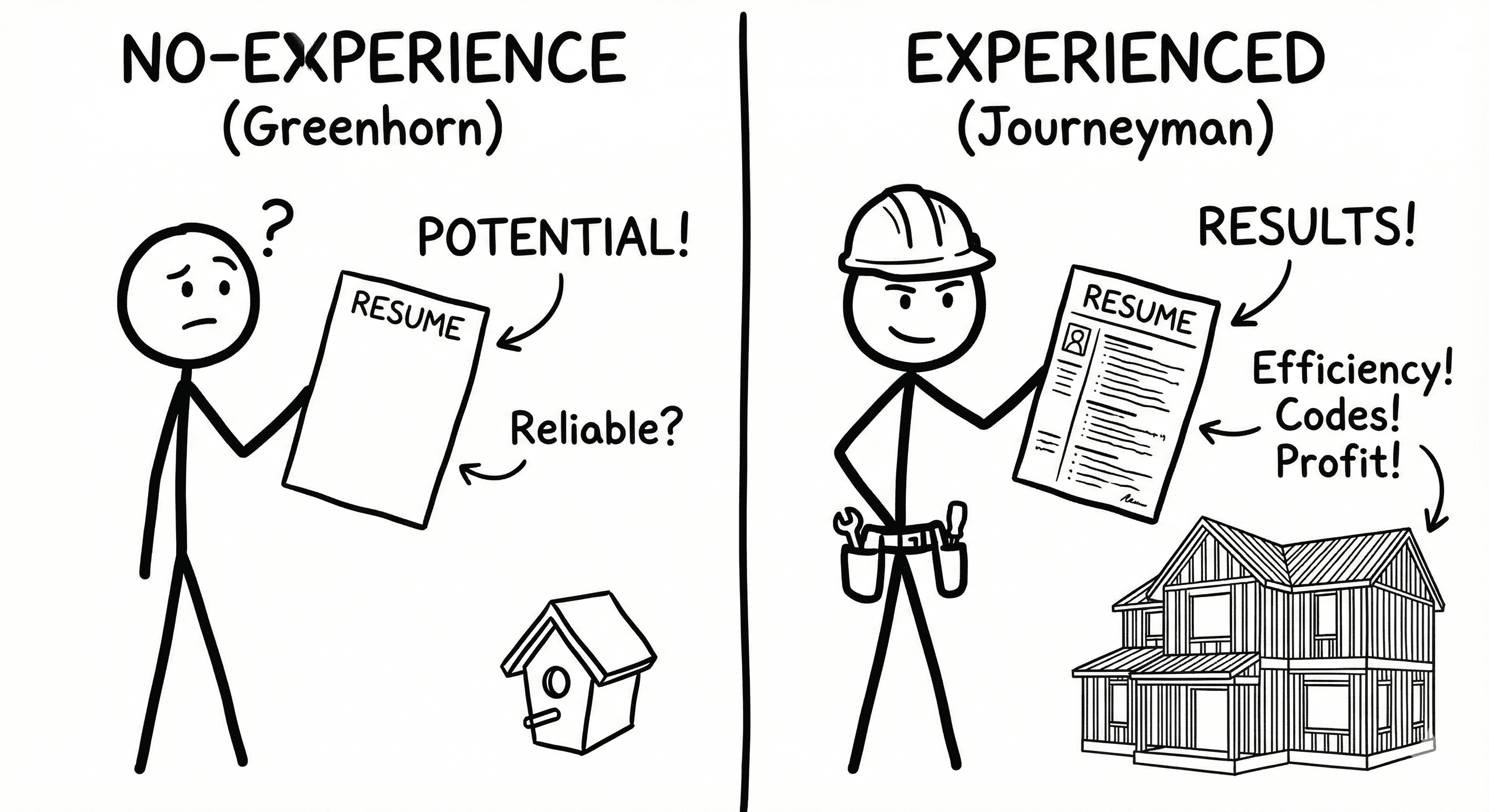
Strategy 1: The "Greenhorn" Resume (No Experience)
If you are looking for an apprenticeship or a helper role, you face a common catch-22: you need experience to get a job, but you need a job to get experience. The solution is to pivot your resume from "history" to "potential."
Employers hiring entry-level workers are looking for three things: reliability, safety awareness, and physical aptitude. They can teach you how to cut a rafter; they cannot teach you to show up on time.

How to compensate for zero experience:
Highlight Transferable Labor: Did you work in landscaping, warehousing, or moving? These prove you can handle physical labor and long hours.
Showcase "Garage" Projects: If you built a deck with your uncle or fixed drywall in your basement, list it. It shows genuine interest.
Emphasize Math & Safety: Mention your ability to read a tape measure accurately or any safety certifications (like OSHA 10) you got on your own.
Example: Entry-Level Carpenter Resume
Professional Summary
Reliable and physically fit aspiring carpenter with a strong work ethic and aptitude for mechanical tasks. Recent trade school graduate with hands-on training in basic framing, safety protocols, and power tool operation. Committed to learning the trade and maintaining a safe, accident-free job site.
Relevant Skills
Technical: Tape measure reading (to 1/16"), circular saw operation, hammer drill use, basic blueprint reading, lumber handling.
Soft Skills: Punctuality, strong mental math, active listening, ability to lift 50+ lbs, team collaboration.
Work Experience Warehouse Associate | Amazon Fulfillment | 2022 – Present
Maintained 100% attendance record over 18 months.
Operated pallet jacks and followed strict safety protocols in a high-traffic warehouse.
Collaborated with a team of 10 to meet daily shipping quotas, ensuring efficiency under pressure.
Education
Pre-Apprenticeship Certificate Training (PACT) | Home Builders Institute | 2023
OSHA 10-Hour Construction Safety | 2023
Strategy 2: The Journeyman Resume (Experienced)
Once you have dirt on your boots, your resume strategy shifts. You no longer need to prove you can use a hammer; you need to prove you are efficient, code-compliant, and profitable. Experienced resumes should focus on specialization and quantifiable results.
General Contractors (GCs) want to know if you can run a crew, solve layout problems without calling the architect, and finish jobs under budget.

How to level up an experienced resume:
Be Specific with Scope: Don't just say "Framing." Say "Commercial metal stud framing for 5-story mixed-use buildings."
Quantify Achievements: Use numbers. How large was the crew? What was the budget? How many square feet of flooring did you install daily?
Mention Codes & Compliance: Explicitly state your knowledge of IBC (International Building Code) or local residential codes.
Example: Experienced Carpenter Resume
Professional Summary Journeyman Carpenter with 7+ years of experience specializing in residential finish carpentry and custom cabinetry. Proven track record of managing small crews and delivering high-end millwork within strict deadlines. Expert in blueprint interpretation and building code compliance, ensuring zero inspection failures on the last 15 projects.
Key Qualifications
Specialties: Crown molding, wainscoting, custom built-ins, stair layout, window installation.
Tools: Laser levels, compound miter saws, pneumatic nailers, joiners.
Leadership: Crew supervision, material estimation, subcontractor coordination.
Work Experience Lead Carpenter | Apex Custom Homes | 2019 – Present
Lead a 4-man crew in finish carpentry for luxury custom homes ranging from 3,000 to 5,000 sq. ft.
Reduced material waste by 15% through precise layout and cut-list management.
Install complex cabinetry and millwork packages valued up to $50,000 per home.
Coordinate directly with site superintendents to resolve blueprint discrepancies, preventing costly rework.
Carpenter Apprentice | Sullivan Construction | 2016 – 2019
Assisted in rough framing of 20+ residential units, including wall, floor, and roof systems.
Mastered layout techniques for stud walls and floor joists under journeyman supervision.
Ensured daily site safety and organization, contributing to an accident-free record for 3 consecutive years.
The Tool Belt: Skills to Include
Your skills section is critical for keyword matching. Many companies use software to scan for specific terms before a human ever reads your document. Ensure you categorize them clearly so the hiring manager can scan them in seconds.

Hard Skills (The Tools)
Rough Carpentry: Wood & metal framing, truss installation, subflooring, concrete formwork, blocking, sheathing.
Finish Carpentry: Trim, baseboards, crown molding, door & window installation, cabinetry, flooring (hardwood/laminate).
Technical: Blueprint reading, material estimation (takeoffs), building codes (IBC/IRC), laser layout, scaffolding.
Soft Skills (The Character)
Communication: explaining issues to GCs or clients.
Problem-solving: troubleshooting uneven levels or out-of-square walls.
Adaptability: working in extreme weather or changing project scopes.
Time Management: meeting tight project deadlines.
Common Mistakes That Get Resumes Tossed
Even the most skilled carpenter can lose a job opportunity due to a poor resume. Avoid these "wood butcher" mistakes:
Spelling and Typos: In finish work, a millimeter matters. On a resume, a typo suggests a lack of attention to detail. "Messuring" instead of "Measuring" looks bad.
Generic Duties: Writing "Did carpentry work" tells the employer nothing. Be specific. Did you frame walls? Install cabinets? Build concrete forms?
Irrelevant History: If you have 10 years of carpentry experience, you do not need to list your high school burger flipping job. Keep it relevant to the trade.
Formatting Walls of Text: No one wants to read a novel. Use bullet points. Keep descriptions punchy and action-oriented.
Applicant Tracking Systems (ATS)
A quick note on the digital gatekeeper: The ATS. Large construction firms and staffing agencies use these systems to filter applications. If the job description asks for "Commercial Framing" and "OSHA 30," those exact words need to appear on your resume.
Pro Tip: Look at the job posting. If they use the term "Blueprint Reading," use that term. Do not change it to "reading plans" or "interpreting drawings." Mirror their language to get your foot in the door.
Conclusion
Whether you are cutting your first rafter or running a multi-million-dollar job site, your resume is the first tool you pick up. It needs to be sharp, precise, and fit for the job. For the apprentice, it is about selling your potential and work ethic. For the veteran, it is about selling your efficiency and expertise.
Build your resume with the same care you would build a house. Lay a strong foundation, frame it with solid experience, and finish it with the details that showcase your skill.