Mastering the Trim: The Real Scope of a Finish Carpenter

ChiselJobs Team
Published on 1/5/2026
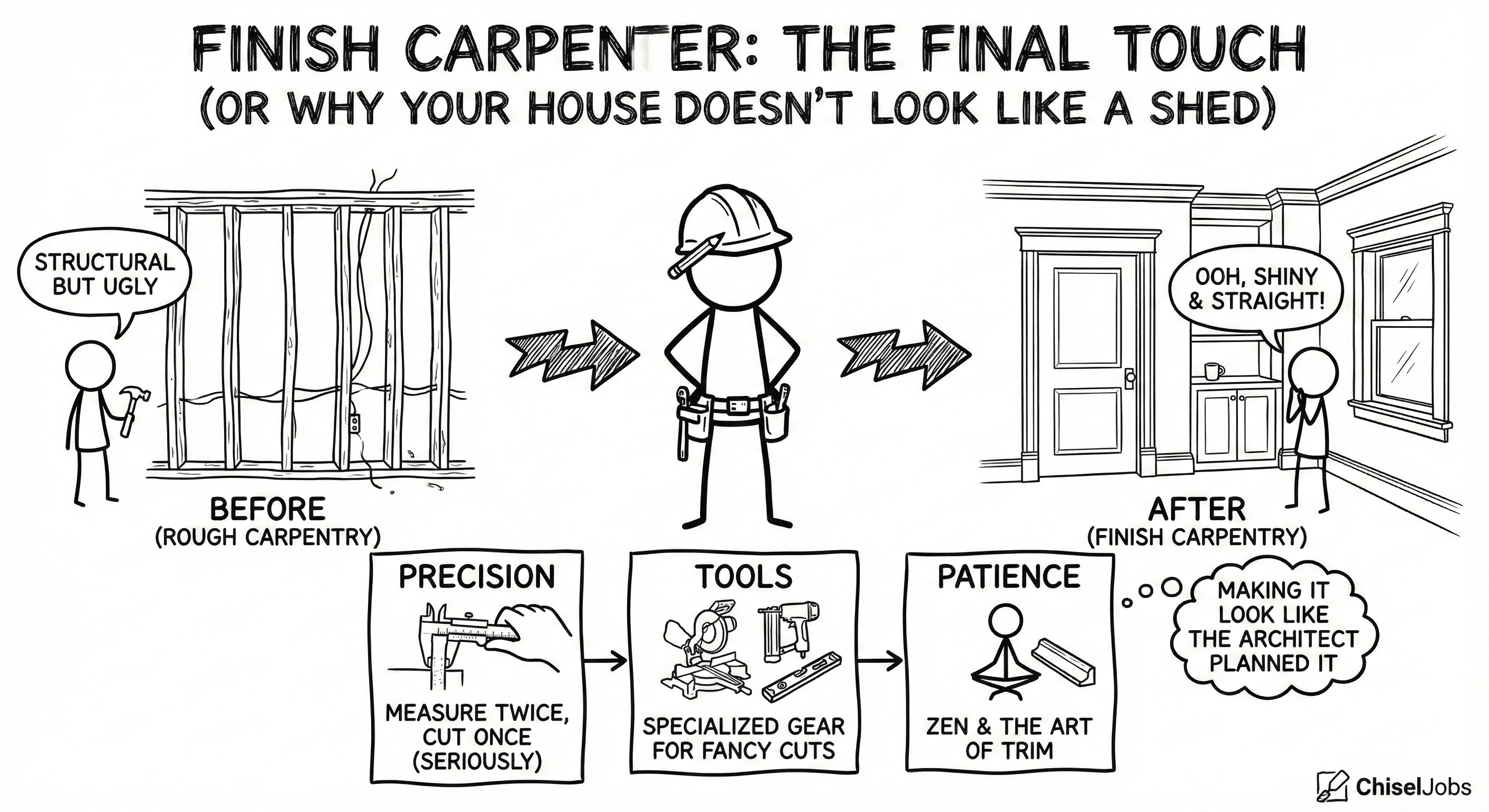
When the rough framing crews pack up and the drywall dust settles, the character of a building finally begins to emerge. This transformation is entirely in the hands of the finish carpenter. While framers provide the structural bones of a house, finish carpenters provide its soul. This role requires a distinct shift in mindset from speed and heavy lifting to patience, precision, and aesthetics.
A finish carpenter is a skilled tradesperson who installs, repairs, and constructs the interior and exterior visible wood features of a building. This job description encompasses everything from hanging doors and installing window casings to building intricate staircases and laying hardwood floors. It is a trade where a sixteenth of an inch matters and where every joint must be seamless. For employers and aspiring tradespeople alike, understanding the depth of this role is crucial for success in the construction industry.
Core Responsibilities and Daily Execution
The day-to-day life of a finish carpenter is varied, but the goal remains consistent: flawless execution of architectural details. Unlike rough carpentry where structural integrity is the primary focus, finish work combines structural soundness with visual perfection.

Interior Trim and Millwork The bread and butter of this role involves cutting and installing trim. This includes baseboards, crown molding, chair rails, and wainscoting. A professional must understand how to navigate imperfect walls and unlevel floors to make the trim look perfectly straight. This often involves scribing wood to match the contours of a wall or using a coping saw to create tight inside corners that will not open up over time.
Door and Window Installation Hanging a door is an art form. A finish carpenter must ensure the jamb is plumb, level, and square so the door operates smoothly without ghosting (swinging open or shut on its own). This includes mortising hinges with chisels or routers, drilling for locksets, and applying the casing around the opening.
Cabinetry and Built-ins Kitchens, bathrooms, and libraries rely heavily on the finish carpenter. Responsibilities here include installing upper and lower cabinets, ensuring they are level and securely fastened to blocking in the walls. It also involves building custom shelving, fireplace mantels, and closet organizers that fit specific site dimensions.
Staircase Construction Perhaps the most complex task is stair building. This involves installing treads, risers, newel posts, balusters, and handrails. The geometry involved in layout and the safety codes regulating rail height and baluster spacing require advanced mathematical skills and deep code knowledge.
Technical Skills and The Art of Joinery
To succeed in this position, a carpenter needs more than just a basic understanding of wood. They need a mastery of joinery and material properties. Wood moves. It expands with humidity and contracts with dryness. A skilled finish carpenter anticipates this movement and uses techniques to hide it.
Coping vs. Mitering One of the surest signs of an expert is their approach to inside corners. While a novice might simply cut two 45 degree angles, a pro often copes the joint. This involves cutting the profile of the molding into the end of the board so it slides over the adjacent piece. This ensures a tight fit even if the corner is not a perfect 90 degrees.
Material Knowledge You must understand the difference between stain grade and paint grade materials. Stain grade work, using species like Oak, Cherry, or Walnut, leaves zero room for error. You cannot hide gaps with caulk. Every cut must be perfect, and the grain selection must be intentional to ensure a pleasing visual flow.
Blueprint Reading Finish carpenters must interpret complex architectural drawings. You need to read floor plans for layout, reflected ceiling plans for crown molding details, and interior elevations for cabinet placement.
The Essential Tool Kit for Finish Work
The toolset for this trade is specialized. While you still need a hammer and tape measure, the focus shifts to precision instruments.
Sliding Compound Miter Saw: The workhorse of the trade. It must be calibrated perfectly to cut exact angles for crown molding and casing.
Pneumatic or Cordless Nailers: You will use a variety of gauges. A 15-gauge or 16-gauge nailer is standard for hanging doors and heavy trim. An 18-gauge brad nailer handles standard trim, while a 23-gauge pin nailer is used for delicate moldings to leave nearly invisible holes.
Table Saw: Portable job site table saws are essential for ripping filler strips, sizing panels, and creating custom widths for jamb extensions.
Hand Tools: A sharp set of wood chisels is non negotiable for hinge mortising. You also need a block plane for shaving down doors, a coping saw, nail sets, and high quality combination squares.
Laser Levels: Modern finish work relies on laser levels to establish consistent reference lines for chair rails and cabinets across large rooms.
Working Conditions and Physical Requirements
The environment for a finish carpenter differs significantly from that of a framer. You are usually working indoors, often in a building that is climate controlled or at least enclosed. However, this does not mean the work is easy.

Dust Control and Cleanliness Because you are often working in homes that are near completion or even occupied, cleanliness is paramount. You must be disciplined about dust management, often connecting tools to HEPA vacuums. You must also be careful not to damage finished floors or painted walls.
Physical Stamina The work is physically demanding. You will spend hours on your knees installing baseboards or on ladders installing crown molding. Lifting heavy solid core doors, sheets of plywood, and hardwood bundles requires significant strength.
Safety Protocols Safety remains a top priority. Eye protection is critical when cutting wood and using nail guns. Hearing protection is necessary due to the high pitched whine of saws and compressors. Furthermore, finish carpenters must be aware of silica dust and use proper respiratory protection when necessary.
Required Qualifications and Experience
Employers looking to fill a finish carpenter role typically seek candidates who have moved beyond the apprentice stage.

Education and Apprenticeship Most professionals start with a high school diploma and enter a formal apprenticeship program or learn on the job as a helper. A typical apprenticeship lasts three to four years and combines classroom instruction with on the job training.
Math and Measurement Strong mathematical skills are mandatory. You must be able to add, subtract, multiply, and divide fractions quickly and accurately. Trigonometry comes into play when calculating rafter lengths or stair angles.
Soft Skills Attention to detail is the defining character trait. Patience is equally important; rushing a cut often leads to wasted expensive material. Good communication skills are also vital, as finish carpenters often interact directly with homeowners, architects, and general contractors to resolve design issues.
Salary Expectations and Career Trajectory
Finish carpentry is a high value trade. Because the work is highly visible and requires expensive materials, the pay scale typically reflects the level of responsibility.
Earning Potential Wages vary by region and union status. Generally, finish carpenters earn a premium over general labor due to their specialized tool investment and skill set. Entry level positions may start lower, but experienced journeymen and master carpenters can command significant hourly rates, especially when specializing in high end custom homes or commercial millwork.
Growth Opportunities There is a clear path for advancement. A skilled finish carpenter can move into roles such as a lead carpenter, site foreman, or project manager. Many choose to specialize further, becoming cabinet makers, stair builders, or timber framers. Others eventually start their own contracting businesses, focusing on renovations or custom woodwork.
Why This Role Matters
A house is framed to be strong, but it is finished to be beautiful. The finish carpenter bridges the gap between a construction site and a living space. They are the ones who make sure the doors latch with a satisfying click, the drawers slide effortlessly, and the trim lines draw the eye seamlessly around the room. It is a career that offers immense tangible satisfaction. At the end of the day, you can point to a beautiful mantel or a complex library and say, "I built that."
For employers, finding the right person for this job description means finding someone who cares as much about the final product as the homeowner does. For tradespeople, it offers a lifelong career of learning, creating, and refining a craft that has existed for centuries.
Looking for verified carpentry jobs across the U.S. and Canada? Explore opportunities on ChiselJobs, the job board built for skilled trades.