How to Negotiate a Raise in the Trades: Strategies That Work

ChiselJobs Team
Published on 1/13/2026
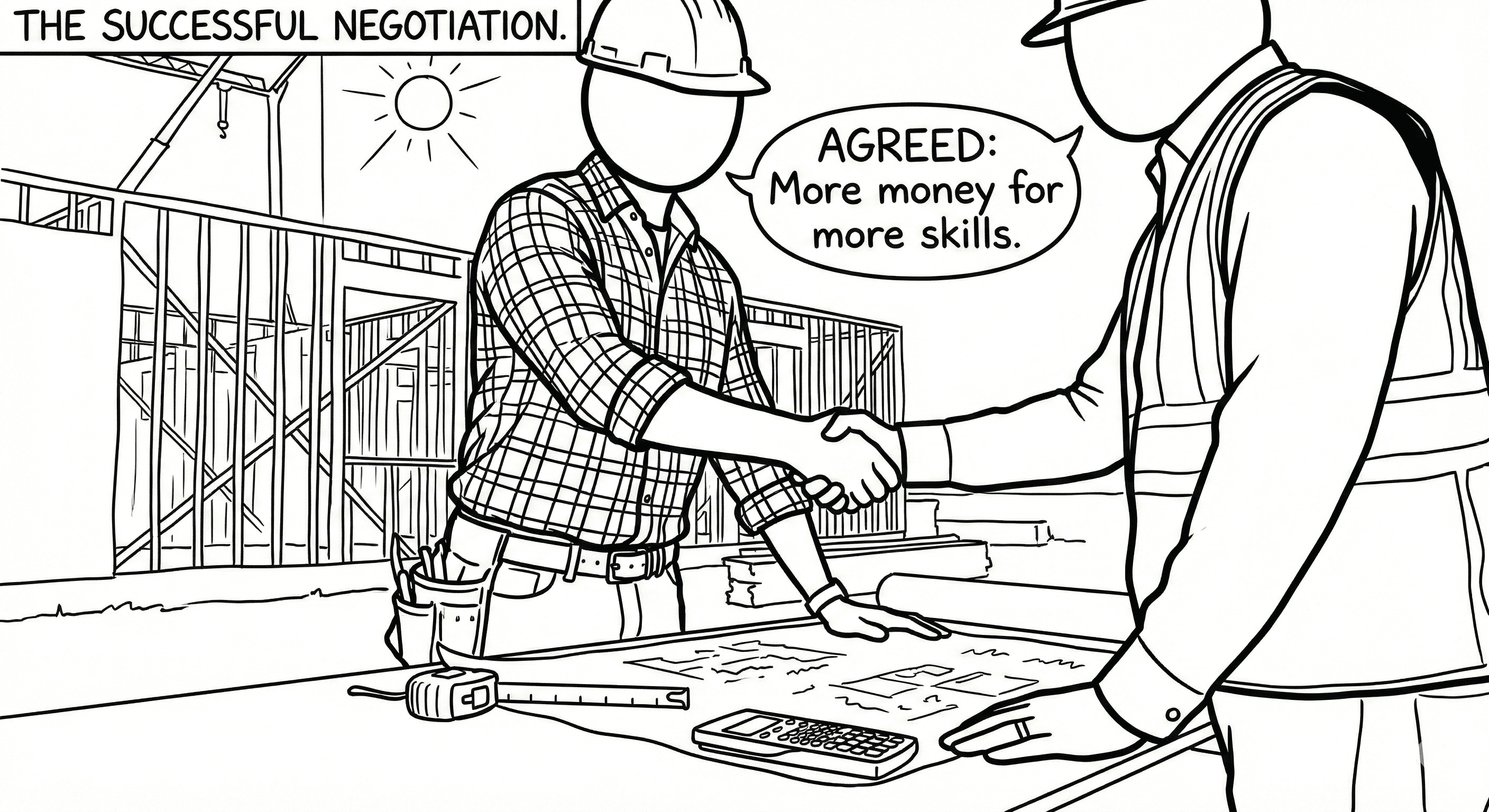
Asking for a pay increase is rarely easy. It feels uncomfortable for most people. In the construction industry, the dynamic is often different that in an office job. You are not sitting behind a desk. You are out in the elements, handling dangerous tools, and physically building the world around you. Your work has a tangible value that is easy to see at the end of the day.
Despite the obvious results of your labor, many skilled carpenters and tradespeople remain underpaid. They might wait for a boss to notice their hard work. In this industry, waiting typically means staying at the same wage for years. The squeaky wheel gets the grease. If you want a higher hourly rate, you typically need to request it.
Negotiating a raise is not about demanding more money because inflation is high. It is about demonstrating that your production value has increased. You need to prove that you make the company more money now than you did when you were hired.
Assessing Your Current Market Value
Before you walk into the trailer or the office to demand a raise, you need data. You must know what your skills are actually worth in your specific location. A journeyman carpenter in Vancouver might make a different rate than one in Dallas.
Start by researching current job listings. Look at what competitors are offering for roles similar to yours. If you are a lead framer, look for "Lead Framer" job posts on boards like ChiselJobs. Note the hourly ranges. If you are earning $28 an hour but the local average is $35 an hour, you have a strong starting point for your argument.
Honest self-assessment is critical here. Do not compare yourself to the top earners if you still struggle with complex roof pitches or intricate stair layouts. Be realistic about your skill set.

Consider the following factors:
Speed and Efficiency: Do you complete tasks faster than the estimated time?
Error Rate: How often does the foreman have to correct your work?
Autonomy: Can you run a crew or work alone without supervision?
Versatility: Can you switch from rough framing to installing cabinets if needed?
If you check these boxes, you are likely underpaid if your wage has not moved in the last year.
Quantifying Your Contribution to the Project
Construction is a business of margins. General Contractors and subcontractors work on tight budgets. When you ask for a raise, you are asking them to increase their overhead. To say yes, they need to see that you are protecting their profit margins.
You need to speak the language of the business owner. Do not just say you work hard. Everyone works hard in the trades. Give specific examples of how you save the company money.
Perhaps you recently caught a layout error in the blueprints before the concrete was poured. That catch saved thousands of dollars in rework. Maybe you figured out a cut list that reduced lumber waste by 15 percent on the last framing job. These are tangible numbers.

Think about your tool inventory as well. In the non-union sector, bringing your own high-end tools adds value. If you invested in a high-quality laser level, a track saw, or a specialized framing nailer that speeds up production, mention it. Your personal investment in better equipment makes the whole crew faster. It reduces the need for the boss to rent or buy that gear.
Highlight your safety record. Insurance is a massive cost for construction companies. If you have been on the job for two years with zero accidents and you actively ensure the apprentices wear their PPE, you are reducing liability. That is worth money.
Timing Your Request Strategically
You could have the best argument in the world, but if you ask at the wrong time, the answer will be no. Construction is cyclical and project-based. Understanding the rhythm of your company is essential.

Avoid asking for a raise when:
A project has just gone over budget.
The company just lost a big bid.
The boss is visibly stressed about a deadline or inspection.
It is the middle of a chaotic concrete pour or crane day.
Look for the wins. The best time to ask is right after you have successfully completed a difficult phase of a project. If you just finished framing a complex custom roof and the inspection passed on the first go, the boss is happy. That is your window.
Seasonal timing matters too. In many regions, the busy season starts in spring. Employers are desperate to lock in good crews before the rush. February or March can be excellent times to negotiate, as owners are planning their labor budgets for the upcoming year.
If you are nearing your one-year anniversary, that is a standard milestone for a performance review. If your company does not do formal reviews, request a brief meeting to discuss your future with the company.
The Conversation: Professionalism and Confidence
When the time comes to talk, treat it like a business meeting. Do not corner your boss at the lunch truck or shout it out over the noise of compressors. Ask for ten minutes of their time at the end of the day or before the shift starts.
Keep your emotions in check. This is not personal. It is a business transaction.
Start by expressing your commitment to the company. Make it clear you like working there and want to stay. This lowers their defenses. They will not feel like you are threatening to quit immediately.
State your case clearly. Use the points you prepared regarding your skills, your safety record, and your production speed.
Be specific with your number. Do not just ask for "more." If you want a $3 raise, ask for $3. If you ask for "whatever you can give me," you might get a quarter.

Example script:
"I enjoy working with this crew and I am committed to our projects. Over the past year, I have taken over the layout duties for the second floor and I have been training the new apprentices on proper blocking techniques. I have also invested in new tools that have sped up our trim work. Based on the local market and my output, I would like to adjust my hourly rate to $32."
Then, stop talking. Let them respond. Silence can be a powerful negotiation tool.
Leveraging Leadership and Soft Skills
Technical skills are the baseline in carpentry. You are expected to know how to measure, cut, and fasten. What truly separates the high earners from the average workers are the soft skills.
Reliability is the number one currency in the trades. If you show up on time every single day, sober and ready to work, you are already ahead of half the workforce. Remind your employer of your attendance record. A worker who is 90 percent skilled but 100 percent reliable is often more valuable than a genius carpenter who calls out sick every Monday.
Leadership capability commands a premium. If the foreman can leave the site for three hours to run errands and know that you will keep the crew moving, you are acting as a lead. You should be paid as a lead.
Point out instances where you solved problems without calling the boss. Did you resolve a conflict between subcontractors? Did you figure out a workaround for a missing material delivery? These actions reduce the stress on the business owner. They pay a premium for peace of mind.
Alternatives When the Cash Isn’t There
Sometimes the answer is genuinely no. The company might be locked into fixed-price contracts and the budget simply does not exist right now.
If they deny the raise, do not get angry immediately. Ask why. Ask what specific benchmarks you need to hit to get that raise in the future.
If the hourly rate cannot move, negotiate other perks. These can sometimes be worth more than a dollar an hour.
Company Vehicle: Getting a work truck or a gas card saves you hundreds of dollars a month in fuel and wear on your personal vehicle.
Tool Allowance: Ask the company to pay for your next major tool purchase or provide a monthly stipend for blades and bits.
Paid Time Off: Many small construction outfits do not offer PTO. Negotiating for a week of paid vacation is a significant win.
Training: Ask them to pay for certifications, such as a crane operator license, welding ticket, or OSHA 30 class. This increases your long-term value.
Setting a Future Review Date
If you do not get the raise or the perks you wanted, you have a decision to make. You can look for another job, or you can set a timeline.
If the boss says "not right now," ask "when?"
Agree on a specific date to revisit the conversation. Three months or six months is standard. Ask exactly what you need to demonstrate during that time to get the 'yes.'
Get this in writing if possible, or at least send a text or email summarizing the conversation. "Thanks for the meeting. I understand the budget is tight. I will focus on increasing my speed on the siding install, and we agreed to review my rate again on June 1st."
This holds them accountable. If June 1st comes around and you have hit those goals but they still refuse to pay, you have your answer. It is time to move on.
Knowing When to Walk Away
Loyalty is a virtue, but it should not cost you your financial future. The construction industry pays for production. If you are producing at a high level and your current employer refuses to compensate you fairly, the market will correct that imbalance.
There are thousands of employers looking for skilled tradespeople. Sometimes the only way to get a significant jump in pay is to change companies.
Do not burn bridges. The trades community is small. If you decide to leave, give proper notice. Finish your current tasks. clean out your gang box, and shake hands. You never know when you might end up on a job site with those people again.
Knowing your worth is the first step. Communicating it clearly is the second. In the trades, you earn every dollar with sweat and skill. Do not be afraid to claim what is yours.