Union vs. Non-Union Carpentry: Which Path is Right for You?

ChiselJobs Team
Published on 12/2/2025
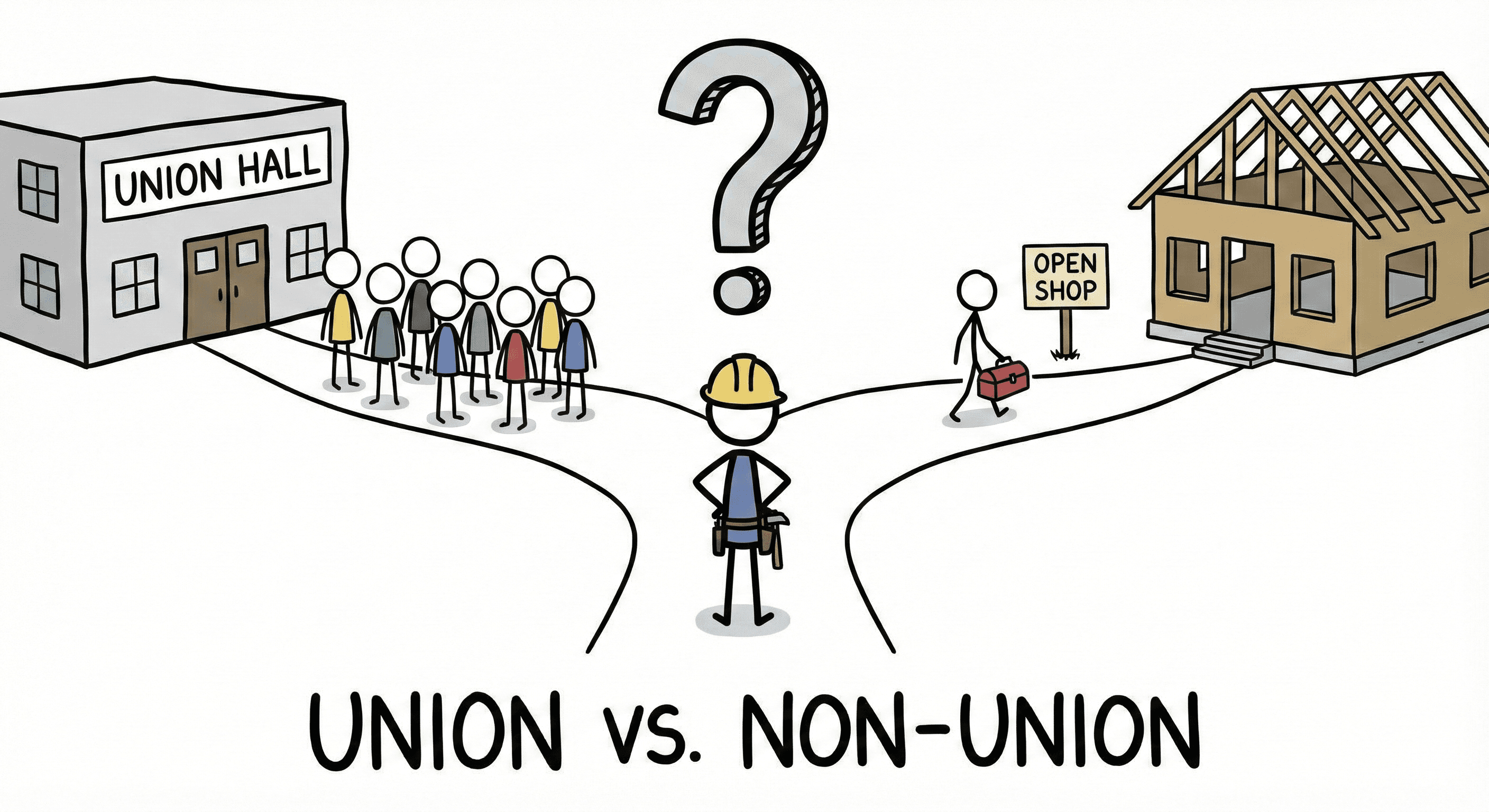
You are standing at a crossroads early in your trade career. In one direction lies the structured, collective power of the union. In the other direction lies the independent, merit-based world of open shop carpentry. This isn't just a choice about who signs your paycheck. It is a decision that dictates your daily work environment, your retirement strategy, and the very specific skills you will master over the next thirty years.
This guide acts as a critical spoke in our comprehensive Career Roadmap Hub, designed to help you navigate the complex terrain of the skilled trades. Whether you are a green apprentice holding a hammer for the first time or a seasoned framer looking for a change of pace, understanding the mechanics of union versus non-union work is essential.
Defining the Players: What is the Carpenters Union?
Before analyzing the paychecks, we must define the two systems. When we talk about "Union" carpentry in North America, we are primarily discussing the United Brotherhood of Carpenters and Joiners of America (UBC). This is a centralized organization that uses collective bargaining to negotiate wages, benefits, and safety standards for its members across specific regions or "Locals."
So, what is a union carpenter? They are tradespeople bound by a Collective Bargaining Agreement (CBA). They do not negotiate their own wages; they rely on the solidarity of the group to set a standard "scale" for everyone. In contrast, non-union (or "Open Shop") carpenters negotiate their own worth directly with the business owner, often valuing individualism and flexibility over standardized protections.
The Financial Breakdown (According to ChiselJobs Data)
The most common argument between carpenters on job sites revolves around money. However, comparing a union pay stub to a non-union pay stub is rarely apples-to-apples. You have to look at the "Total Package."
How Much Do Union Carpenters Make?
Union pay is transparent but complex. According to ChiselJobs’ 2025 Salary Insights, unionized job postings consistently reflect a higher base wage in metropolitan areas compared to their open-shop counterparts.
The Check: This is your taxable hourly wage. In major hubs like Chicago, Seattle, and New York, union journeyman listings average between $35 and $55+ per hour.
The Total Package: This is the real number. It includes your hourly wage plus the contributions the contractor makes on your behalf to the pension, annuity, and health funds.
The Data Gap: Our platform analytics show that while non-union residential listings often cap out at $35–$40/hour for lead carpenters, the total compensation cost for a union carpenter (wages + benefits) often exceeds $75–$100 per hour in strong union markets.

The Cost of Membership: Union Dues
You don't get these benefits for free. How much are carpenters union dues? Based on user-reported data from the Internet (Local 22, Local 1889, Local 272, etc.), dues typically break down into two categories:
Window Dues: A flat monthly fee (usually $20–$30) you must pay whether you are working or not to stay active.
Working Dues: A percentage deduction from your paycheck (typically 3% to 5%) for every hour you work.
Benefits: Pensions and Paid Time Off
Carpentry is physically demanding. Your knees, back, and shoulders are "consumable." This is where the union vs. non-union debate becomes a conversation about long-term survival.
How Much is a Union Carpenter’s Pension Per Month?
There is no single flat rate, but major UBC locals show that pensions are "Defined Benefit" plans based on a credit system.
The Formula: Pension Credits × Years of Service.
Real Numbers: If a Local offers $100 per credit year (a common figure in our data set) and you worked for 30 years, you receive $3,000/month for life.
The Comparison: Conversely, 68% of non-union listings on ChiselJobs for small-to-mid-sized residential companies do not list a defined pension, relying instead on 401(k) matching or higher immediate cash bonuses.

Do Union Carpenters Get Paid Holidays?
Surprisingly, no, not usually. In most Locals, you are paid only for the hours you work. If the job site is closed for Christmas or July 4th, you do not get a check.
The Workaround: Many unions (North Atlantic States Carpenters Benefit Funds, Carpenter Funds Administrative Office) have a "Vacation Fund." The employer pays a few dollars per hour into a separate savings account for you. You receive this as a lump sum check once or twice a year. It is forced savings, not "paid time off" in the corporate sense.
The Daily Grind: What Does a Union Carpenter Do?
Union work is heavily skewed toward commercial, industrial, and infrastructure projects.
Projects: High-rise concrete forming, hospital interiors, bridge decking, scaffolding, and drywall systems.
Specialization: You are often a specialist.
ChiselJobs hiring trends show that union listings frequently ask for specific certifications (like "ICRA" for hospitals or "Scaffold Erector") rather than general carpentry skills.
Non-Union work dominates the residential sector.
Projects: Custom home framing, kitchen remodels, decks, and light commercial.
Generalization: You must be a "Jack of all trades." You might frame in the morning and install cabinets in the afternoon.

Can a Union Carpenter Work Non-Union?
Generally, no. working non-union while holding a union card is often called "working rat" and can lead to fines or expulsion from the union.
The Exception (Salting): Sometimes, a union will authorize a member to get hired by a non-union company specifically to help organize those workers. This is a strategic tactic known as "salting."
Breaking In: How to Join the Carpenters Union
If the union path sounds right for you, the entry process is more formal than simply applying for a job on Craigslist.
How to Join
Locate your JATC: Find the "Joint Apprenticeship and Training Committee" in your area.
Apply: Submit an application during their open recruitment window.
Aptitude Test: Many Locals require a math and reading comprehension test.
Interview: You will face a panel interview to assess your reliability and attitude.
How Hard Is It to Get Into the Carpenters Union?
It depends on the economy. ChiselJobs market data shows a direct correlation between commercial building permit volume and union apprenticeship openings. In boom times, Locals are desperate for bodies. In recessions, the "list" is closed, and it can be very competitive.
Can You Join the Carpenters Union with a Felony?
Yes. The construction trades are known for being a "second chance" industry. The union itself typically does not discriminate based on criminal history.
The Catch: While the union will take you, specific job sites (like schools, government buildings, or nuclear plants) may require background checks that could bar you from entry.
Does the Carpenters Union Drug Test?
Absolutely. Safety is the union's biggest selling point to contractors.
Entry: Expect a drug test when you are accepted into the apprenticeship.
Job Site: Many large commercial sites have mandatory pre-access drug screening and random testing policies. If you fail, you are often suspended from the bench.

Assessing Your Personality and Career Goals
There is no single "correct" choice. The right path depends on your temperament and your life goals.
Choose the Union Path if:
You live in a "strong union state" (like IL, NY, WA, or CA) where the wage gap is largest.
You value long-term stability and a guaranteed pension.
You prefer a structured environment where rules and pay scales are black and white.
Choose the Non-Union Path if:
You love the variety and artistry of residential custom building.
You want to start your own contracting business (residential offers better "general" training).
You prefer negotiating your own pay based on your personal hustle and speed.

Looking for verified carpentry jobs across the U.S. and Canada? Explore opportunities on ChiselJobs, the job board built for skilled trades.