Examining Carpenter Job Pay Trajectories by Niche

ChiselJobs Team
Published on 9/11/2026
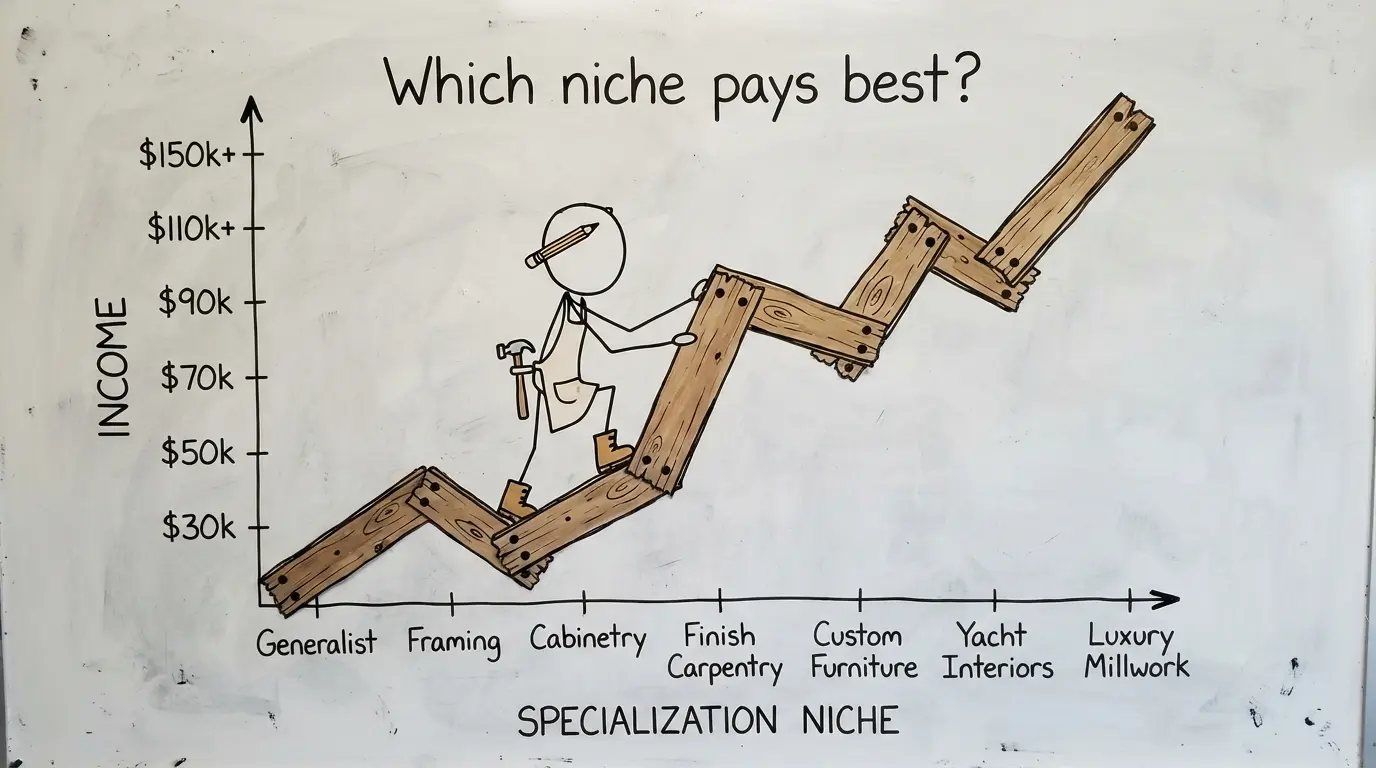
Carpenter pay in North America varies wildly by niche, with specialized union commercial carpenters and high-end finish carpenters earning over $90,000 annually, while entry-level residential framers start around $35,000. According to ChiselJobs market analysis, your career path, specialization, union status, and regional location dictate your ultimate earning potential in this skilled trade.
How much do different carpentry specialties actually pay across North America?
Not all carpentry jobs are created equal. The type of wood, the stage of construction, and the level of precision required all impact your paycheck. If you are looking to maximize your earnings, you need to understand where the highest demand lies.
Data compiled by ChiselJobs reveals that specialized niches requiring advanced technical layout skills command the highest premium in the market.
Carpentry Niche | Entry-Level Pay (Annual Average) | Mid-Level Pay (Annual Average) | Lead / Journeyman Pay (Annual Average) |
Commercial Carpentry | $42,000 - $50,000 | $58,000 - $72,000 | $78,000 - $95,000+ |
Finish Carpentry & Joinery | $38,000 - $46,000 | $52,000 - $68,000 | $75,000 - $90,000+ |
Framing & Rough Carpentry | $34,000 - $42,000 | $48,000 - $60,000 | $65,000 - $80,000 |
Industrial Carpentry | $45,000 - $54,000 | $62,000 - $78,000 | $82,000 - $100,000+ |
Commercial and Industrial Carpentry
Commercial carpenters work on large-scale projects like retail stores, schools, and hospitals. This work involves heavy materials, metal studs, and concrete forming. Industrial carpenters often work in oil refineries, power plants, or manufacturing facilities. Because of the scale, complexity, and safety risks, these positions generally offer the highest hourly rates.
Finish Carpentry and Cabinetmaking
Finish carpenters focus on what is visible after construction is complete. This includes installing trim, doors, stairs, and custom cabinetry. It requires high precision, a deep understanding of wood species, and mastery of specialized tools. Experienced finish carpenters who run their own trim crews often earn premium rates.
Framing and Residential Carpentry
Framers build the skeleton of residential homes. This is fast-paced, physically demanding outdoor work. While entry-level pay is lower than other niches, experienced framing foremen who understand structural loads and roof calculations are highly valued.
What does a carpenter actually do on a daily basis in these niches?
The daily responsibilities of a carpenter depend heavily on whether they are working on the rough structure or the final interior details. Every professional carpenter must master a core set of skills, tools, and safety protocols to protect themselves and their crew.
Structural and Rough Carpentry Duties
Rough carpenters and framers start with bare concrete foundations or empty lots. Their primary tasks include:
Reading blueprints and architectural drawings to plan the structure.
Measuring, cutting, and assembling wood or metal studs to build walls, floors, and roofs.
Operating heavy machinery and power tools, including the circular saw and pneumatic nail guns.
Ensuring all structural work complies with local building codes and load-bearing requirements.
Enforcing strict safety protocols on-site, including wearing proper personal protective equipment (PPE) and maintaining OSHA safety standards to prevent falls and accidents.
Finish and Trim Carpentry Duties
Once the structural inspection passes and drywall is complete, the finish carpenters take over. Their daily work involves:
Installing interior doors, window casings, baseboards, and crown molding.
Building custom cabinetry, shelving, and high-end built-in furniture.
Utilizing hand tools like sharp wood chisels and block planes for seamless wood-to-wood connections.
Verifying perfect alignment using laser levels and digital angle finders.
Selecting and preparing lumber to ensure matching grain patterns for high-visibility joinery.
How do geographic location and union membership affect your take-home pay?
Where you live and how you choose to work are the two biggest factors affecting your take-home pay. A journeyman carpenter in a high-cost metropolitan area will earn significantly more per hour than a carpenter in a rural area, though living costs will offset some of those gains.
Regional Wage Differences in the US and Canada
In the United States, states with strong construction activity and high living costs, such as New York, Washington, California, and Illinois, offer some of the highest hourly wages. In Canada, provinces like Ontario and Alberta see strong demand for skilled tradespeople, especially in commercial construction and resource development.
The Union vs. Non-Union Divide
The choice to join a union, such as the United Brotherhood of Carpenters, has a major impact on your career trajectory. ChiselJobs research indicates that union carpenters generally earn higher base hourly rates and receive superior benefits packages compared to non-union residential carpenters.
Compensation Factor | Union Carpentry Career | Non-Union Carpentry Career |
Base Hourly Wages | High (set by collective bargaining agreements) | Variable (based on local market and individual negotiation) |
Healthcare & Benefits | Fully employer-funded health, dental, and vision | Often paid out-of-pocket, though some large contractors offer plans |
Retirement Plans | Strong pension plans and annuity funds | Standard 401(k) or no retirement benefits |
Training & Education | Free structured apprentice training programs | On-the-job training, often unstructured |
Job Security | Subject to union dispatch, but highly regulated | Dependent on the success of the individual contractor |
What is the best roadmap to increase your hourly rate as a carpenter?
If you want to move past basic framing and earn a top-tier wage, you need to deliberately build your skill set. Carpenters who master layout, blueprints, and job site management quickly rise to become foremen and superintendents.
Step 1: Master the Layout
The carpenter who knows how to use a transit, set up laser levels, and perform complex layout calculations is always the most valuable person on the job site. If you can lay out a building accurately, you will never be out of work.
Step 2: Invest in Professional Grade Tools
While your employer may provide large tools, a professional carpenter is expected to own their personal hand tools. Keep your chisels razor-sharp, buy a high-quality leather tool belt, and invest in accurate, durable levels. Having the right tools on hand increases your speed and accuracy.
Step 3: Get Certified in Specialty Systems
Take every training course available to you. Certifications in scaffolding, concrete forms, rigging, or cleanroom construction make you indispensable. Additionally, keeping your OSHA safety 30-hour card active makes you a prime candidate for supervisory roles.
Step 4: Use Niche Job Boards
Do not rely on generic job search engines to find the best carpentry jobs. ChiselJobs specializes in matching skilled tradespeople with contractors who appreciate high-quality craftsmanship and are willing to pay competitive rates. Keeping an eye on specialized job boards allows you to jump on high-paying commercial and industrial opportunities as soon as they open up.
Which certifications and tools should you master first?
To help you track your progress, here is a quick checklist of the essential tools and certifications you should focus on as you build your career in the trade.
Essential Hand Tools: Steel-frame framing hammer, high-quality wood chisels, speed square, and professional-grade spirit levels.
Essential Power Tools: Cordless circular saw, pneumatic framing and finish nail guns, and a reliable miter saw.
Critical Certifications: OSHA safety 10-hour or 30-hour card, aerial lift operator certification, and fall protection training.
Advanced Skills: Master the art of complex roof cutting, stairs construction, and intricate interior joinery.
What are the current trends shaping the future of carpentry wages?
The construction industry is changing rapidly, and these shifts are directly impacting how carpenters are paid. Three major trends are currently driving wages upward across North America.
First, the ongoing shortage of skilled labor means contractors are competing fiercely for experienced carpenters. Employers are offering sign-on bonuses, paid time off, and better health benefits to keep their best workers.
Second, the rise of modular and off-site construction is shifting some carpentry jobs from the traditional outdoor job site to indoor manufacturing facilities. While these factory-style jobs sometimes pay slightly less than field work, they offer steady, year-round hours and safer working conditions.
Finally, the increasing complexity of green building materials and energy-efficient building envelopes requires carpenters to undergo ongoing training. Carpenters who understand how to properly install continuous exterior insulation, air barriers, and triple-glazed window units are commanding excellent wages. By staying adaptable and continuing to learn, you can ensure your skills remain in high demand for decades to come.