Carpenter Jobs in Denver, Colorado: Market Breakdown

ChiselJobs Team
Published on 6/21/2026
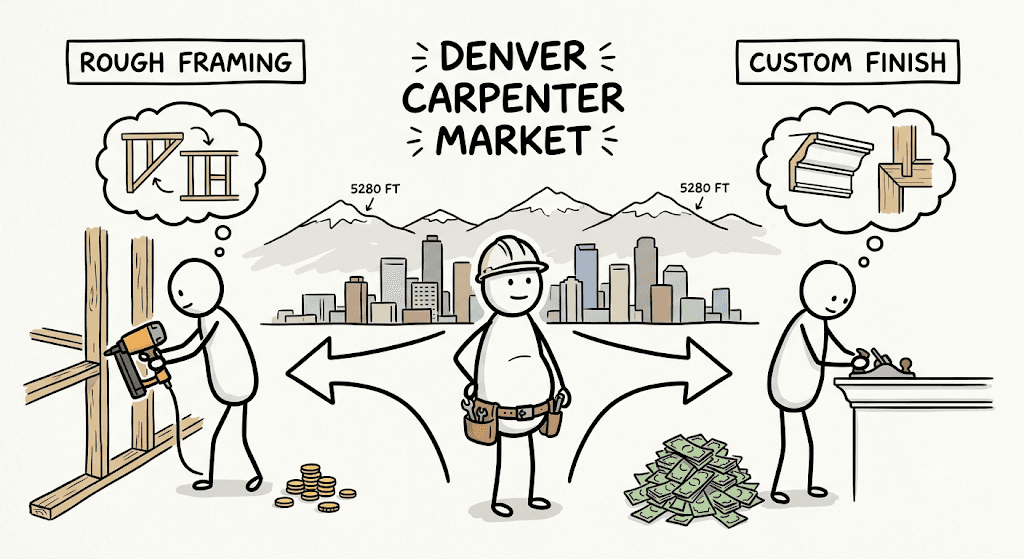
Denver is a booming market for skilled tradesmen. From massive commercial developments rising downtown to residential expansions in the suburbs, the demand for precise, reliable carpentry is relentless. For a craftsman ready to strap on a tool belt and put in the hours, the Front Range offers a solid living and plenty of room to grow.
If you take pride in a plumb wall, a perfectly mitered casing, and a job done right the first time, this market breakdown will give you the lay of the land. At ChiselJobs, we know that finding the right crew and the right pay rate requires accurate, street-level information. We have gathered the essential details on wages, local demand, and licensing to help you map out your career in Colorado.
Gauging the Paycheck: Denver Salary Insights
Money talks on the job site. In the Denver metro area, the compensation for carpenters reflects the high demand and the cost of living. Whether you are swinging a hammer for a local residential builder or managing a commercial framing crew, the pay scale offers a clear path upward.
Average Earnings and Experience Levels
Apprentices and Entry-Level: Those just learning the ropes, mastering layout basics, and getting comfortable with a circular saw can expect to make around $25 to $26 per hour. Annualized, this sits near $50,000 to $54,000.
Journeyman Level: Once you have a few years under your belt, understand complex roof framing, and can independently execute finish carpentry, the average hourly wage bumps up to $29 to $31. The average yearly salary for a solid mid-level carpenter in Denver hovers right around $61,000 to $65,000.
Lead Carpenters and Foremen: If you can read blueprints, manage a crew, ensure OSHA safety compliance, and handle site logistics, you are looking at $33 to $35 per hour or more. Top earners and specialized craftsmen easily pull in over $75,000 a year.
Union Versus Non-Union Opportunities
Colorado is traditionally a strong market for open-shop contractors, meaning non-union opportunities are abundant. However, the United Brotherhood of Carpenters maintains a solid footprint in the commercial and industrial sectors. Union jobs often come with standardized pay scales, robust health benefits, and structured pension plans. Non-union shops might offer more flexibility and the chance to rapidly climb the ranks based on raw skill and hustle.
High-Paying Suburbs and Nearby Hubs
Denver itself is just the center of the action. Several surrounding cities frequently post higher-than-average wages to attract reliable talent:
Golden: Up to $32 per hour for experienced tradesmen.
Centennial: Averaging around $30 to $31 per hour.
Fort Collins: A strong northern market offering near $30 per hour.
Boulder: High end residential remodels keep wages competitive, often exceeding $30 per hour.
Daily Life on the Job Site
Carpentry is not a single job; it is a massive trade with distinct specialties. A job description in Denver will vary wildly depending on the contractor you sign on with.
Framing and Structural Work
Rough carpenters are the backbone of the Denver housing boom. You will spend your days doing layout, erecting walls, framing roofs, and installing floor joists. You must be comfortable working at heights and deeply familiar with local building codes to ensure structural integrity.
Essential Skills: Rafter calculation, reading blueprints, understanding load-bearing requirements.
Primary Tools: Framing nailers, speed squares, chalk lines, heavy duty circular saws.
Finish Carpentry and Custom Joinery
If you work in high-end neighborhoods like Cherry Creek or Boulder, finish carpentry is where the real money sits. This work demands a lighter touch and an obsessive eye for detail. You will be installing baseboards, crown molding, custom cabinetry, and intricate stair rails.
Essential Skills: Scribing, coping joints, flawless measuring, understanding wood movement.
Primary Tools: Compound miter saws, block planes, chisels, laser levels, brad nailers.
The Work Environment and OSHA Compliance
Denver weather is notoriously unpredictable. A framing crew might be dealing with a snowstorm one day and blistering sun the next. Employers expect you to show up ready to work regardless of the elements. Furthermore, reputable contractors take safety seriously. Familiarity with OSHA safety standards regarding fall protection, scaffolding, and proper personal protective equipment is mandatory. Being a safe worker makes you a valuable worker.
Navigating the Colorado Licensing Maze
Colorado handles contractor licensing differently than most states. There is no unified, state-wide general contractor license or carpentry license. Instead, the state allows individual municipalities to set their own rules.
City-by-City Requirements
If you are strictly working as an employee for an established company, you do not need to worry about holding a personal license. Your employer covers the insurance, the permits, and the liability.
If you plan to branch out on your own, pull permits, and run jobs as a general contractor or subcontractor, you must navigate local regulations:
Denver: The city operates on a two-step system. You first need a Supervisor Certificate, which requires proving your experience and passing an International Code Council exam. After that, you can apply for a specific Contractor License class based on the size and type of buildings you intend to work on.
Boulder: Requires a specific city contractor license and proof of ICC certification, along with strict insurance requirements.
Colorado Springs: Known for having very minimal licensing requirements for basic carpentry, though you still need insurance and must follow local code enforcement rules.
Always check with the local building department before bidding a job or starting a project. Ignorance of the local code is never a valid excuse for poor work.
Building Your Career with ChiselJobs
The Denver market rewards craftsmen who show up early, work hard, and continually refine their skills. Whether you are an apprentice eager to learn the geometry of a hip roof or a seasoned foreman looking for a better crew, the opportunities are waiting.
We built ChiselJobs to connect dedicated tradesmen with contractors who respect the craft. Keep your tools sharp, stay updated on the latest building codes, and never stop learning. The Front Range needs builders, and your next opportunity is just one solid connection away.