Job Requirements for a Carpenter: Certifications Needed Now

ChiselJobs Team
Published on 2/21/2026
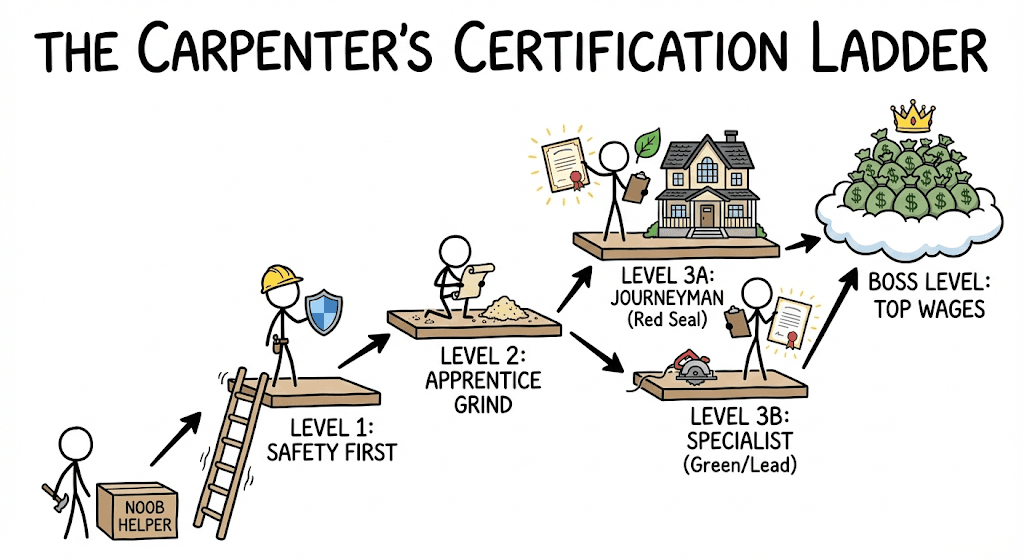
Job Requirements for a Carpenter: Certifications Needed Now
At ChiselJobs, we see the daily data coming straight from hiring managers and general contractors across North America. The verdict for 2026 is crystal clear. The construction industry is booming, but employers are no longer just looking for a warm body with a customized tool belt. They want verifiable proof of your expertise.
While holding a basic high school diploma is the standard baseline to enter an apprenticeship, it is only the beginning of your educational journey. The Bureau of Labor Statistics occupational outlook for carpenters clearly shows that those who pursue formal training secure higher wages and better job security. Whether you are snapping chalk lines for complex framing layouts, interpreting strict building codes, or coping baseboards with precision chisels, your skills need documentation. If you want to command top-tier wages and secure the best roles on a major construction project, you need the right credentials. This guide breaks down the exact carpenter certifications required to elevate your career from a basic helper to a highly paid professional.
The Baseline of Workplace Safety
Before you ever plug in a circular saw or load a coil into your nail gun, contractors need to know you are not a liability. Workplace safety certifications are the absolute minimum barrier to entry on any commercial, industrial, or high-end residential site. Modern job sites are dynamic and dangerous environments, requiring rigorous safety measures to consistently protect workers from severe injury.
Navigating Regulatory Standards in the United States
For carpenters working in the United States, the Occupational Safety and Health Administration sets the rules. It is vital to understand that construction has its own specific OSHA standards (Part 1926), which differ significantly from those governing general industry (Part 1910). Proper safety training ensures you comply with these strict, trade specific regulations.
OSHA 10 Hour Construction: This is the baseline credential for entry level construction workers. It covers the fatal four hazards on a job site, including electrocution, struck by incidents, caught in between accidents, and the ever present fall hazard. You can find accredited trainers through the official OSHA Outreach Training Program directory.
OSHA 30 Hour Construction: If you want to be a foreman or site superintendent, this extended certification is mandatory. It provides a deep dive into hazard recognition and scaffolding erection. It is highly respected by dedicated safety professionals managing large scale operations.
Proper PPE Usage: Knowing how to use personal protective equipment ppe is just as important as owning it. The National Institute for Occupational Safety and Health (NIOSH) construction safety program provides excellent free resources on selecting the right hard hats, cut resistant gloves, and safety glasses for your specific crew. You can also review comprehensive hazard mitigation strategies in the OSHA Training and Reference Materials Library.
Canadian Safety Benchmarks
If you are swinging a hammer in Canada, particularly in active markets like Vancouver, British Columbia, safety requirements are strictly enforced.
SiteReadyBC: This is the standard orientation program ensuring workers understand basic site hazards before they step onto a commercial build. You can register for this mandatory credential through the BC Construction Association's SiteReadyBC portal.
Fall Protection Certification: Carpenters spend a massive amount of time working at heights. Certified fall protection training is a non negotiable legal requirement across all provinces to prevent catastrophic falls from roof trusses or scaffolding.
Earning Your Professional Trade Status
Once your safety tickets are sorted, the next goal is proving your technical mastery. Your journeyman ticket is your most valuable asset. It proves you have mastered the physical tools of the trade, from laser levels and speed squares to complex joinery techniques.
The Interprovincial Red Seal Program
For Canadian carpenters, the Red Seal endorsement is the ultimate standard of excellence. It allows tradespeople to work seamlessly across provinces and territories without needing to pass additional regional exams. You can learn exactly how to register your training agreement and apply for financial aid through the official Canadian Government Skilled Trades and Apprenticeship portal.
To earn a Red Seal in carpentry, you must complete a rigorous apprenticeship. You will be tested heavily on structural framing, exterior finishing, and interior installations. You must also prove you can navigate complex municipal regulations. In the United States, mastering these rules often means studying the comprehensive standards set by the International Code Council (ICC), which form the backbone of local building regulations.
Advanced Credentials for Remodelers and Leaders
If your goal is to move off the framing crew and into management, specialized leadership certifications will set you apart from the competition.
The NARI Certified Lead Carpenter Designation
The National Association of the Remodeling Industry offers a highly respected credential. A lead carpenter is a hands on professional who oversees the entire technical aspect of a project.
To qualify, you need at least five years of continuous field experience. You must pass a comprehensive exam testing your knowledge of project scheduling and client communication. You can review the full eligibility requirements and exam prep materials on the NARI Certified Lead Carpenter official page. Holding a certification of this caliber proves you can take a set of plans, manage a crew of specialized sub trades, and deliver a flawless finish carpentry package on time and under budget.
Niche Skills to Boost Your Long Term Pay Grade
General carpentry will always provide a steady paycheck. However, acquiring niche certifications allows you to bid on specialized, high margin projects, securing your long term earning potential in a shifting market.
Green Building and Energy Efficiency: The Building Performance Association offers incredible training for carpenters wanting to tighten building envelopes. By understanding advanced insulation techniques and vapor barriers, you help clients achieve massive energy savings while actively reducing the greenhouse gas emissions of the built environment.
Lead Safe Certification: If you work in residential remodeling, you will frequently encounter lead paint. The Environmental Protection Agency requires specific certifications to safely disturb and dispose of lead-based materials without contaminating the site. You can apply for your firm's credentials directly through the EPA Lead Safe Certification portal.
Taking Control of Your Carpentry Career
The construction sector heavily rewards ambition. Employers on ChiselJobs are actively filtering resumes for candidates who invest in their own education. Relying solely on field experience is no longer enough to secure the top tier salaries in 2026.
Start by auditing your current credentials. Ensure your safety tickets are up to date and physically in your wallet. If you are an apprentice, focus entirely on logging your hours and mastering your hand tools. The verified credentials on your resume are what ultimately dictate your hourly rate.