How to Become a Carpenter: A Step Guide That Works in 2026

ChiselJobs Team
Published on 11/16/2025
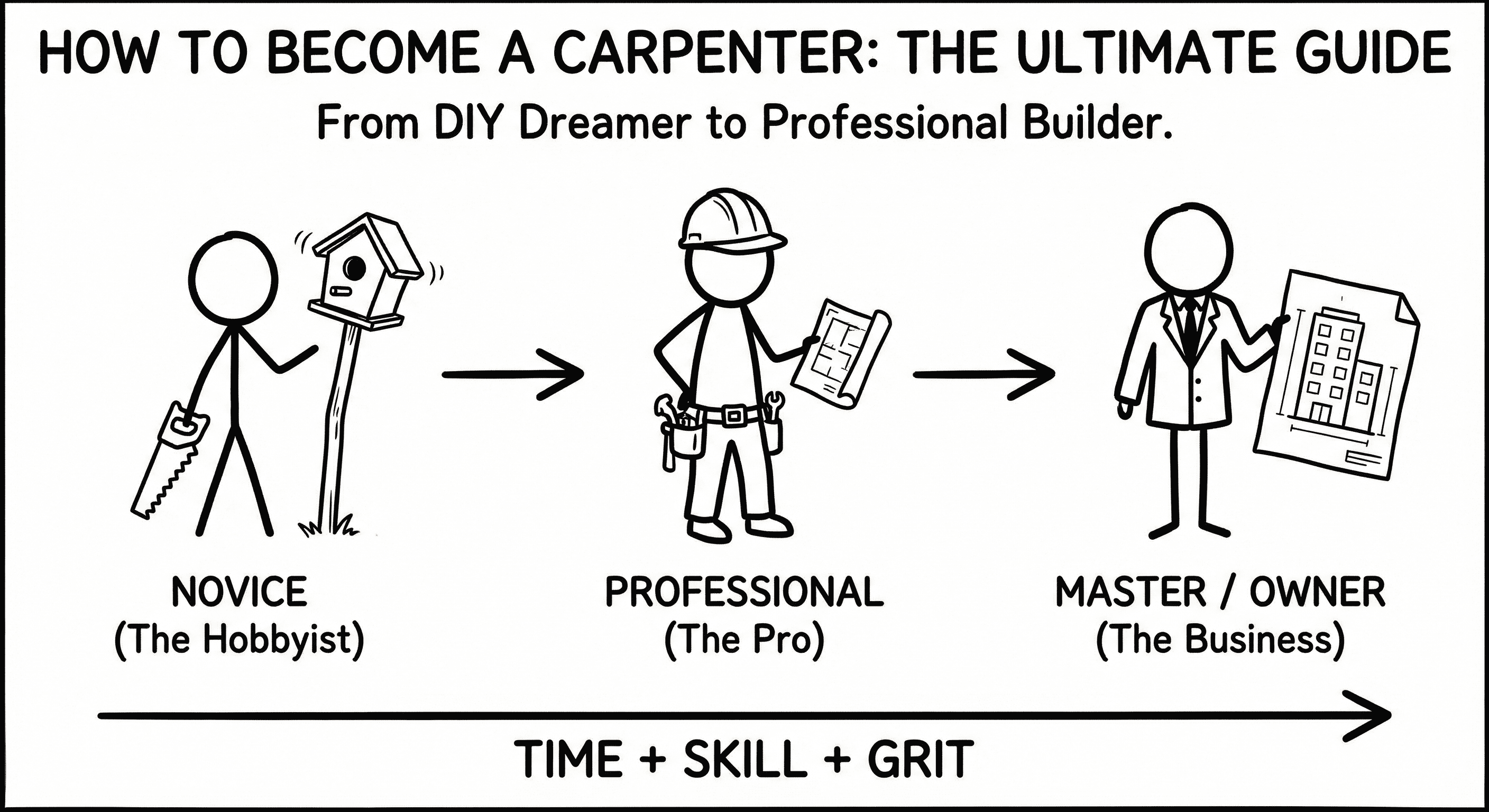
Carpentry remains the backbone of the North American construction industry. While technology changes how we manage projects, the fundamental need for skilled hands to frame structures, pour concrete forms, and install complex finish work has never been higher. For those considering this trade, the pathway is not just a job application. It is a structured journey of skill acquisition, physical discipline, and technical mastery.
Because the trade has evolved to include advanced technology and complex geometry, many entering the field wonder how the profession is viewed today. Explore our deep dive on Is a Carpenter a Blue Collar Job?to see how modern job sites are redefining traditional labels.
This comprehensive guide breaks down the reality of the trade. We move beyond the basic job description to explore the specific educational requirements, the critical decision between union and open-shop pathways, and the long-term career trajectory for a modern carpenter.
If you are staring at job boards that demand three years of site time and wondering how to break in, check out our tactical guide on How to Get Carpenter Jobs with No Experience to learn exactly what contractors are looking for from a greenhorn.
The Chain of Command: From Greenhorn to Master
Understanding the hierarchy of a construction site is critical. You will not be cutting complex roof rafters on day one. You have to earn the right to touch the expensive materials. Here is the standard progression path in the North American building trades.
The Carpenter Assistant (The Laborer)
If you enter the trade without a formal union apprenticeship, you will likely start here. Your job is pure logistics and support. You will spend your days unloading lumber, organizing the cut station, sweeping the site, and handing tools to the lead carpenters. It is physically grueling, but it is your chance to observe how a site operates and prove your work ethic.
A lot of greenhorns walk onto the job site expecting to frame walls immediately, only to spend eight hours moving heavy plywood. If you want to survive your first shift and earn the respect of your crew lead, you need to know exactly what is coming. Dive into our complete hour by hour breakdown of carpenter assistant job duties on day one so you can show up fully prepared and ready to work.
The Apprentice (The Sponge)
An apprentice is officially enrolled in a training program, either through a union like the United Brotherhood of Carpenters or an open-shop contractor program. You are splitting your time between classroom instruction and paid on-the-job training. You will start handling power tools, performing basic framing layout, and learning building codes. You are expected to ask questions and absorb everything the veterans tell you.
But before you can start logging official hours and learning wall layout, you actually have to land the job. Navigating union local intakes or finding an open-shop sponsor comes down to knowing the exact hiring windows. If you are ready to get your paperwork sorted and secure your spot on a crew, read our complete guide on where and when to apply for carpentry apprenticeship programs.
The Journeyman Carpenter (The Backbone)
After logging roughly 6,000 to 8,000 hours of swinging a hammer and passing your trade exams, you achieve Journeyman status. You are now a fully certified professional capable of working unsupervised. You can read complex blueprints, frame an entire house, and troubleshoot structural issues. In major metropolitan areas, a skilled Journeyman can easily command top-tier wages and comprehensive benefits.
For a complete breakdown of the hours, testing, and requirements needed to reach the top of the pay scale, read our detailed guide: What is a Journeyman Carpenter? The Path to Full Certification.
The Master Carpenter and Superintendent (The Brains)
This is the pinnacle of the trade. Master carpenters possess decades of experience and can execute the most complex architectural designs flawlessly. At this level, many transition into Superintendent roles. You put down your personal tool belt and take over the entire project, managing schedules, enforcing OSHA safety protocols, and coordinating other trades like plumbers and electricians to keep the build profitable.
Deconstructing the Trade: Rough vs. Finish
A common misconception is that all carpenters do the same work. in reality, the trade is generally divided into two main disciplines: the structural builders (Rough) and the detail specialists (Finish).
The Rough Carpenter (The "Bones")
Rough carpenters are responsible for the structural integrity of the building. They work with dimensional lumber, engineered I-joists, and steel studs to create the frame.
Structural Framing: Erecting walls, floors, and roof systems.
Concrete Formwork: Building the molds for foundations and footings.
Exterior Envelope: Installing sheathing and weather-proofing systems.
The Vibe: Heavy lifting, speed, production, and working outdoors in all weather.
The Finish Carpenter (The "Showcase")
Finish carpentry job duties focus on the visible woodwork completed toward the end of a project. As a finish specialist, your work is what the client actually sees and touches.
Interior Trim: Cutting and installing baseboards, crown molding, wainscoting, and window casings with zero gaps.
Door & Window Hardware: Hanging doors with precise reveals and installing locksets.
Cabinetry & Built-ins: Setting kitchen cabinets, mantels, and custom shelving units.
Stair Construction: Installing treads, risers, and intricate handrail systems.
The Vibe: Precision, patience, indoor work ("dried-in"), and a "game of millimeters" where every joint must be seamless.
If you are ready to take your chosen specialty to the highest possible level, you need to understand the exact steps required to get your official credentials.
Essential Prerequisites Before You Step on Site
You do not need a university degree to succeed in this field, but you do need a specific set of intellectual and physical capabilities. Most employers and apprenticeship programs require a high school diploma or GED as a baseline. Beyond that, the trade relies heavily on applied mathematics.
Learn the exact structural layout, custom finish carpentry, and code compliance keywords that top general contractors look for on winning resumes here.

The Math Behind the Craft
Carpentry math is non-negotiable. If you cannot calculate, you cannot build. Daily tasks require:
Fractional Arithmetic: Adding and subtracting 1/16ths and 1/8ths rapidly without a calculator.
Geometry: Using the Pythagorean theorem (3-4-5 method) to square up walls and foundations.
Unit Conversion: Switching between decimal feet and inches, or metric and imperial systems in Canadian border regions.
Volume Calculation: Determining cubic yards for concrete pours.
Physical Conditioning

The job site is an athletic environment. You will be climbing scaffolding, working on knees, and lifting materials overhead. Stamina is just as important as strength. Weather conditions add another layer of difficulty. Carpenters work in freezing rain, scorching heat, and mud. Mental toughness is required to maintain safety and quality standards when the environment is fighting against you.
Choosing Your Path: Organized Labor vs. Open Shop
One of the first strategic decisions an aspiring carpenter faces is the choice of training environment. Both pathways lead to journey level status, but the methods and compensation structures differ.
The Union Route (UBC)
Joining the United Brotherhood of Carpenters (UBC) creates a highly structured career path.
Training: Joint Apprenticeship Training Committees (JATCs) run rigid programs involving 3 to 4 years of schooling paired with on-the-job training.
Benefits: Union members typically enjoy defined pension plans and comprehensive health coverage.
Pay Scale: Wages are collectively bargained. First-year apprentices often start at a percentage (usually 40 to 50 percent) of the journey worker rate, with guaranteed raises every 6 to 12 months upon completing hours.
Scope: Union carpenters are prevalent on large commercial jobs, bridges, infrastructure, and high-rise projects.
The Merit Shop (Non-Union) Route
Working for an independent general contractor or subcontractor offers different advantages, often allowing for immediate entry into the workforce.
Entry-Level Access: unlike the rigid application windows of unions, many contractors hire year-round. You will likely start as a Carpenter Helper, where you will focus on material handling, site cleanup, and safety basics while watching how the pros work.
Flexibility: You may have more variety in residential and light commercial work, learning "ground-up" building rather than specializing in just concrete or just drywall.
Speed: Advancement is often based on merit rather than hours logged. A fast learner can negotiate higher pay more quickly.
Earnings: While starting pay varies, recent ChiselJobs data indicates non-union apprentices earn between $17 and $23 per hour.
Ready to talk numbers and trade-offs? Choosing between a union card and an open shop is one of the biggest career decisions you will make as a tradesman. Both paths can build a solid future, but they require a completely different strategy. If you want a deep dive into the actual hourly rates, healthcare packages, and real-world rules of organized labor, read our full breakdown on Carpenter Labor Union Benefits: Is It Worth Joining? to see which environment fits your personal goals.
Building Your Loadout: Essential Gear for Day One
A carpenter is useless without their tools. While employers provide large equipment like table saws and compressors, you are expected to have your own "bags" (tool belt) fully stocked.
The Mandatory Starter Kit:
Tape Measure: 25-foot or 30-foot "fat max" style tapes are industry standard.
Speed Square: The Swanson or Empire rafter square is essential for marking cuts and guiding saws.
Hammer: A 19 to 22-ounce framing hammer. Titanium handles are popular for reducing elbow fatigue.
Chalk Line: For snapping layout lines on subfloors.
Utility Knife: With a quick-change blade mechanism.
Cat’s Paw: A nail puller for correcting mistakes.
Pencils: Carpenter pencils that won't roll away.
As you advance, you will invest in power tools. The cordless revolution has changed the job site. Impact drivers, circular saws (both sidewinder and worm drive styles), and reciprocating saws are now personal tools for many professionals.
Learn exactly how to upgrade your safety kit and stay ahead of the curve by reading our complete guide on Carpenter Safety Requirements: 2026 OSHA Updates and Wearables.
Mastering the Mental Game: Prints, Layout, and Code
The difference between a laborer and a carpenter is the ability to look at a 2D drawing and visualize a 3D structure.

Blueprint Literacy You must learn to navigate architectural sheets (A-series) and structural sheets (S-series). This involves interpreting:
Floor Plans: Looking down from above to see wall locations.
Elevations: Looking at the building from the side to understand heights and exterior finishes.
Section Views: A "slice" through the building showing how the foundation connects to the frame.
Check out our latest blog post about how to read blueprints here.
The days of fighting the wind with a torn set of paper plans are ending. Today, top carpenters use tablets and 3D models to spot layout clashes before the first board is even cut. Ready to step up your game and earn a lead framing spot? Read our full breakdown on Blueprint Reading for Carpenters: Mastering Digital Layouts and BIM.
Building Codes In the U.S., the International Residential Code (IRC) and International Building Code (IBC) govern how we build. In Canada, the National Building Code (NBC) sets the standard. You must know fastener schedules (how many nails per stud), span tables (how far a joist can run without support), and egress requirements (window sizes for fire escape).
Layout Techniques Layout is the highest skill in the rough carpentry phase. It involves marking the "plates" (top and bottom of walls) to show exactly where every stud, door header, and window cripple goes. Good layout minimizes waste and ensures the drywallers and plumbers who follow you have an easy job.
Crossing the Threshold: Journey Level and Red Seal Certification
After logging your hours—typically 6,000 to 8,000 depending on the region—you reach a critical milestone.

United States: Journey Level Status
In the U.S., completing your apprenticeship makes you a "Journeyman" or "Journey Level Carpenter." While carpentry itself is not federally licensed like plumbing or electrical work, your status is recognized by unions and employers nationwide.
Earning Power: Journey level workers in major metros like Boston, Seattle, or San Francisco can command wages exceeding $48 per hour plus benefits.
Licensing: If you plan to work independently, you will likely need a state Contractors License Board (CSLB) license, which requires passing law and trade exams.
Canada: The Red Seal Endorsement
Canada has a highly integrated system known as the Red Seal Program.
Process: After completing a provincial apprenticeship (approx. 7,200 hours), you take the Interprovincial Standards Red Seal Examination.
Mobility: Passing this exam allows you to work in any province or territory without re-certifying.
Value: Red Seal carpenters are viewed as the gold standard of the trade, often earning between $34 and $46 CAD per hour.
Beyond the Tools: Career Advancement Opportunities
Carpentry is rarely a dead-end job. It is a launchpad. Because carpenters touch every phase of a project from foundation to finish, they make the best leaders.

Common Career Trajectories:
Lead Carpenter: Runs a small crew, handles material take-offs, and solves immediate site problems.
Foreperson: Manages large crews, coordinates with other trades (electricians, plumbers), and handles timecards.
Superintendent: The on-site boss of the entire project. Responsible for the schedule, safety enforcement, and quality control.
Estimator: Moves to the office to calculate costs and bid on new projects.
Project Manager: Oversees the financial and client-facing side of construction.
Structuring Your Career: Employee vs. Business Owner
As you advance in the trade, you will eventually face a financial fork in the road: remaining a W-2 employee or becoming an independent service provider.

Employee (W-2): You trade your time for a steady paycheck, benefits, and tax withholding managed by your employer.
Independent Contractor (1099): You are a business of one. You command higher hourly rates but must manage your own taxes, insurance, and billing.
Understanding the legal and financial differences between contract vs. freelance carpenters is critical to avoiding tax trouble and ensuring you are actually making a profit, not just cash flow. This distinction affects everything from your daily liability to your retirement planning.
Final Thoughts: The Pride of Craftsmanship
Becoming a carpenter is a commitment to lifelong learning. Materials change, codes update, and tools evolve, but the core satisfaction remains the same. You are creating shelter and infrastructure that will stand for decades. Whether you choose the union path for its stability or the open shop route for its entrepreneurial potential, the industry is hungry for those willing to work hard and build smart.
Looking for verified carpentry jobs across the U.S. and Canada? Explore opportunities on ChiselJobs, the job board built for skilled trades.