Essential Carpenter Job Skills for Your Resume

ChiselJobs Team
Published on 3/3/2026
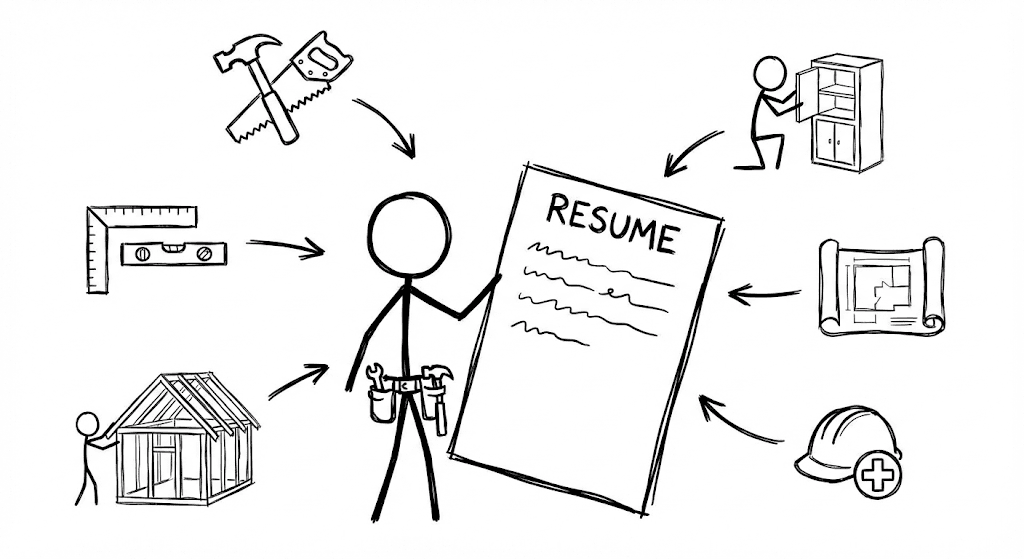
Landing a high-paying carpentry position requires more than a sturdy toolbelt and a solid work ethic. General contractors and hiring managers sift through countless applications daily. To catch their eye, your resume must clearly communicate your specific proficiencies, safety knowledge, and reliability.
At ChiselJobs, we analyze thousands of successful hires across the construction industry. Building a strong resume means translating your physical labor into professional terminology. Here is how to detail your expertise effectively.
Breaking Down Your Structural Framing Capabilities
Contractors hiring framers and rough carpenters are looking for structural problem solvers. They need to know you understand load paths, building envelopes, and the mathematics behind a solid build. It is not enough to say you build walls. You must detail the scale and complexity of the structures you erect.
Engineered Lumber and Seismic Layout
When describing your framing experience, specify the materials and building systems you handle daily. Standard dimensional lumber is just the baseline. You should highlight your experience working with engineered wood products. Resources from APA The Engineered Wood Association outline the exact specifications for installing laminated veneer lumber (LVL), I-joists, and parallel strand lumber (PSL), and employers want to see these terms on your application.
Furthermore, detailing your knowledge of shear transfer is incredibly important, especially in regions with strict seismic codes like British Columbia and California. Make sure your resume reflects your ability to build in accordance with the National Building Code of Canada or the specific BC Building Code.
Be sure to list your proficiency with installing specialized hardware. Mentioning your hands-on experience with Simpson Strong-Tie structural connectors proves you understand how to secure a building against lateral loads and uplift.
Key framing details to include:
Execution of advanced platform framing and structural load transfer.
Installation of rainscreen systems and breathable building wraps for exterior moisture management.
Mathematical layout for custom structural stair stringers and complex roof hips.
Articulating Precision in Architectural Millwork
Finish carpentry is entirely about tolerances, patience, and visual perfection. If your expertise leans toward the final stages of a build, your resume needs to reflect your extreme attention to detail. Employers looking for interior specialists want to see terminology that proves you understand the difference between standard production work and high-end craftsmanship.
High-end contractors often build to the rigorous standards set by the Architectural Woodwork Institute. If you know how to meet these premium grade specifications, state it clearly.
You need to explicitly mention your ability to cope inside corners for baseboards and crown molding. Scribing architectural millwork to uneven drywall or masonry is a highly sought-after skill. For more advanced joinery techniques, referencing professional publications like Fine Woodworking magazine techniques in your cover letter can show your dedication to the craft. We also highly recommend reviewing the ChiselJobs guide about How to Become a Carpenter: Guide That Works in 2026 to help you find the right vocabulary for your application.
Key finish carpentry skills to highlight:
Installing complex, multi-piece stain-grade crown molding and baseboards.
Executing tight, seamless joinery utilizing hand chisels and premium power tools.
Hanging solid core interior doors and routing precise mortises for architectural hardware.
Highlighting Technological Fluency on the Job Site
A master carpenter does not just follow orders. They interpret complex architectural drawings and anticipate potential problems before cutting a single board. Showing that you can independently read blueprints elevates you from a laborer to a skilled tradesperson capable of leadership.
Today, paper blueprints are frequently replaced by digital tablets on the job site. Your resume should reflect your ability to understand scale and cross-reference structural drawings using modern software. Mentioning your proficiency with digital markup tools like Bluebeam Revu will immediately set you apart from candidates who only know traditional methods.
Additionally, note your ability to calibrate and use advanced measurement devices. Transitioning from a standard spirit level to advanced optics saves contractors time.
Prioritizing Site Safety and Hazard Mitigation
Construction sites are inherently dangerous. A contractor's biggest fear is a workplace injury that halts production or results in an expensive liability claim. Proving that you are a safety-conscious worker is a massive selling point.
Keep this section of your resume concise and factual. Simply list any formal credentials you hold to show you meet industry compliance standards. In the Vancouver area, demonstrating your knowledge of WorkSafeBC safety protocols is absolutely mandatory.
Key safety credentials to list prominently include:
Completion of standardized OSHA safety training courses (OSHA 10 or OSHA 30).
Valid fall protection and scaffold erection awareness training.
Active Canadian Red Cross First Aid certification and CPR training.
Mobile elevating work platform (MEWP) operating licenses.
Structuring Your Professional Experience
The way you present these skills matters just as much as the skills themselves. Avoid dense, unreadable paragraphs. Use a clean, modern resume format with clear bullet points. Integrate these keywords naturally into your previous job duties rather than just dumping them into a list at the bottom of the page.
Instead of writing "Framed houses," upgrade your resume to say: "Led a three-person crew in the structural layout and framing of custom residential homes, ensuring strict adherence to municipal building codes."
This approach provides context, proves your authority, and incorporates the exact terminology that search algorithms and human recruiters look for. If you need help getting ready for the next step of the hiring process, check out the ChiselJobs interview preparation tactics to ensure you can speak confidently about every skill you just listed.