Navigating Commercial Carpenter Wages and Job Demand Realities

ChiselJobs Team
Published on 2/24/2026
The commercial construction sector relies on the precision and endurance of skilled tradespeople. If you are swinging a hammer on large-scale projects, you already know that commercial carpentry is a different beast compared to residential builds. From soaring concrete formwork to intricate interior office fit-outs, the scale of the work demands top-tier expertise.
Welcome to ChiselJobs. We built this platform because we understand the trades. Whether you are an apprentice eager to log hours, a seasoned journeyman looking for better pay, or a contractor hunting for reliable talent, knowing the current market conditions is your sharpest tool. Let us break down exactly what commercial carpenter jobs look like in 2026, covering realistic salary expectations, overtime potential, and the regions where demand is surging.
The Daily Grind: Core Responsibilities and Required Expertise
A commercial carpenter does much more than cut wood. You are the backbone of hospitals, retail centers, high-rises, and industrial facilities. The work environment is fast-paced, highly regulated, and requires a deep understanding of complex blueprints and strict building codes.
Commercial sites demand rigorous adherence to Occupational Safety and Health Administration (OSHA) regulations in the United States or provincial standards like those enforced by WorkSafeBC in Canada. A single misstep in layout or a failure to spot a structural flaw can cost a contractor thousands of dollars and jeopardize site safety.
Core job duties on a commercial site typically include:
Structural Framing and Formwork: Erecting heavy-gauge steel studs, building complex concrete forms, and installing robust structural frameworks.
Precision Layout: Using lasers and traditional transit levels to ensure absolute accuracy before the first nail is driven.
Commercial Finish Carpentry: Installing high-end architectural millwork, commercial doors, specialized hardware, and custom joinery for office lobbies or retail spaces.
Safety and Code Compliance: Navigating stringent commercial building codes and maintaining spotless safety records while operating heavy machinery and aerial lifts.
To execute these tasks, a commercial carpenter must be a master of their toolbelt. You need to operate a commercial-grade circular saw with precision, maintain razor-sharp chisels for hinge mortising, rely on high-quality levels for structural accuracy, and safely handle pneumatic nail guns all day long.
Unpacking the Paycheck: Commercial Carpentry Earnings
Let us talk about the money. Commercial carpentry generally pays a premium over residential work, largely due to the scale of the projects and the strict deadlines involved. According to the Bureau of Labor Statistics (BLS), the median pay for carpenters reflects a strong baseline, but commercial specialists often push those numbers much higher.
Earnings vary based on your experience level, whether you carry a journeyman ticket, and if you are working a union or non-union gig. Here is a breakdown of what you can expect to earn in the current North American market:
Apprentice and Entry-Level: Those just starting out typically earn between $45,000 and $55,000 annually. This is the earning-while-learning phase where mastering the tape measure and circular saw pays off in steady raises.
Mid-Level Journeyman: With a few years of experience, average salaries hover between $60,000 and $68,000 per year. Hourly rates typically sit around $29 to $35.
Senior Carpenters and Foremen: Lead carpenters, specialized finish carpenters, and site foremen regularly pull in $75,000 to over $90,000 annually.
The Union Advantage
When evaluating commercial carpenter jobs, the union versus non-union debate is always present. Members of the United Brotherhood of Carpenters (UBC) often see higher hourly base rates and robust benefits packages, including pensions and comprehensive healthcare. Non-union roles might offer a slightly lower hourly rate but can sometimes provide more flexibility and faster paths to site supervisor roles for highly motivated workers.
Regional Hotspots: Where the Trades Are Booming
Location dictates your earning power. The demand for commercial carpenters is highly regional, tied directly to local infrastructure investments and commercial real estate development tracked by organizations like the Associated General Contractors of America (AGC).
Thriving Markets in the United States
Major metropolitan hubs continue to drive demand. Cities like San Francisco, New York, and Seattle offer some of the highest wages in the country, with top earners making well over $40 an hour. However, the cost of living in these areas eats into that paycheck. Secondary markets like Dallas and Charlotte are seeing massive commercial booms, offering a highly attractive wage-to-living-cost ratio.
The British Columbia Construction Boom
Looking closely at the Canadian market, Vancouver and the broader British Columbia region are experiencing intense demand. Forecasts from groups like BuildForce Canada show a consistent need for skilled trades as billions are slated for infrastructure and nation-building projects in 2026.
Here is what the commercial carpentry landscape looks like in BC right now:
Hourly Rates: Journeyman carpenters in Metro Vancouver are consistently commanding $35 to $45 or more per hour.
High-Demand Sectors: Formwork carpenters are desperately needed for concrete high-rises, while finish carpenters are in demand for commercial retrofits.
Certification Edge: Holding a certification through the Red Seal Program gives you a massive advantage in BC. This national standard instantly bumps your resume to the top of the pile and maximizes your hourly rate across the province.
Maximizing Income Through Overtime and Shift Work
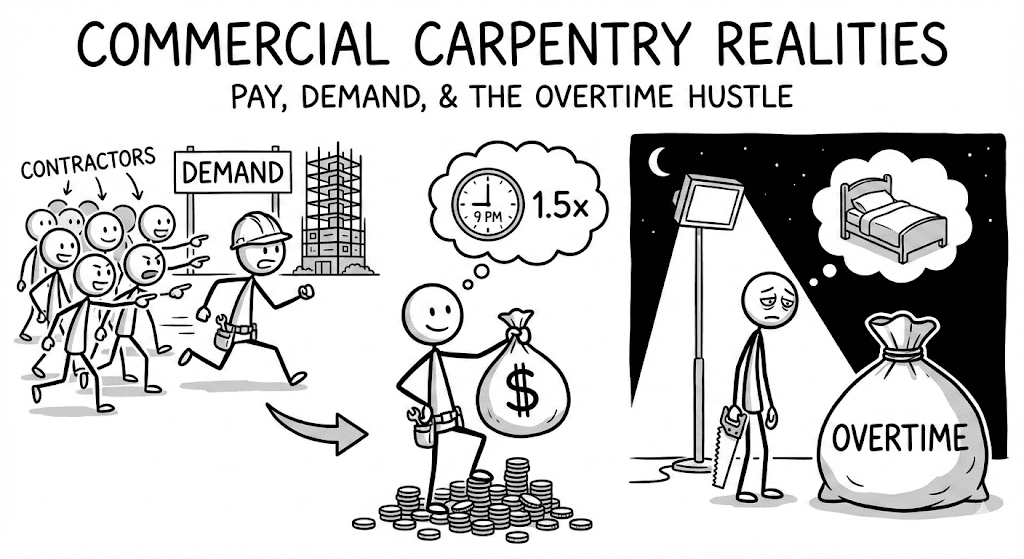
One of the biggest financial draws of the commercial sector is the availability of overtime. Commercial contractors face massive financial penalties for missing project deadlines. As industry platforms like Procore consistently highlight, schedule delays drastically impact a contractor's bottom line. When a project slips behind, they open the checkbook to catch up.
Understanding how to leverage overtime is crucial for maximizing your income:
Time and a Half: Most commercial jobs abide by the U.S. Department of Labor (D OL)standards or equivalent provincial labour laws, paying time and a half for anything over 40 hours a week. In certain regions, this applies to anything over 8 hours a day.
Weekend and Night Pushes: Retail retrofits and hospital renovations often happen after hours. Volunteering for night shifts or weekend pushes can result in double-time pay.
Burnout Prevention: While the extra money is great, working 60-hour weeks on a concrete deck takes a physical toll. Protect your body, prioritize sleep, and adhere strictly to safety protocols when fatigued.
The Long-Term Outlook for Your Carpentry Career
The future is incredibly bright for hands-on trades. While office workers worry about artificial intelligence replacing their jobs, a computer program cannot frame a commercial bulkhead or hang a 200-pound fire door. Publications tracking industry trends like the Engineering News-Record (ENR) continually report on the massive wave of retirements currently hitting the sector, leaving a vacuum of leadership and expertise.
For commercial carpenters, this means fast-tracked growth opportunities. If you show up on time, communicate well, and master your craft, moving from the tools to a site superintendent or project management role is highly achievable within a decade.