Navigating Carpenter Jobs in Florida: The Sunbelt Expansion

ChiselJobs Team
Published on 3/28/2026
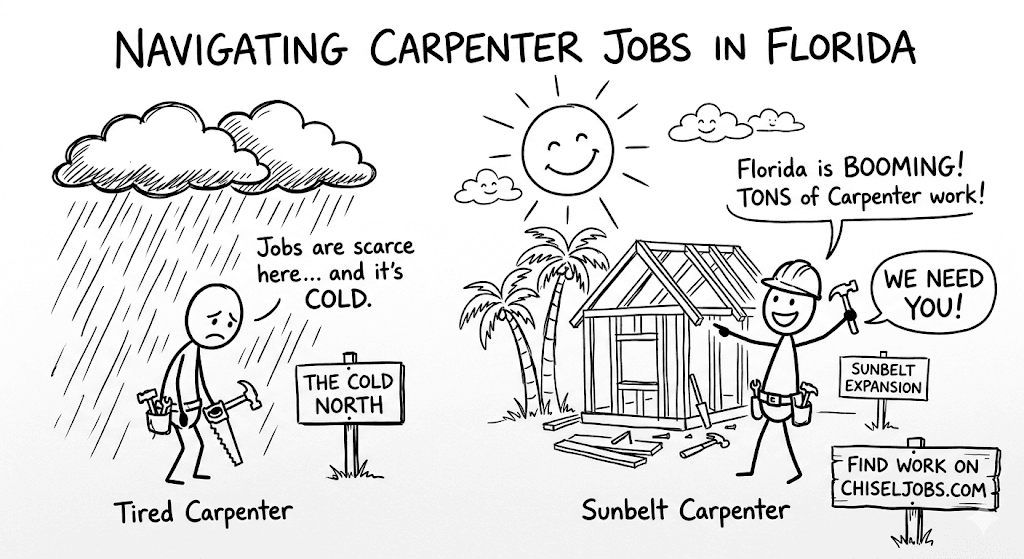
The mass migration to the American South has triggered a massive wave of construction, and Florida sits right at the epicenter of this boom. For skilled tradespeople looking to capitalize on this growth, the Sunshine State offers a unique environment filled with high-volume residential developments, massive commercial infrastructure projects, and a constant need for specialized craftsmen. Whether you are swinging a hammer as a first-year apprentice or running a crew as a veteran foreman, understanding the local market dynamics is critical for building a lucrative career.
Riding the Wave of Southern Construction
Florida is experiencing unprecedented population growth, driving an incredible demand for housing and commercial spaces. Cities like Miami, Tampa, Orlando, and Jacksonville are expanding their footprints rapidly. This translates directly to a massive backlog of projects for local contractors. According to the Associated General Contractors of America, the construction sector in the Sunbelt states continues to outpace the national average in job creation.
For carpenters, this means consistent work. The environment here is fast-paced and highly competitive. Contractors are constantly hunting for reliable hands who can read a set of prints, snap a chalk line, calculate stair stringer rise and run, and frame a wall plumb and square. If you show up with your toolbelt ready and a solid understanding of layout and basic building codes, you will not be out of work for long.
The Need for Structural Framing and Formwork
Because Florida faces severe weather patterns and hurricane threats, the building codes here are some of the strictest in the country. This heavily influences the type of carpentry work available. A massive portion of the structural work involves concrete formwork. Carpenters skilled in building sturdy, precise forms for poured concrete tie-beams and columns are highly sought after.
Rough framing also looks a bit different here. You will be dealing with heavy-gauge metal stud framing in commercial settings and strict wind-load requirements for residential timber framing. Proficiency with standard site tools like your trusty 7-1/4 inch circular saw, pneumatic framing nailers, and laser levels is the baseline. You also need to know how to install hurricane straps and structural tie-downs properly.
What to Expect in Your Paycheck
Compensation in Florida varies wildly depending on your location, your experience level, and whether you are working union or non-union. According to recent market data and active employer postings analyzed directly by ChiselJobs, the earning landscape is highly competitive. While the Bureau of Labor Statistics provides national baseline data, the proprietary insights from ChiselJobs show that real-world jobsite wages in Florida frequently exceed those averages to combat the severe shortage of skilled labor.
Several key factors will influence your earning potential in this regional market:
Location: Major metropolitan areas like Miami and Orlando offer higher hourly rates to offset the elevated cost of living.
Experience Level: Based on ChiselJobs metrics, entry-level apprentices typically start between $18 and $22 per hour, whereas seasoned journeymen command $30 to $40 per hour or more.
Union Affiliation: Union members working under the United Brotherhood of Carpenters Florida Regional Council receive standardized pay scales, robust pension contributions, and comprehensive health benefits.
Specialization: Carpenters skilled in high-end finish work or complex commercial formwork frequently earn premium pay compared to general rough framers.
Strategies for Maximizing Your Earning Potential
If you want to move to the top of the pay scale, you need to specialize. Finish carpentry is a highly respected and well-compensated niche. Homeowners in wealthy coastal enclaves demand flawless trim work, custom built-ins, wainscoting, and complex crown molding. Developing your skills with block planes, coping saws, routers, and fine chisels will set you apart from the rough framing crowd.
Certifications also equal cash. Completing standardized training modules through the National Center for Construction Education and Research (NCCER) proves your competency to prospective employers and can give you serious leverage during salary negotiations.
Life on a Florida Jobsite
Working in the Sunshine State is not just about sunshine. The environmental conditions are a major factor in your daily routine. The heat and humidity during the summer months are intense. Hydration, proper sun protection, and pacing yourself are essential survival skills for any tradesperson working outdoors.
Your daily job duties will require versatility and physical endurance. Common expectations include:
Reading and interpreting architectural blueprints and shop drawings.
Performing accurate site layout, including shooting elevations and squaring foundations.
Erecting structural framework, installing floor joists, and pitching complex roof trusses.
Applying exterior sheathing, weather barriers, and siding materials.
Navigating Hazards and OSHA Fall Protection
Safety is non-negotiable. The Occupational Safety and Health Administration (OSHA) closely monitors job sites, and fall protection is its top priority. In residential construction, carpenters frequently work at dangerous heights while setting roof trusses, installing fascia board, or laying roof sheathing.
OSHA regulations dictate that any worker exposed to a fall hazard of six feet or more must be protected. This means you must be proficient in using Personal Fall Arrest Systems. Knowing how to properly inspect your harness, calculate fall clearance, and secure your lanyard to an approved anchor point is just as important as knowing how to use your speed square. Ongoing safety training programs, often provided by organizations such as the Associated Builders and Contractors (ABC), are vital for keeping crews compliant and safe.
Licensing Rules and Moving Up the Ladder
Unlike electricians or plumbers, individual carpenters do not need a state-issued journeyman license to work as an employee in Florida. However, if you plan to start your own business, pull permits, and bid on jobs directly, you will need to become a licensed contractor. The Florida Department of Business and Professional Regulation (DBPR) oversees this process. You will typically need to pass comprehensive business, finance, and trade exams, as well as prove your financial stability and carry adequate insurance.
For those who prefer to work for an established company, the career trajectory is clear. A driven apprentice who shows up on time, asks the right questions, and masters their tools will quickly become a lead carpenter. From there, developing leadership skills and a deep understanding of the entire construction sequence can lead to highly paid positions as a foreman, site superintendent, or project manager.
Are you ready to pack your toolbelt and take advantage of the booming Sunbelt market? Exploring the latest postings on ChiselJobs is the perfect way to find the right crew and start building your future today.