A Guide to Government Carpenter Jobs and Security Clearances

ChiselJobs Team
Published on 7/4/2026
You know the drill in the private sector. You bid a job, swing your hammer, and move on to the next site. But what happens when the residential housing market cools off? Many tradesmen start looking for something a bit more steady. Government carpenter jobs offer a completely different path.
These roles provide unmatched job security, rock-solid pensions, and predictable hours. However, there is a catch. To work on military bases, federal courthouses, or secured research facilities, you will often need a security clearance. Here is everything you need to know about getting your foot in the door and passing the background check.
What Does a Public Sector Carpenter Actually Do?
If you take a job with the government, your day-to-day tasks will look different than standard residential framing. You are rarely building custom homes from the ground up. Instead, you are doing heavy maintenance, structural repairs, and commercial remodeling.
You might work for the Department of Defense, the Veterans Affairs hospital system, or a local municipality. The work is highly varied and requires a wide skill set. One day you are repairing heavy timber framing on an old military barracks. The next day, you are using a chisel to mortise secure hardware into solid core doors at a federal administration building.
You need a strong understanding of commercial building codes and strict OSHA safety protocols. Government sites do not cut corners on safety. You will use the exact same tools you already own, like circular saws, levels, framing squares, and nail guns, but the environment is strictly regulated.
Why Do Carpenters Need Security Clearances?
You might be wondering why a guy hanging drywall or fixing baseboards needs a government clearance. The answer comes down to access.
As a maintenance or facility carpenter, you have the keys to the building. You are walking through restricted areas where sensitive national information is stored, or where high-level officials work. The government needs to know you are trustworthy before they let you bring your toolbelt into a secure facility. They want to ensure you are reliable, honest, and cannot be blackmailed.
Breaking Down the Clearance Levels
Not every government carpentry job requires a top-tier spy clearance. The level of scrutiny depends heavily on where you will be working.
Public Trust: This is the most common level for basic federal buildings and national parks. It is a background check that looks into your criminal history, employment records, and credit history. It is mostly designed to prove you are a reliable, upstanding citizen.
Secret Clearance: If you are working directly on a military base or a defense contractor site, you might need a Secret clearance. This involves a much deeper dive into your past. Investigators will look at the last ten years of your life in detail.
Top Secret Clearance: It is rare for a standard maintenance carpenter to need a Top Secret clearance, but it happens at highly restricted facilities. This process is intense and includes in-person interviews with your neighbors, past employers, and friends.
The Background Check Process Step by Step
Getting cleared takes time. It is not like a private contractor calling your references on a Tuesday and putting you on the payroll by Wednesday.
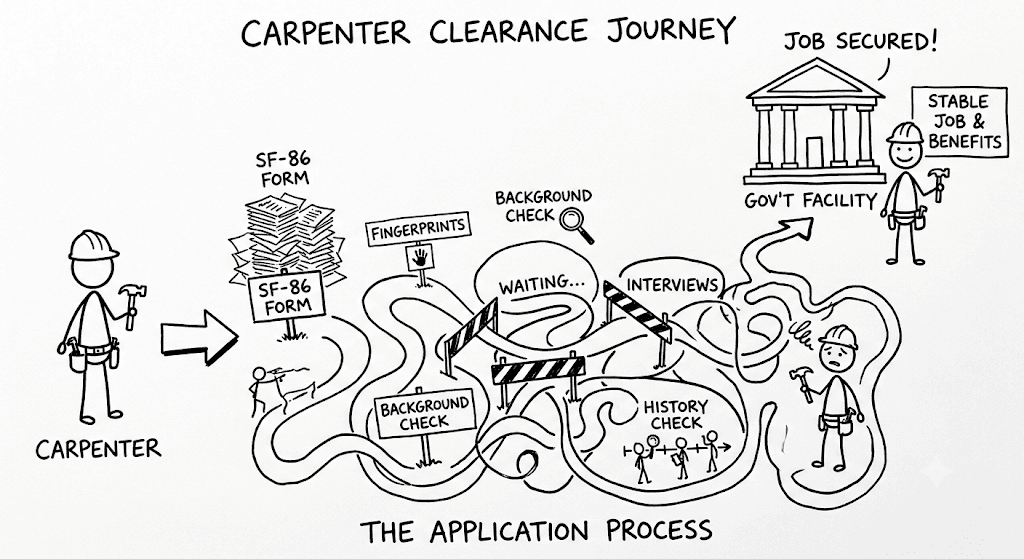
First, you will receive a massive packet of paperwork. In the United States, this is usually the SF-86 form. You have to list every place you have lived, worked, and traveled over the last seven to ten years. You will also get fingerprinted and undergo a thorough background investigation. Investigators look for red flags like a history of serious crimes, massive unpaid debts, or ties to foreign governments.
Expert advice from veteran federal workers is incredibly simple: do not lie on your forms. If you had a rough patch and missed some credit card payments five years ago, tell the truth. Bad credit or past debt will not automatically disqualify you. However, lying about that debt will instantly ruin your chances. Honesty is the single most important factor in this process.
The Reality of Drug Testing
One crucial detail for tradesmen is drug testing. Even if you live in a state or region where marijuana is perfectly legal for recreational use, the federal government does not recognize it. Failing a drug test for federal employment will immediately disqualify you from getting a security clearance. If you want these jobs, you must keep your system clean.
The Waiting Game
The biggest frustration for tradesmen entering the public sector is the wait. A Public Trust check might take a few weeks. A Secret clearance can take several months. You have to be patient. Often, the government agency will give you an interim clearance so you can start working on non-sensitive projects while the final paperwork clears.
The Paycheck, Benefits, and Pension
Why go through all this paperwork just to do layout and finish carpentry? The answer is long-term stability and unmatched benefits.
Government jobs pay competitive wages. In the United States, these roles often fall under prevailing wage laws or the Davis-Bacon Act, meaning you get paid fairly based on your local market rate. But the real draw is the benefits package.
Federal and state workers get excellent health insurance that covers their families. You also get paid sick leave, paid holidays, and actual vacation time. Private contractors rarely match these perks.
Finally, there is the pension. Many government jobs still offer a traditional pension plan, like the Federal Employees Retirement System (FERS) in the US. If you put in twenty or thirty years of service, you will receive a guaranteed monthly check for the rest of your life.
How to Build a Federal Resume and Apply
Applying for a government job requires a specific approach. You cannot just hand a foreman a one-page resume and shake his hand.
If you are in the United States, you will primarily use a website called USAJOBS. You need to use their built-in resume builder. A federal resume is much longer and more detailed than a standard one. You must clearly explain your experience with framing, finish work, reading blueprints, and job site safety.
List every tool you are proficient with, from basic hand tools to heavy machinery. Be specific about your OSHA certifications, safety training, or union apprenticeship background. The HR department reviewing your application might not know trade slang, so use clear, professional language to describe your skills.
Finding Your Next Opportunity with ChiselJobs
If you are ready to trade the unpredictable residential market for a stable career, the opportunities are out there. Building your skills, keeping your record clean, and practicing patience during the hiring process will pay off immensely. Keep an eye on the listings at ChiselJobs to find local, state, and federal contracting roles in your area. The paperwork might be heavy, but the retirement benefits are absolutely worth the effort.