Is a Carpenter a Blue Collar Job?

ChiselJobs Team
Published on 6/28/2026
Slug: is-carpenter-blue-collar-job
Defining the Modern Carpenter: Is It Still a Blue Collar Job?
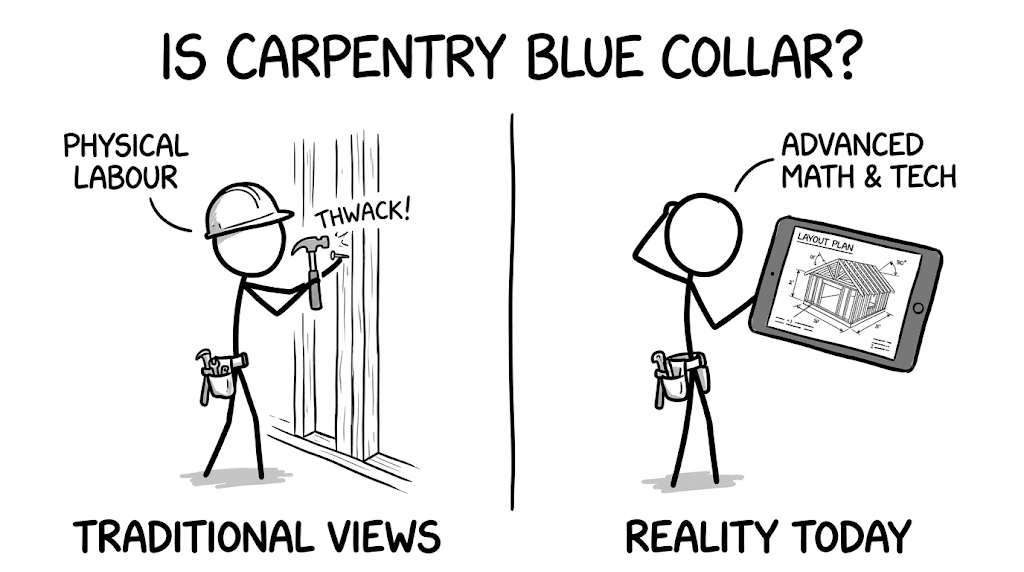
If you ask the average person what a blue collar job looks like, they will probably picture someone wearing steel-toed boots, a hard hat, and a tool belt heavy with a framing hammer and a speed square. By traditional definitions, carpentry is the textbook definition of blue collar work. It is physical, it requires manual labor, and you get your hands dirty on a daily job site.But the construction industry is changing fast. Today, a professional carpenter is just as likely to be analyzing a digital blueprint on an iPad or calculating complex roof pitches with a construction calculator as they are to be swinging a hammer.For anyone looking to start a career through ChiselJobs, understanding what it actually means to be a carpenter today is essential. The line between traditional manual labor and advanced technical skill is blurring, making carpentry one of the most dynamic paths in the skilled trades.
Where the Blue Collar Label Comes From
Historically, the terms blue collar and white collar were used to describe the shirts workers wore. Office workers wore white shirts that stayed clean, while factory workers, mechanics, and builders wore durable blue denim or canvas that hid dirt and grease.Carpentry fits into this classic category for several obvious reasons:
Physical Labor: You are on your feet for eight to ten hours a day. You are lifting dimensional lumber, hauling sheets of plywood, and working in the elements, whether it is freezing winter framing or hot summer roofing.
Hourly Wages: Most carpenters start out tracking hours. Unlike corporate salaries, you are paid for the exact time you put into the job site, with overtime rules kicking in after forty hours.
Tangible Output: At the end of the day, a white collar worker leaves behind emails and spreadsheets. A carpenter leaves behind a newly framed wall, a finished deck, or a set of custom kitchen cabinets.
Why Carpentry is Shifting Toward "New Collar"
While the physical grit of the trade remains, calling carpentry just a blue collar job does not tell the whole story anymore. A better term used by industry experts today is "new collar." This refers to highly skilled roles that require specialized technical training but not necessarily a four-year college degree.The modern job site requires a level of math and engineering knowledge that surprises many high school graduates.
Advanced Math and Practical Geometry
You cannot build a straight house without a solid grasp of geometry. If you are cutting rafters for a roof layout, you are using the Pythagorean theorem ($A^2 + B^2 = C^2$) to calculate the hypotenuse for your rafter lengths. If your layout is off by even an eighth of an inch at the foundation, that mistake multiplies by the time you reach the roofline.
Tech on the Job Site
Technology has completely changed how carpenters work. Walk onto a commercial job site managed by top contractors today, and you will see:
Digital levels that measure angles down to the decimal point.
Laser lines that replace traditional chalk lines for perfect alignment across large spaces.
Total Station devices used for highly accurate foundation layouts.
Building Information Modeling (BIM) software used to view 3D framing plans before a single piece of wood is cut.
Specializations Within the Craft
Carpentry is not a single job. It is a massive trade with different paths, some of which lean heavier into manual labor, while others lean closer to precision engineering and design.
Framing and Rough Carpentry
These are the crews that put up the skeleton of the building. It is fast-paced, heavy work using circular saws and framing nailers. It requires immense physical stamina and strict adherence to OSHA safety standards, especially when working at heights or managing fall protection.
Finish and Trim Carpentry
Once the building is enclosed, finish carpenters take over. This work involves installing crown molding, baseboards, doors, windows, and custom staircases. The tolerances here are tiny. You are working with fine chisels, miter saws, and block planes to create seamless joints. This side of the trade requires extreme patience and an eye for detail, resembling artistry as much as construction.
Construction Management and Estimating
Many experienced carpenters eventually move out of the tool belt and into the field office. Superintendents and estimators use their years of field experience to manage crews, order materials, and ensure projects meet local building codes. This is where the trade bridges the gap completely into project management.
Union vs. Non-Union: The Financial Reality
When looking at carpentry as a career path in North America, the structure of your employment matters.
Factor | Union Carpentry (e.g., UBC) | Non-Union / Private Contractor |
Training | Structured, paid 4-year apprenticeship programs. | On-the-job learning, variable timeline. |
Pay Structure | Set hourly scales based on journey level; guaranteed overtime. | Negotiated pay; can grow quickly based on individual skill. |
Benefits | Robust healthcare, pension plans, and annuity. | Varied; larger contractors offer benefits, smaller shops may not. |
Work Environment | Mainly large commercial, industrial, and infrastructure projects. | Highly varied; heavy focus on residential building and remodeling. |
Both paths offer incredible earning potential. A skilled journey-level carpenter who understands layout and can run a crew is always in high demand, regardless of union status.
More Than Just a Label
So, is a carpenter a blue collar worker? Yes, in the best way possible. It carries the pride of hard work, self-reliance, and building the communities we live in.But do not let the old stereotypes fool you. Today’s carpenter is a technical problem solver, a geometric strategist, and a critical asset on any job site. If you enjoy working with your hands but also want a career that challenges your brain and offers a clear path to running your own business, carpentry is a premier choice.
Ready to find your next project? Whether you are looking for an entry-level apprenticeship or a lead carpenter role, check out the latest listings on ChiselJobs to build your future in the trades.