Top Carpentry Jobs in Chicago, IL: Union Presence & Pay

ChiselJobs Team
Published on 6/6/2026
Chicago is a city built by the working class. If you look at the skyline, you are looking at the direct result of millions of hours of hard work by skilled tradesmen. For carpenters, the Windy City offers some of the best pay and strongest union support in the country. Whether you are swinging a framing hammer on a residential build in Naperville or setting forms for a massive concrete pour downtown, the opportunities are endless.
Here at ChiselJobs, we want to give you the exact details on what it takes to succeed as a carpenter in the Chicago area. We will cover the union presence, real salary numbers, and the skills you need to stay employed year-round.
The Reality of Working as a Chicago Carpenter
Carpentry in Illinois is not a one-size-fits-all trade. The job duties change based on the contractor and the season. Winter in the Midwest is brutal, so a lot of the heavy framing and exterior work is pushed hard during the warmer months, while interior finish work takes priority when the snow flies.
Typical Job Duties on the Site
A typical week might involve shooting elevations with a transit level, reading complex blueprints, and snapping chalk lines for a new layout. Commercial carpenters often spend their days doing steel stud framing, hanging drywall, or installing acoustical ceilings in large office buildings. Residential carpenters usually stick to wood framing, cutting rafters with a circular saw, or installing custom cabinets with precision chisels and finish nailers.
Core Skills and Tools of the Trade
To make it in this market, you must be completely comfortable with the core tools. You need to know your way around a tape measure, a framing square for cutting stair stringers, and a laser level. You also need a solid understanding of local building codes. Chicago has some of the strictest building and fire codes in North America. Knowing these rules keeps the job moving forward and keeps the local inspectors happy.
Safety is another massive factor. OSHA regulations are strictly enforced on commercial sites. Wearing your hard hat, safety glasses, and high-visibility gear is mandatory at all times. If you ignore OSHA safety rules, you will get sent home quickly.
The Daily Grind on the Jobsite
Construction is physically demanding. You are on your feet all day, lifting heavy lumber, carrying sheets of drywall, and working in awkward positions. In the summer, the heat and humidity in the Midwest will test your endurance. In the winter, you are working in freezing winds right off Lake Michigan. You have to dress in layers and take care of your body. Good boots, knee pads, and regular stretching are just as important as having sharp saw blades.
The Power of the Union in Illinois
Chicago is a historic stronghold for organized labor. For carpenters, this means the Mid-America Carpenters Regional Council (MACRC) is a major player in the local market. This union represents thousands of workers across Illinois and neighboring states, securing high wages and safe working conditions.
Union Versus Non-Union Shops
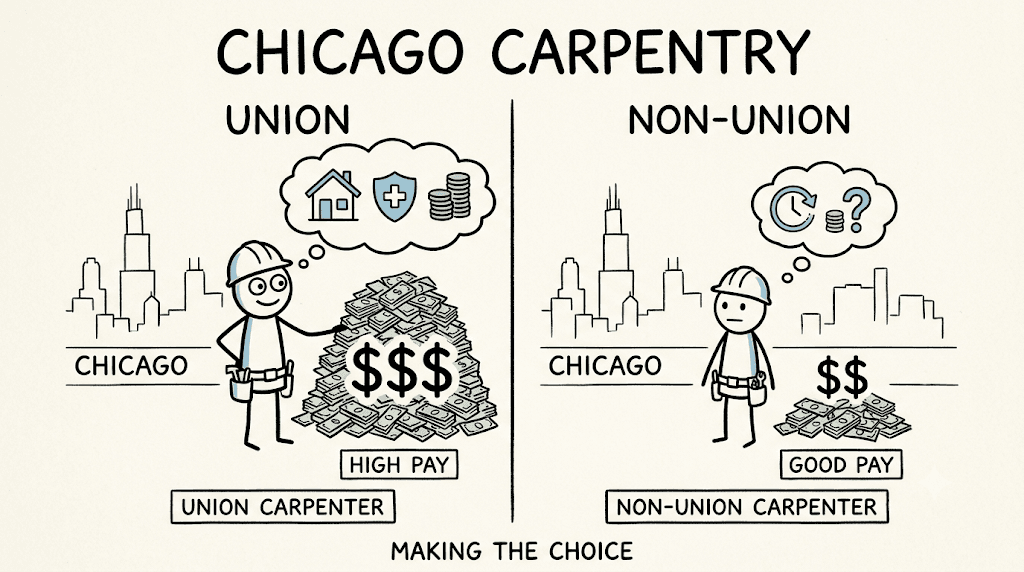
Working non-union in the residential sector is very common. Many custom home builders and remodeling contractors operate as independent shops. The pay is usually negotiated directly with the boss, and benefits can vary widely from one company to the next.
However, if you want to work on large commercial projects, hospitals, or high-rises in Cook County, you will likely need a union card. The union controls a massive share of the commercial market. The benefit of joining the union is the collective bargaining agreement. This legally guarantees your wage, your pension, and your health insurance.
Stepping Into an Apprenticeship
If you are just out of high school or looking for a serious career change, the union apprenticeship is the best path forward. The MACRC runs an intensive four-year training program. You get paid to learn on the job, and you attend dedicated classes a few weeks out of the year. During training, you will master everything from basic wall framing to complex roof pitches and heavy concrete formwork.
First-year apprentices usually start at 40 percent of the journeyman wage. Every time you pass a training milestone and gain more hours on the jobsite, your paycheck gets bigger.
Breaking Down the Pay Scale
When people talk about construction wages in Chicago, the numbers are impressive. The pay scale for a union carpenter is one of the highest in the region, providing a solid middle-class living.
Base Wages and Total Packages
According to recent contracts, a union journeyman carpenter in the Chicago area makes around $50 to $52 an hour on the check. But that is only part of the story. The total package includes money paid into your health insurance, pension, and training funds by the employer. When you add all those fringe benefits together, the total compensation is closer to $85 or $90 an hour.
For a guy working a standard 40-hour week, that base wage easily translates to over $100,000 a year. If you work overtime, which pays time-and-a-half or double-time on Sundays, your annual income can climb much higher.
Non-Union Salary Expectations
If you decide to work outside the union, the pay structure looks a bit different. A highly skilled non-union residential carpenter or lead framer in the Chicago suburbs can still make between $30 and $45 an hour. The main difference is the benefits. You might have to negotiate your own health insurance or contribute to your own retirement account. However, some craftsmen prefer this route because it offers steady, year-round indoor work doing custom kitchens and high-end trim work without paying union dues.
Pay Differences Across the Region
Wages change slightly depending on where you work in the state.Cook, Lake, and DuPage counties typically have the highest hourly rates. If you drive a few hours south or west toward Rockford, Peoria, or Elgin, the cost of living drops, and the hourly wage drops slightly to match it.
How to Increase Your Construction Income
If you want to maximize your earnings, you need to bring more value to the contractor. Here are a few reliable ways to bump up your pay:
Earn specialized certifications, like advanced scaffolding, rigging, or welding.
Step up to a leadership role. Foremen and general foremen receive a premium on top of their journeyman scale, often making $3 to $5 more per hour.
Never turn down overtime when the weather is good and the schedule is tight.
Invest in high-quality tools and keep your skills sharp. A guy who can execute flawless joinery on a finish carpentry job is rarely out of work.
Licensing and Getting to Work
Unlike plumbers or electricians, carpenters in Illinois do not carry a state-issued trade license. However, general contractors must be licensed by the specific city or village where they are working. For example, the City of Chicago requires contractors to hold a specific business license and carry heavy liability insurance.
As an individual carpenter, your focus should be on safety training. Having your OSHA 10 or OSHA 30 certification is highly recommended. Many large sites will simply not let you walk through the gate without proving you have completed this training.
The Future of Carpentry in the Midwest
The demand for skilled tradesmen is not slowing down. Older workers are retiring, and contractors are constantly looking for hungry, reliable people to fill their boots. Whether you choose the union route for the ironclad benefits and big projects, or the non-union route for the flexibility of custom residential building, there is plenty of sawdust to make in Illinois.
At ChiselJobs, we connect hardworking professionals with the best employers in the industry. Your skills are in demand right now. Keep your tape measure handy, stay safe on the site, and take pride in the work you build.