Traveling Carpenter Jobs: Navigating Per Diems in 2026

ChiselJobs Team
Published on 4/20/2026
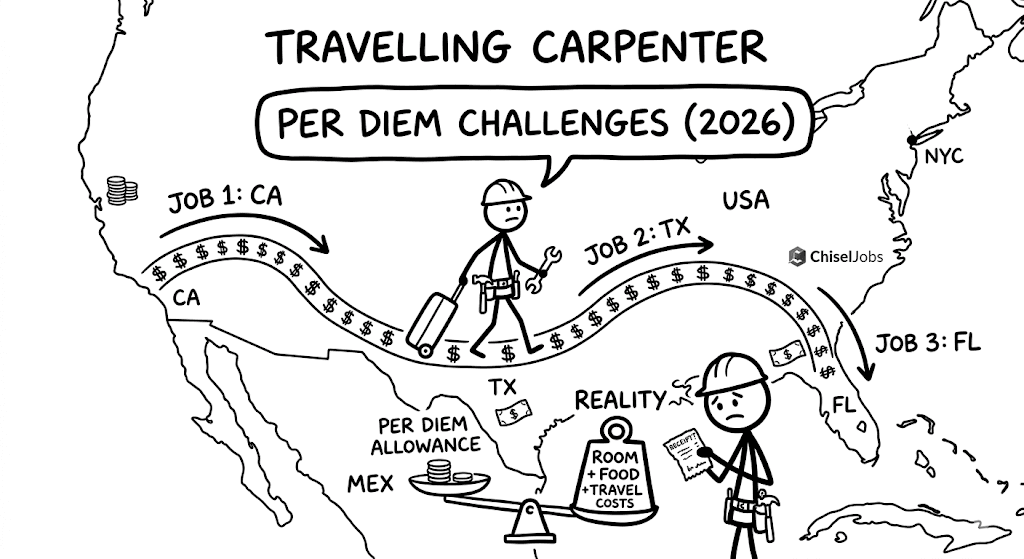
If you spend more time living out of a suitcase than your own house, you know the life of a traveling carpenter is a different beast entirely. You are not just framing walls or dialing in finish carpentry. You are managing travel logistics, adapting to changing building codes, and trying to make sure your daily allowance actually covers a decent steak at the end of a 12-hour shift.
Taking your skills on the road means packing up the truck with your circular saw, chisels, levels, and nail guns, and hitting states with massive construction booms. We are talking about places like Texas, Florida, and New York. But traveling for trade work requires understanding how your money works. Let us look at what 2026 holds for road warriors, breaking down per diems, salary expectations, and safety on the job.
Decoding the 2026 Travel Allowance Landscape
When a contractor asks you to travel across state lines, they usually offer a daily allowance to cover your hotel and food. This is known as a per diem. It is crucial to understand that per diems are not bonuses. They are non-taxable reimbursements for the actual cost of living away from home.
The federal government sets the baseline for these rates. According to the General Services Administration (GSA), the standard continental United States rate for 2026 hovers around $178 per day. This is generally split into a lodging allowance and a Meals and Incidental Expenses allowance.
However, if your employer sends you to frame a massive commercial complex in downtown Chicago or San Francisco, the standard rate will not cut it. The Internal Revenue Service (IRS) allows higher tax-free reimbursements for high-cost localities.
Here is how you protect yourself when negotiating travel pay:
Always ask if the contractor pays the full GSA rate or a flat company rate.
Keep your lodging receipts. The IRS requires lodging documentation regardless of the amount.
Know the first and last day rule. Travel days typically only pay out 75 percent of the standard meal allowance.
Understand the tax implications if your employer pays below or above the federal guidelines.
Real Numbers from the ChiselJobs Dataset
Everyone wants to know if taking a job three states over is worth the wear and tear on their body and their truck. To get a clear picture, we ran the numbers through the ChiselJobs dataset for 2026. The financial upside to traveling is significant, especially if you have specialized skills in complex joinery or heavy timber framing.
Our data shows a distinct wage bump for traveling tradespeople across the country.
Apprentices willing to travel are seeing starting hourly rates jump by 15 percent compared to strictly local crews.
Journeymen carpenters working non-union travel gigs in the Sun Belt are averaging $35 to $45 an hour, not including their untaxed per diem.
Union carpenters aligned with the United Brotherhood of Carpenters (UBC) often see top-tier wages plus standardized travel pay dictated by their collective bargaining agreements.
To maximize your income, consider looking at the Bureau of Labor Statistics (BLS) projections for regional growth. States rebuilding from severe weather or experiencing massive population influxes are desperate for skilled hands. You can easily negotiate higher hourly rates when demand outpaces the local labor pool.
Hauling Your Gear and Adapting to Local Rules
Being a traveling carpenter means you need a highly organized setup. You cannot just run back to the shop if you forget a specific router bit or a framing square. Your truck has to be a mobile command center. Make sure your power tools are secure and your hand tools are well maintained.
You also have to adapt your brain. A framer from Arizona stepping onto a job site in South Florida is going to face a totally different set of hurricane-resistant building codes.
Layouts might require different tie-downs and structural hardware.
Moisture barriers and exterior trim details change drastically depending on the climate zone.
You must be adaptable and willing to read the plans carefully instead of relying on muscle memory from your home state.
Climate changes will also mess with your materials and your tools. A finish carpenter traveling from a dry desert heat to the extreme humidity of the Gulf Coast will face major wood expansion issues. Your tight joinery will swell. You have to account for acclimation time for your lumber before making your final cuts. Furthermore, keeping your circular saw blades and chisels free of rust in humid environments requires daily oiling and maintenance that you might easily ignore back in a dry climate.
Job Site Safety Away from Home
When you are bouncing between cities, safety protocols can feel like a moving target. But OSHA construction standards apply everywhere in the United States. Do not let a rushed out-of-state contractor pressure you into cutting corners.
Expert commentary from a veteran road carpenter: "When I arrive at a new site in a new state, I spend my first hour doing a mental audit. I check the scaffolding, look at the temporary power setups, and find out who the site safety officer is. Never assume the new crew has your back until they prove it."
Keep these safety checks in mind:
Verify all temporary power cords are rated for the environment. The National Institute for Occupational Safety and Health (NIOSH)reports high incidents of electrical hazards on rushed job sites.
Ensure your personal protective equipment is up to date and packed securely for travel.
Familiarize yourself with local emergency response times and the nearest trauma centers.
Construction sites are inherently dangerous, but being the new person on a massive commercial site amplifies the risk. Local crews often have established rhythms and unspoken communication habits. You need to actively break the ice and integrate into their workflow safely. Always participate in the morning toolbox talks.
Advancing Your Career on the Road
If you are tired of building the same subdivisions in your hometown, hitting the road is the fastest way to level up your expertise. You will work alongside different crews, learn new techniques, and build a massive professional network.
To keep your credentials sharp while moving around, look into portable certifications through the National Center for Construction Education and Research (NCCER). If you are an apprentice, make sure your travel hours are properly logged and reported to the Department of Labor Apprenticeship programs so you do not delay your journeyman ticket.
Keep an eye on national housing trends through the Department of Housing and Urban Development (HUD)to predict where the next big boom will be. Whether you are running layout on a skyscraper in Chicago or doing high-end finish work in a Texas mansion, traveling carpenter jobs offer unmatched freedom and financial reward.
Stay sharp, keep your chisels honed, and we will see you on the next job site. Be sure to check the latest postings on ChiselJobs to find a crew that respects your skills and pays a fair per diem.