What is a Journeyman Carpenter? The Path to Full Certification

ChiselJobs Team
Published on 4/6/2026
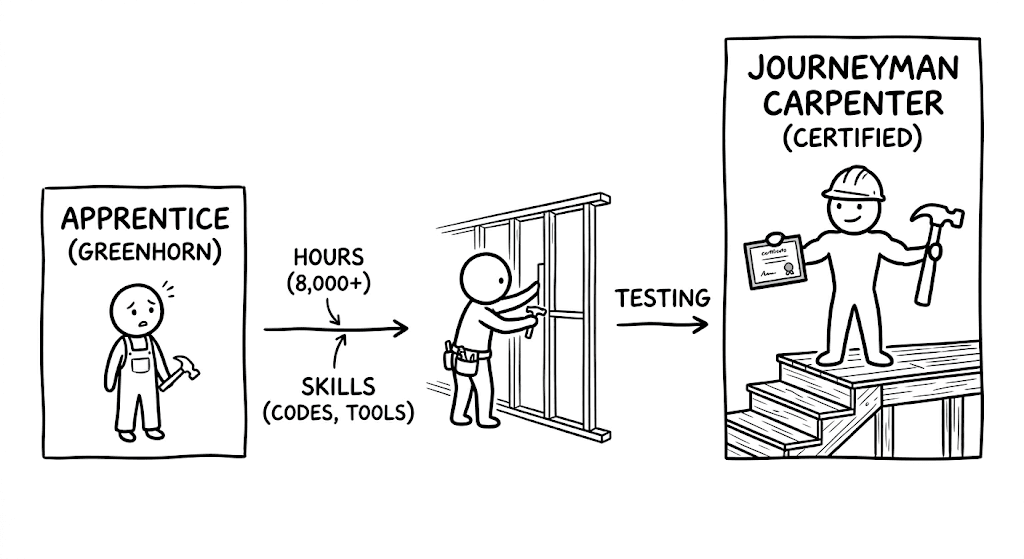
Welcome back to the ChiselJobs community. If you spend your days swinging a hammer in residential framing or managing massive commercial build-outs, you already know the title "Journeyman" carries heavy weight on any job site. It is not just a fancy word you throw on a resume. That card in your wallet means you have put in the necessary hours, bled on the lumber, and know exactly how to read a set of blueprints without constantly asking the foreman for directions.
For the apprentices grinding out their first few years and the greenhorns wondering what the future holds, let us break down exactly what it takes to reach full certification and earn the respect that comes with the title.
Beyond the Apprentice Label
A journeyman carpenter is an individual who has fully mastered the skills of the carpentry trade and can work independently without direct supervision. Reaching this level requires surviving the apprenticeship phase. This is typically a rigorous four-year journey requiring roughly 8,000 hours of on-the-job training.
You cannot simply buy this certification. You have to earn it in the mud, the sawdust, and the weather. Whether you are framing houses in the scorching heat of Texas or tying rebar on a freezing Chicago high-rise, the apprenticeship is designed to test your physical and mental limits. You can explore officially recognized programs through the Department of Labor Apprenticeship Portal to see exactly how these hours are structured.
Mastering the Blueprint and the Code
Fieldwork is only half of the equation. A true journeyman must also conquer the classroom. During your apprenticeship, you are required to complete hundreds of hours of related technical instruction. You will dive deep into construction math, geometry, and structural engineering basics.
You also need a rock-solid understanding of regulations. Knowing how to build a wall is useless if it fails inspection. Carpenters must stay updated on building codes published by the International Code Council to ensure every header, joist, and stud meets legal requirements. Furthermore, a licensed journeyman is an expert in site safety, strictly adhering to OSHA Safety Standards to keep themselves and their crew out of the hospital.
Tool Mastery and Technical Execution
What separates a second-year apprentice from a ticketed journeyman is the sheer refinement of skill. A master carpenter possesses a vast working knowledge of different specialties:
Rough Framing and Layout: You must be able to calculate complex roof pitches, lay out stair stringers perfectly, and square up a foundation using nothing but math and a tape measure.
Finish Carpentry: This requires incredible patience. You will install crown molding, baseboards, and intricate cabinetry where a fraction of an inch ruins the entire aesthetic.
Joinery: Understanding how wood moves, expands, and locks together is essential for high-end custom builds.
A journeyman is also an absolute surgeon with their tools. They operate a circular saw with precision, maintain razor-sharp chisels for fine joinery, calibrate laser levels for massive commercial floor plans, and handle pneumatic nail guns with speed and safety. For continuing education on these technical skills, many turn to the National Center for Construction Education and Research (NCCER) to keep their knowledge sharp.
Navigating the Industry Terrain
When chasing your certification, you will inevitably encounter the choice between union and non-union paths. Both avenues create excellent carpenters, but the environments differ vastly depending on your location.
In heavily unionized states like New York and California, joining an organization like the United Brotherhood of Carpenters offers structured training facilities, standardized pay scales, and robust pension plans. On the other hand, in states like Florida or Arizona, the open-shop or non-union route is highly prevalent. Organizations such as the Associated Builders and Contractors provide excellent resources and apprenticeship pathways for those choosing the merit-shop side of the industry.
The Payoff and Regional Demand
Once you earn your journeyman status, your earning potential jumps significantly. Employers know they are hiring a problem solver, not just a laborer.
According to data provided by the Bureau of Labor Statistics, the median pay for carpenters is solid, but top earners pull in significantly more. A journeyman working in San Francisco or Seattle will see drastically different wage rates compared to someone working in rural Ohio due to the cost of living and local demand. If you are working on federal or state-funded projects, you will also benefit from prevailing wage laws, which you can track through the Department of Labor Wage Data.
Protecting Your Future in the Trade
Carpentry is a notoriously tough way to make a living. Your body is your primary tool, and protecting it is just as important as protecting your circular saw. Journeymen who want a long career pay strict attention to ergonomics and fatigue management.
Achieving journeyman status is not the end of the road. It is simply the gateway to the rest of your career. From here, you can step up to become a site foreman, transition into project management, or start your own contracting business. For those looking to branch out into building their own developments, organizations like the National Association of Home Builders (NAHB) offer incredible networking and business resources.
Stick with it, keep your tape measure tight, and stay safe out there. The ChiselJobs community is always here to help you nail down your next big career move.