Where and When to Apply for Carpentry Apprenticeship Programs

ChiselJobs Team
Published on 5/30/2026
Getting your foot in the door as a carpentry apprentice takes more than just buying a tool belt and showing up at a jobsite. A structured apprenticeship is your foundation. It is the proving ground where you learn the physical realities of framing, layout, finish carpentry, and local building codes. Whether you want to master roof pitching, install intricate joinery, or understand the load paths in structural framing, an apprenticeship is where the real work begins.
For newcomers, figuring out how to actually land one of these roles can feel like reading a blueprint without a legend. At ChiselJobs, we see countless applications, and the candidates who succeed are the ones who know exactly where to look and when contractors are actively hiring. Here is everything you need to know about navigating the application process across North America.
Choosing Your Path: Union and Merit-Shop Training
Before you start filling out applications, you need to understand the two primary routes for carpentry apprenticeships. Both paths lead to journey-level status, but they operate quite differently.
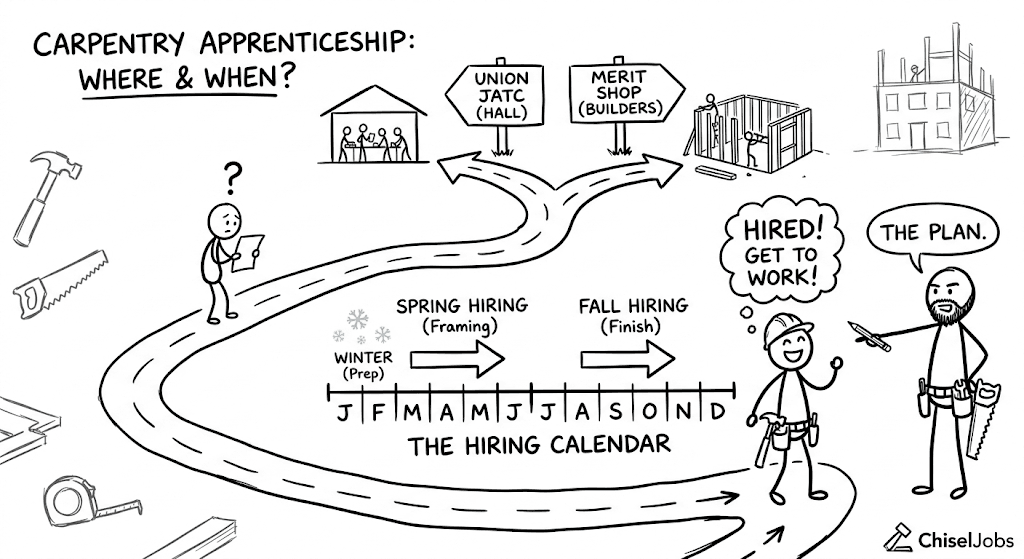
Union Apprenticeships: The United Brotherhood of Carpenters and Joiners of America (UBC)is the major player here. Union programs are highly structured and typically run through a local Joint Apprenticeship and Training Committee (JATC). You will earn while you learn, moving from basic OSHA safety protocols to advanced layout and formwork. Applications for union halls are highly localized, so you will need to contact the specific local branch in your region to check their exact intake schedules.
Merit-Shop (Open-Shop) Programs: If you go the non-union route, your training will likely be sponsored by individual contractors or industry associations. Organizations like the Associated General Contractors of America (AGC)and the National Center for Construction Education and Research (NCCER) set the curriculum for many open-shop apprenticeships. These programs offer excellent flexibility and allow you to work directly with private residential and commercial builders.
Navigating Government and Provincial Apprenticeship Finders
Finding an opening is much easier when you use the official channels designed to connect apprentices with employers. Do not just rely on generic job boards. Use the tools specifically built for the skilled trades.
In the United States, the Department of Labor manages a highly effective Apprenticeship Job Finder. This database tracks registered apprenticeship programs nationwide. It allows you to filter by location and trade, ensuring you are applying to verified, legitimate programs that meet federal training standards.
For our Canadian carpenters, the federal government offers dedicated resources through the Canada Job Bank. Employers specifically flag apprenticeship openings here, making them easy to sort and find. You will also want to align your training goals with the Red Seal Program, which is the recognized standard of excellence for trades across the country. Securing an apprenticeship that puts you on track for your Red Seal ensures your skills are respected and highly paid anywhere you go.
The Best Time of Year to Submit Your Application
Timing is critical in the construction industry. The volume of available work dictates when contractors take on green apprentices. If you apply during a slow period, your resume will likely sit in a pile.
The Spring Hiring Surge (March to May): This is the golden window. As the ground thaws and the weather improves, residential framing and commercial exterior projects ramp up. This is when excavation crews hand the site over to the framing carpenters. Floor joists need to be set, walls need to be stood up, and sheathing needs to be nailed off. Contractors need bodies on the site. Start making calls and submitting applications in late February. By the time the spring rush hits, you want your name at the top of the list.
The Late Summer Push (August to September): Many commercial projects have deadlines tied to the end of the fiscal year or need to be closed in before winter weather hits. Finish carpenters are often in high demand during this season as builders push to complete interiors. Hanging doors, installing baseboards, and executing clean joinery requires a lot of extra hands when the schedule gets tight.
Winter Strategy: Winter is typically slow for exterior framing in many regions, but it is the perfect time to get your paperwork in order. Use January and February to gather your high school transcripts, update your resume, and study for aptitude tests.
Requirements and Skills You Need on Day One
You do not need to know how to cope crown molding or safely run a pneumatic nail gun to get accepted. Employers know you are there to learn. However, they do expect a baseline level of competence and preparation.
According to the Bureau of Labor Statistics, the foundational requirement is a high school diploma or equivalent. Beyond that, the most successful applicants bring a few key assets to the table.
Applied Math Skills: Carpentry is applied geometry. You must be able to read a tape measure down to the sixteenth of an inch effortlessly. You will be dealing with fractions, calculating square footage, and determining angles on a daily basis.
Basic Tool Familiarity: You do not need a massive custom tool setup, but you should know your way around basic hand tools. Understand the difference between framing and finish hammers, know how to use a speed square, and understand the basic operation of a circular saw. You will eventually master specialized gear like laser levels and precision chisels, but focus on the basics first.
Safety Awareness: Job sites are inherently dangerous. Earning your OSHA 10-Hour Construction Certification before you apply shows contractors you take safety seriously. It also saves them the time and money of having to put you through the training themselves.
Actions to Take Right Now to Stand Out
Apprenticeship spots are highly competitive. A stack of applications can look identical to a hiring manager. You need to prove that you have the work ethic required to survive early mornings, heavy lifting, and demanding physical labor.
If you are coming straight out of high school or transitioning from another field, look into pre-apprenticeship programs. Programs funded by the Job Corps provide hands-on training that gives you a massive head start. For military veterans transitioning into civilian life, Helmets to Hardhats is an incredible resource that directly connects former service members with quality apprenticeship opportunities in the building trades.
Finally, do not underestimate the power of showing up. While online applications are standard, presenting yourself well in person still matters in the trades. Dress cleanly in sturdy work wear, walk into the local union hall or the contractor's main office, shake a hand, and ask for an application. It proves you are serious, hungry for the work, and ready to pick up a hammer.