Are Carpenter Jobs in Demand in the Midwest?

ChiselJobs Team
Published on 9/25/2026
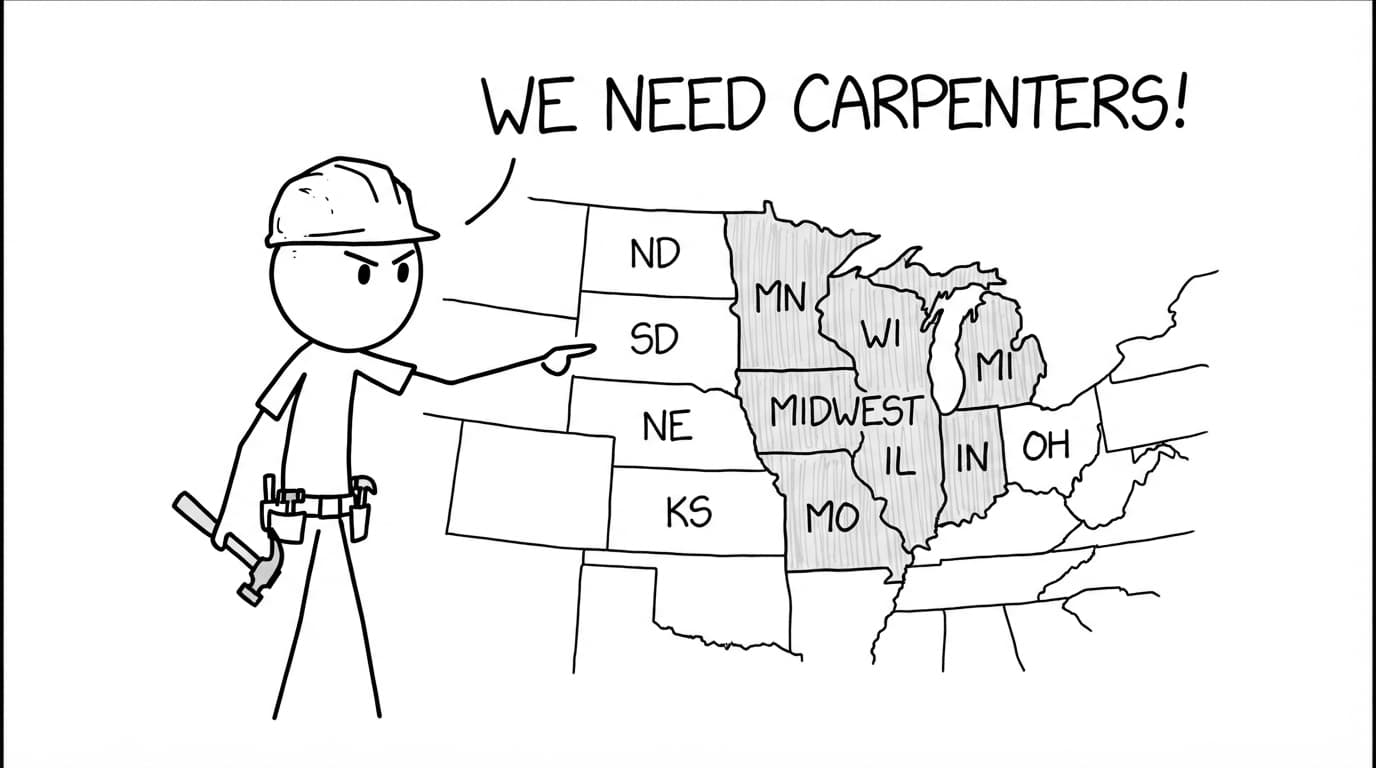
Yes, carpenter jobs are in high demand across the American Midwest. States like Ohio, Illinois, and Wisconsin are experiencing major growth in residential and commercial construction. ChiselJobs data shows a massive need for skilled framers, finish carpenters, and concrete form workers, offering strong starting wages and excellent career longevity.
Why is the demand for carpenters rising in the Midwest?
The Midwest is experiencing a quiet construction boom. Major cities are expanding, suburban housing developments are popping up, and older infrastructure requires significant updates. At the same time, a large portion of the current workforce is reaching retirement age. According to market research from ChiselJobs, senior tradespeople are retiring faster than new apprentices are entering the field, leaving a massive labor shortage.
This supply and demand mismatch works in your favor. Contractors are actively competing for reliable workers who know how to handle basic tools and show up on time. Whether it is building new single-family homes in Ohio or large-scale commercial developments in Chicago, the Midwest has years of backlogged projects waiting for skilled hands.
What daily duties and tools are required for these jobs?
Carpentry is not a single job; it is a collection of specialized skills. On any given day in the Midwest, you might find yourself working on rough framing or doing detailed finish work inside a climate-controlled building.
To succeed on a modern job site, you must become proficient with several core tools and techniques:
Framing and Layout: This is the backbone of residential construction. You will use a circular saw to cut studs, joists, and rafters, and a pneumatic nail gun to assemble the skeleton of the building quickly.
Finish Carpentry: This involves installing doors, windows, crown molding, and cabinets. It requires high precision, a sharp eye, and tools like wood chisels, miter saws, and specialized levels to ensure everything is perfectly plumb.
Reading Blueprints: You must know how to translate paper designs into physical structures while strictly following local building codes.
Safety Standards: Working safely is a requirement, not an option. You must understand OSHA safety regulations, wear proper personal protective equipment (PPE), and know how to safely set up scaffolding and ladders.
How much money do carpenters make in the Midwest?
Your earnings as a carpenter depend heavily on your experience level, your location, and whether you work for a union contractor. ChiselJobs tracking indicates that Midwest wages are highly competitive when balanced against the region's low cost of living.
Average earnings by experience level
An entry-level worker will start as an apprentice or helper, earning a living wage while learning the trade. As your skills in layout, joinery, and blueprint reading improve, your value to the contractor goes up.
Experience Level | Average Hourly Wage | Average Annual Salary |
Apprentice (0-2 Years) | $18.00 - $22.00 | $37,440 - $45,760 |
Journeyman (3-7 Years) | $25.00 - $38.00 | $52,000 - $79,040 |
Lead Carpenter / Foreman | $35.00 - $48.00 | $72,800 - $99,840 |
The union vs. non-union wage difference
The Midwest has a very strong union presence, particularly through the United Brotherhood of Carpenters. Union carpenters often receive higher hourly rates along with robust pension plans and health insurance. However, non-union contractors often offer more flexible hours, faster promotion paths for hard workers, and steady year-round work without union dues. Both paths offer a solid middle-class living.
Which Midwest states and cities have the most carpentry jobs?
Not all Midwestern locations have the same job density. Some states are leading the pack in terms of sheer job volume and high pay.
Illinois
Illinois, especially the Chicago metropolitan area, is a powerhouse for carpentry work. The market here is heavily unionized, resulting in some of the highest hourly wages in the country. Commercial high-rises, transit projects, and suburban remodeling keep local crews busy year-round.
Ohio
Ohio is a massive market for residential framing and drywall installation. Cities like Columbus, Cincinnati, and Cleveland are growing rapidly. Because the cost of living in Ohio is remarkably low, a journeyman carpenter's wage goes much further here than on the coast.
Wisconsin and Michigan
These states have a high demand for residential finish carpenters and timber framers. With a strong tradition of custom home building and lakeside cottage construction, carpenters who specialize in high-end joinery and custom trim are always in demand.
What licensing and training do you need to get started?
You do not need a four-year college degree to become a successful carpenter in the Midwest. Most employers only require a high school diploma or equivalent, a valid driver's license, and a strong work ethic.
Training routes
You can learn the trade through two main pathways:
Registered Apprenticeships: These programs combine paid on-the-job training with classroom instruction. You earn while you learn, with your wages increasing automatically as you complete milestones.
Trade Schools: Many community colleges in the Midwest offer certificate programs in residential construction. These programs teach you how to use a circular saw, read blueprints, and master basic joinery before you ever step foot on a commercial job site.
Licensing requirements
In most Midwestern states, individual carpenters do not need a state-level license to work under a general contractor. However, if you plan to start your own carpentry business and contract directly with homeowners, you will need to obtain a local residential contractor license, pass a business exam, and carry general liability insurance.
How can you increase your value and earn more as a carpenter?
If you want to maximize your earning potential in the Midwest, you cannot just be another hand on the job site. You need to develop high-value skills that make you indispensable to your crew leader.
Master the layout: The framer who can lay out a complex roof or a set of stairs using a framing square and math will always earn more than the person just cutting studs to length.
Get certified: Obtain your OSHA 10 or OSHA 30 safety card. Having these credentials makes you instantly employable on commercial job sites that enforce strict safety standards.
Invest in high-quality tools: While your employer will provide large power tools, owning a reliable, professional-grade set of hand tools, a high-quality level, and professional tool pouches shows you take your career seriously.
Use ChiselJobs to find the right fit: Do not settle for low-paying gigs. Keep your resume updated and use trade-focused job boards like ChiselJobs to connect with top-rated contractors who value craft, safety, and fair compensation.