Examining Carpenter Job Pay Trajectories by Niche

ChiselJobs Team
Published on 7/28/2026
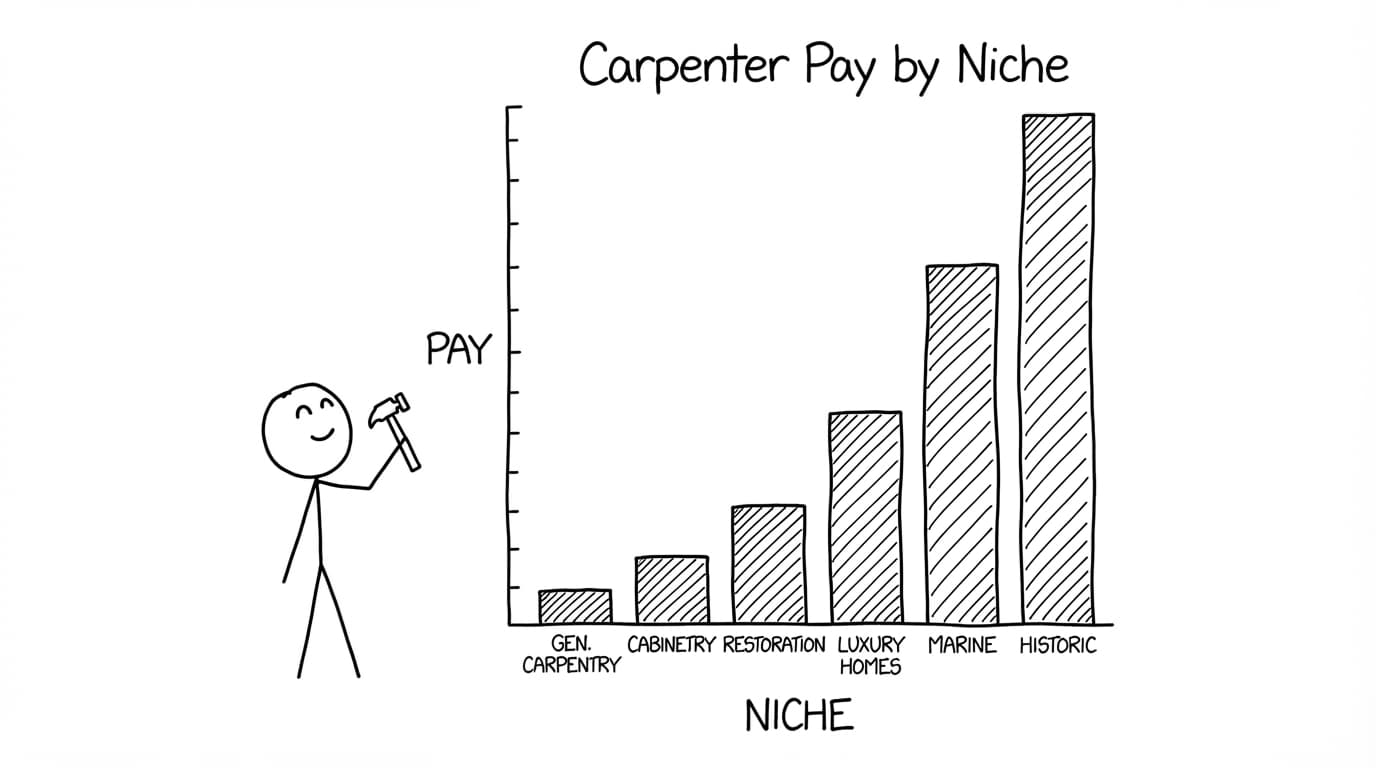
Carpentry pay in North America varies widely by niche, with specialized fields like industrial and finish carpentry earning significantly more than general residential framing. According to market data tracked by ChiselJobs, entry-level carpenters start around $35,000, while specialized, union-backed master craftsmen can easily exceed $90,000 annually.
How much do different types of carpenters actually make across North America?
Not all carpentry jobs are paid the same rate. The specific niche you choose to work in has the biggest impact on your take-home pay. While residential framing is a common starting point, moving into commercial work or high-end finish work opens up much higher earning potential.
Data collected by ChiselJobs shows a clear divide between rough wood construction and precision interior work. Industrial and commercial sectors generally offer the highest hourly rates due to the scale of the projects and the strict safety standards required on site.
The table below breaks down the average annual salaries and hourly wages for the main carpentry niches in North America.
Carpentry Niche | Average Hourly Wage | Average Annual Salary | Key Focus Areas |
Industrial Carpenter | $32.50 - $45.00 | $67,000 - $93,000 | Infrastructure, scaffolding, concrete forms |
Commercial Carpenter | $28.00 - $38.00 | $58,000 - $79,000 | Metal studs, drywall, commercial layouts |
Finish Carpenter | $25.00 - $36.00 | $52,000 - $75,000 | Trim, cabinetry, high-end joinery |
Framing Carpenter | $20.00 - $30.00 | $41,000 - $62,000 | Wood framing, trusses, subfloors |
Formwork Carpenter | $22.00 - $32.00 | $45,000 - $66,000 | Concrete molds, foundations, footings |
What are the highest-paying carpentry niches in today's construction market?
Industrial and Commercial Carpentry
Industrial carpenters work on large-scale infrastructure projects like bridges, power plants, and refineries. This work involves building massive wooden and metal concrete forms, setting up scaffolding, and working under strict OSHA safety regulations. Because these jobs are often unionized and require working in hazardous conditions, they command the highest hourly rates in the trade.
Commercial carpenters focus on offices, schools, and retail buildings. If you go this route, you will spend a lot of time working with metal stud framing instead of traditional wood. You must be highly skilled at reading complex blueprints, executing precise structural layouts, and operating heavy-duty powder-actuated fasteners.
Custom Finish Carpentry and Joinery
If you prefer detail-oriented work over heavy lifting, finish carpentry is a highly profitable path. These craftsmen install crown molding, baseboards, custom stairs, and high-end cabinetry.
To earn top dollar in this niche, you must master:
Precise joinery techniques (like miter joints, coped joints, and mortise-and-tenon work).
The expert use of hand tools, including sharp chisels and hand planes.
Flawless installation of doors, windows, and hardware.
ChiselJobs research indicates that finish carpenters who build a reputation for flawless work can often name their price, especially when working directly for custom home builders or high-end residential clients.
How does your experience level impact your yearly carpentry salary?
Your earning power as a carpenter increases steadily as you gain field experience and master new tools. The journey from a green apprentice to a seasoned master carpenter takes years of hard work, but the financial payoff is clear.
The Apprentice Phase (0 to 4 Years)
As an apprentice, you learn the basics of the trade. You will spend your days carrying materials, cutting studs with a circular saw, and keeping the job site clean. Apprentices typically earn a percentage of a journeyman’s wage, starting around 50% to 60% and receiving regular raises as they complete their training hours.
The Journeyman Phase (4 to 10 Years)
Once you complete your apprenticeship or prove your skills in the field, you reach journeyman status. At this level, you can work independently without constant supervision. You will be trusted to handle complex layouts, run crews, use nail guns safely, and ensure all work meets local building codes.
The Master Carpenter and Lead Foreman Phase (10+ Years)
Master carpenters possess deep knowledge of both structural wood framing and detailed finish work. They understand how different building systems interact and can solve complex structural problems on the fly. At this stage, many carpenters transition into roles like construction foreman, estimator, or project manager, where salaries frequently exceed $90,000 per year.
Does joining a labor union actually guarantee a higher hourly pay rate?
Yes, in most North American markets, union carpenters earn higher hourly wages and better benefits than their non-union counterparts.
The United Brotherhood of Carpenters (UBC) represents tens of thousands of workers across the United States and Canada. Union contracts establish clear pay scales based on your experience level, ensuring you get regular raises.
The main differences between union and non-union paths include:
Hourly Compensation: Union contracts secure higher base wages and guaranteed overtime pay.
Benefits Packages: Union jobs almost always include employer-funded health insurance, pension plans, and paid training.
Safety Enforcement: Union job sites strictly enforce OSHA safety rules, reducing the risk of workplace injuries.
Job Flexibility: Non-union carpenters have more freedom to negotiate their own rates directly with employers or transition quickly into independent subcontracting.
Where are the highest paying locations for skilled carpenters in the US and Canada?
Wages for skilled tradesmen vary depending on local cost of living, construction demand, and union strength.
In the United States, the Northeast, West Coast, and major Midwestern industrial hubs offer the highest wages. Cities in New York, Illinois, and California often see journeymen earning over $40.00 per hour. However, these areas also carry a high cost of living. Conversely, Southern states like Texas and Florida offer lower average hourly wages, but the constant housing demand keeps work steady year-round.
In Canada, provinces like Ontario and Alberta lead the country in carpentry compensation. Heavy industrial projects in Alberta's energy sector and major commercial developments in Toronto drive up the demand for skilled formwork and framing specialists. Canadian carpenters often benefit from the Red Seal program, a national standard that makes it easy to move between provinces and secure top-tier pay.
What daily duties and specialized tools define these profitable carpentry career paths?
To earn top-tier pay, you must be highly proficient with both traditional hand tools and modern power equipment. Your daily duties will shift depending on the stage of construction.
A professional carpenter's daily duties include:
Reading Blueprints: Interpreting architectural drawings to calculate material lists and layout dimensions.
Establishing Layouts: Using lasers, chalk lines, and heavy-duty levels to ensure all walls and foundations are perfectly square and plumb.
Cutting and Shaping Materials: Operating a circular saw, miter saw, and table saw to prepare wood and engineered lumber.
Assembling Structures: Fastening studs, joists, and rafters using pneumatic nail guns and structural screws.
Adhering to Safety Rules: Keeping a clean work area and wearing personal protective equipment to prevent common construction injuries.
What steps can you take right now to increase your value and earn more money?
If you want to boost your income without waiting years for a standard promotion, ChiselJobs recommends focusing on these high-value professional upgrades:
Earn Advanced Certifications: Get your OSHA-30 safety card, rigging certifications, or aerial lift operator license. Employers pay extra for workers who can safely manage hazardous tasks.
Master the Layout: The carpenters who know how to use transit levels and total stations to lay out a building from scratch are always the most valuable people on the job site.
Invest in High-Quality Tools: Having your own reliable power tools, sharp chisels, and accurate levels makes you faster and more independent.
Learn Spanish: In many North American construction markets, being bilingual allows you to bridge the gap between management and field crews, making you an ideal candidate for a foreman role.