What Do Carpenters Do? Daily Work, Types & Where They Work

ChiselJobs Team
Published on 10/17/2026
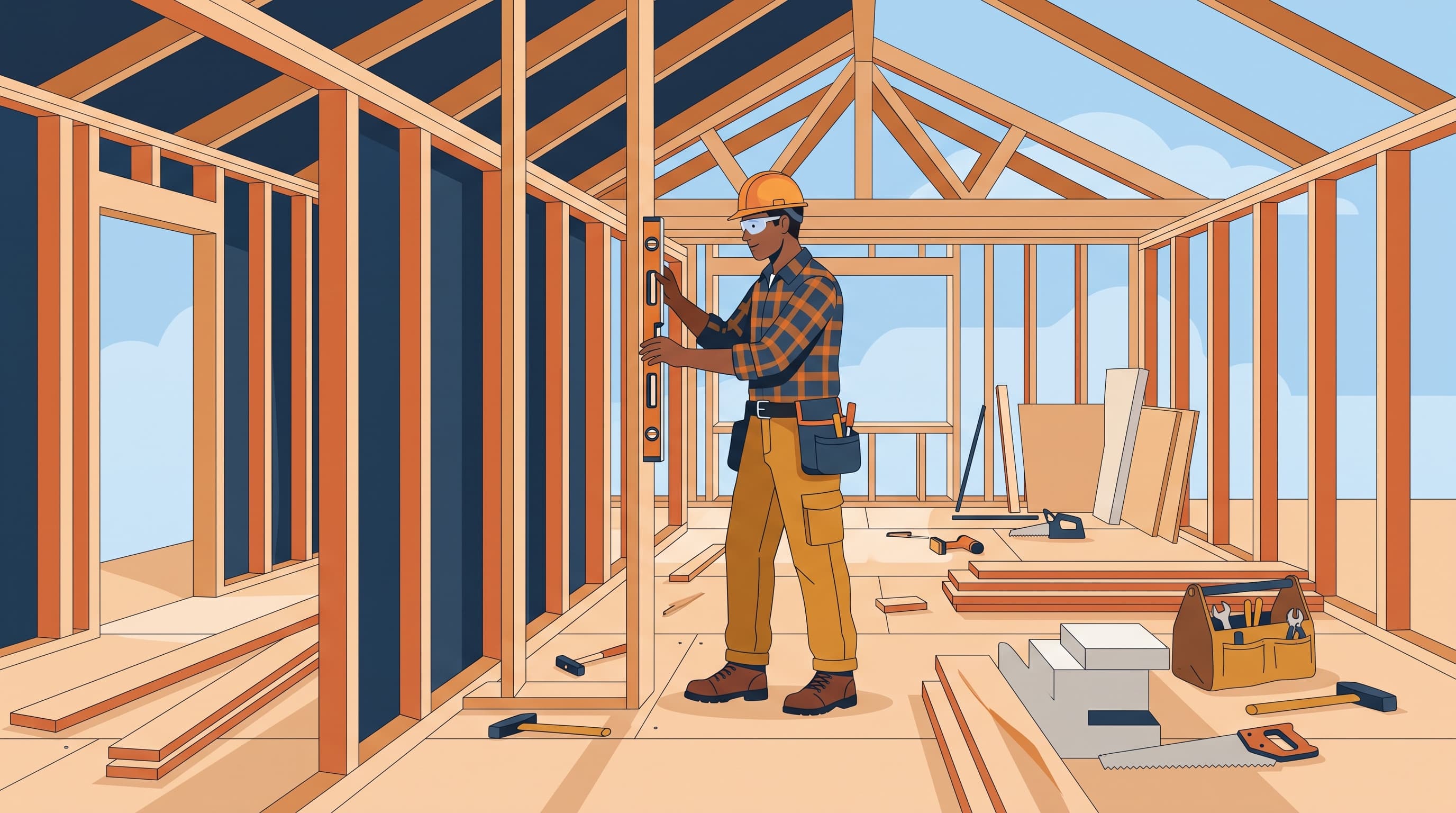
Carpenters build, install and repair the parts of a building that hold it up and make it usable: the wall framing, floor and roof systems, concrete forms, stairs, doors, trim and cabinets. What a carpenter actually does on a given day depends heavily on which kind of carpentry they do, because a framer on a housing tract and a finish carpenter in a hotel lobby are barely doing the same job.
That's the short version. The longer version is more useful if you're thinking about working as a carpenter, so let's get into what the work looks like, the main types, where carpenters work, and what it pays.
What is carpentry work, exactly?
Carpentry work is cutting, shaping and joining materials (mostly wood, but also engineered lumber, plywood, metal studs and even plastics) to build something that matches a set of plans. The Bureau of Labor Statistics (BLS) breaks the core duties down like this:
Follow blueprints and building plans
Measure, cut and shape wood, plastic and other materials
Build and install frameworks, including walls, floors and doorframes
Install structures and fixtures, like windows and molding
Inspect and replace damaged framework or fixtures
Direct laborers and construction helpers
That list is accurate but a little bloodless. In practice, most of a carpenter's skill comes down to three things: reading plans correctly, laying things out accurately, and building fast without building wrong. A wall that's half an inch out of square on the first floor becomes everybody's problem by the third floor. A lot of the job is quietly preventing that.
It's also worth knowing that "carpenter" is a broad label. Someone who builds plywood forms for a concrete parking garage and someone who scribes crown molding to a wavy plaster ceiling are both carpenters. They'd also both probably tell you the other one has the weird job.
What does a carpenter do on a typical day?
There's no single typical day, but most days on a construction site follow a similar rhythm. Here's roughly how it goes for a carpenter on a crew:

Early start. Construction days usually start early, partly to beat the heat and partly because that's how the trade has always run. Expect a short safety meeting (often called a toolbox talk) on many sites, especially commercial ones.
Get the plan for the day. The lead carpenter or foreman tells the crew what's getting built and who's doing what. If you're an apprentice, this is when you find out whether you're cutting, carrying or cleaning up.
Layout. Before anything gets built, someone marks where it goes. Snapping chalk lines, checking measurements against the drawings, setting reference points with a laser level. Good layout is the difference between a smooth day and a day of tearing things out.
Cut and build. This is the bulk of the day: cutting material, assembling it, fastening it and checking it for plumb, level and square as you go.
Fix what doesn't fit. Plans and reality disagree constantly. Lumber is crooked, the concrete slab isn't quite where the drawings say, another trade's pipe is exactly where your wall needs to go. Solving these on the spot is a real part of the job.
Clean up and stage for tomorrow. Sweep, stack offcuts, put tools away, get material ready for the next day.
What changes from job to job is the setting and the material. On a residential framing crew you might stand up the walls of an entire house in a few days. On a commercial interiors job you might spend a week framing metal-stud walls and hanging door frames on one floor of an office building. In a cabinet shop you might never set foot on a jobsite at all.
The tools carpenters use
Every carpenter's kit starts with the basics: tape measure, speed square, framing square, chalk line, pencil, utility knife, hammer and levels of several lengths. On top of that, most of the daily work runs on power tools:

Circular saw (the workhorse for cutting framing lumber and sheet goods)
Miter saw for accurate crosscuts and angles, especially in trim work
Table saw for ripping boards and sheet goods
Nail guns (framing, finish and brad nailers) with an air compressor or battery
Cordless drill and impact driver
Laser level for layout over long distances
Specialists add their own gear. Formwork carpenters use form ties, walers and shoring. Finish carpenters carry coping saws, block planes and a lot of patience. Cabinetmakers work with shop machinery like jointers, planers and CNC routers. If you want a deeper look at the math side of the job, our stud calculator and stair calculator show the kind of figuring carpenters do daily.
Types of carpenters
Carpentry splits into a handful of main specialties. Most carpenters start broad and then drift toward one, often based on whichever kind of work their first employer happened to do.

Type | What they build | Where you'd find them |
|---|---|---|
Framing (rough) carpenter | Wall, floor and roof framing; sheathing; stairs (rough) | New houses, apartments, light commercial |
Formwork carpenter | Wood and metal forms that hold concrete while it cures | Foundations, parking garages, bridges, high-rises |
Finish and trim carpenter | Doors, baseboards, crown molding, built-ins, stair trim | Custom homes, renovations, hotels, offices |
Cabinetmaker / millwork | Cabinets, countertops, custom furniture and paneling | Shops and factories, then installed on site |
Commercial interiors carpenter | Metal-stud walls, ceiling grids, door frames and hardware | Offices, hospitals, schools, retail |
Scaffold carpenter | Scaffolding systems for other trades to work from | Industrial plants, large commercial jobs |
Maintenance carpenter | Repairs to doors, floors, walls and fixtures | Universities, hospitals, property managers, governments |
A few notes on the big ones:
Framing carpenters do the "rough" structural work, and it's where a lot of people start. It's fast, physical and often outdoors. You see real progress every day, which is satisfying, and you're exposed to the weather every day, which is less so. Our framing carpenter job description and rough carpenter job description go deeper on the duties.
Formwork carpenters build the molds that concrete gets poured into. It's heavy, precise work, because a form that bulges or blows out under the weight of wet concrete is an expensive and dangerous mess. This is a big part of commercial and civil construction, and it's covered in our concrete formwork carpenter job description.
Finish carpenters handle everything you actually see and touch once the building is done. Tolerances are tight, mistakes are visible, and clients notice. It's slower and more detail-oriented than framing. More on that in our finish carpenter guide.
Commercial interiors carpenters build out the inside of commercial buildings. Despite the job title, a lot of this work is in light-gauge steel studs rather than wood, which surprises people.
For the full list of specialties and their duties, see our carpenter job description guide, which links to every role we've covered.
Where do carpenters work?
Carpenters held about 889,700 jobs in the US in 2025, according to BLS. Here's where they worked:
Employer type | Share of carpenters |
|---|---|
Self-employed | 25% |
Residential building construction | 23% |
Building finishing contractors | 13% |
Nonresidential building construction | 12% |
Foundation, structure and building exterior contractors | 10% |
The number that jumps out is the first one. A quarter of carpenters are self-employed, which is a lot for any trade. That includes people running small remodeling businesses, independent finish carpenters, and subcontractors who work crew-to-crew. It's a real path, but it also means a real chunk of the trade lives with irregular income, finding their own work and buying their own insurance.
Beyond the settings in that table, carpenters also work in:
Commercial and industrial construction: office towers, hospitals, data centers, factories
Civil and heavy construction: bridges, tunnels, dams and highway structures (mostly formwork)
Maintenance roles: colleges, hospitals, school districts and large property managers keep in-house carpenters
Shops and factories: cabinet shops, millwork shops and modular or prefab home plants
Residential and commercial carpentry feel like different jobs. Residential work tends to be smaller crews, more variety and more direct contact with homeowners. Commercial work tends to be bigger crews, more structure, more safety paperwork, and more often union. Neither is better. They just suit different people.
Union vs. non-union
A meaningful share of commercial carpentry in the US and Canada is done by union carpenters, mainly members of the United Brotherhood of Carpenters (UBC) in the US and its Canadian councils. Union carpenters typically train through a joint apprenticeship program and work under a negotiated wage and benefit package. Non-union carpenters are more common in residential work. We compare the two paths in detail in Union vs. Non-Union Carpentry.
How do you become a carpenter?
The short answer: most carpenters learn on the job, either through a formal apprenticeship or by starting as a helper and working their way up. BLS says a high school diploma or equivalent is typically required, and that apprenticeships are often sponsored by unions or contractor associations, combining classroom instruction with paid on-the-job training.
The usual path looks like this:
Get a high school diploma or GED (math and shop classes help).
Get hired as a carpenter helper or accepted into an apprenticeship.
Learn the trade over several years of paid work and classroom training.
Reach journeyman level.
Specialize, move up to lead carpenter or foreman, or go out on your own.
On safety training: BLS lists the OSHA 10-hour construction course as a requirement for carpenters, and many employers, unions and some states require it before you set foot on a site. If you're starting out, getting your OSHA 10 card is an easy, cheap way to look more hireable.
We cover every step, including how long each one takes, in How to Become a Carpenter.
How much do carpenters make?
The median annual wage for carpenters in the US was $60,580 in May 2025, which works out to about $29.12 an hour, according to BLS. The lowest-paid 10% earned less than $40,410, and the top 10% earned more than $99,910.
Pay also shifts by the kind of employer (May 2025 BLS medians):
Nonresidential building construction: $63,780
Building finishing contractors: $60,880
Residential building construction: $60,600
Foundation, structure and building exterior contractors: $58,790
The spread between the bottom and top 10% is more interesting than the median. It mostly reflects experience (apprentices at the bottom, seasoned journeymen and foremen near the top), location (big-city and high-cost states pay more), and union status. If pay is your main question, our carpenter salary guide and carpenter salary page break it down further.
Is the work in demand?
Steady, not booming. BLS projects carpenter employment to grow 4% from 2025 to 2035, about as fast as the average for all jobs. That sounds modest, but BLS also expects about 62,800 openings a year, mostly from carpenters retiring or leaving the trade. In plain terms: the trade isn't exploding, but there's a constant need to replace people, which is good news if you're trying to get in.
The honest downsides
Carpentry is a good trade, and we'd be doing you a disservice if we only talked about the good parts. Here's what people working as carpenters deal with:

It's hard on your body. BLS notes that overexertion injuries from lifting and moving materials are common, along with falls, slips, trips and getting struck by things. Years of kneeling, lifting and overhead work add up, especially in your knees, back and shoulders.
Falls are serious. Working on roofs, ladders, scaffolds and open floor edges is routine, and falls are among the most common causes of serious work injuries and deaths, according to OSHA. In US construction, OSHA requires fall protection at six feet above a lower level. This isn't optional and it isn't a paperwork thing. Use the harness, use the guardrail, and don't let anyone talk you out of it.
Weather. Framing and formwork crews work outdoors in heat, cold and rain. BLS also notes that bad weather can affect construction schedules, which can mean lost hours.
Work can be uneven. Construction follows the economy. When building slows down, so does the work, and some regions have seasonal slowdowns.
Early mornings, sometimes long days. Most carpenters work full time, and BLS notes that can include evenings and weekends to meet deadlines.
The first years pay less. Apprentice and helper wages are well below the median. The money gets good, but you have to get through the learning years first.
None of this is a reason not to do it. It's just the stuff worth knowing before you show up on day one.
A note for Canada
In Canada, carpenters fall under NOC 72310. Job Bank lists a national median wage of $32.12 an hour, with a low of $22.00 and a high of $44.23 (wages updated November 19, 2025). Medians vary a lot by province: $36.84 in Quebec, $34.00 in Alberta, and $32.00 in both British Columbia and Ontario.
The training path is similar to the US, but more formal. Job Bank describes a three to four year apprenticeship as the standard route, and carpenter is a Red Seal trade, so passing the interprovincial Red Seal exam lets you work across provinces. Trade certification is compulsory in Quebec and voluntary everywhere else. Check your provincial apprenticeship authority for the current rules where you live.
Quick answers
What is a carpenter? A carpenter is a skilled tradesperson who builds, installs and repairs structures and fixtures, mostly from wood and wood products, following plans. That includes framing, concrete forms, stairs, doors, trim and cabinets.
What's a carpenter's main job? Turning drawings into real, square, solid structures. Most of the daily work is measuring, laying out, cutting, assembling and fastening, then checking that it's plumb, level and square.
What does a carpenter do on a construction site? On most construction sites, carpenters build the framing, the forms for concrete, the interior walls and the finished woodwork, then install doors, windows and trim. They also often supervise helpers and coordinate with other trades.
What is carpentry work? Carpentry work is the craft of cutting, shaping and joining materials to build or repair parts of a building. It ranges from heavy structural work (framing and formwork) to fine detail work (trim and cabinets).
What is working as a carpenter like? Physical, hands-on and usually outdoors or on active jobsites, with early starts and full-time hours. Most people like seeing what they built at the end of the day. Most people don't love the toll on their knees and back after a decade or two.
Do carpenters need a license? In the US, carpenters generally don't need a state license to work for an employer, though contractors who run their own business often need a contractor's license, and the rules vary by state. In Canada, trade certification is compulsory only in Quebec.
Bottom line
Carpenters build the bones and the finish of almost every building, and the job looks very different depending on the specialty: framing, formwork, finish, cabinetry, commercial interiors or maintenance. It's physical, it pays a solid middle-class wage once you're past the apprentice years, and there's steady demand to replace people leaving the trade.
If you want to see what carpenter work looks like where you live, browse carpenter jobs near you on ChiselJobs, or go straight to apprentice carpenter jobs if you're just getting started.
Sources
U.S. Bureau of Labor Statistics, Occupational Outlook Handbook: Carpenters (May 2025 wage data; 2025 to 2035 projections)
Job Bank Canada: Carpenter wages, NOC 72310 (updated November 19, 2025)